Detailed Explanation of the Method for Making a Redbud Bonsai
The redbud's purplish-red flowers bloom in spring before the leaves, with a butterfly-like shape; when in full bloom they are densely packed, clinging close to the branches, until the whole tree is covered in flowers. Not only can flowers appear on the branches, but the old trunk, and even the trunk close to the roots, can also bloom. After the leaves fall in winter, the frame of the branches and trunk is fully revealed, and a sense of rugged, twisting strength springs before the eyes. Using it to make a bonsai, the roots and trunk are quaint and full of grace, in spring the branches are covered with abundant flowers, in summer and autumn the green leaves flutter, and in winter the dark branches and twisted trunk are full of rigidity; it has something to admire in each of the four seasons, and is a bonsai plant worth promoting.
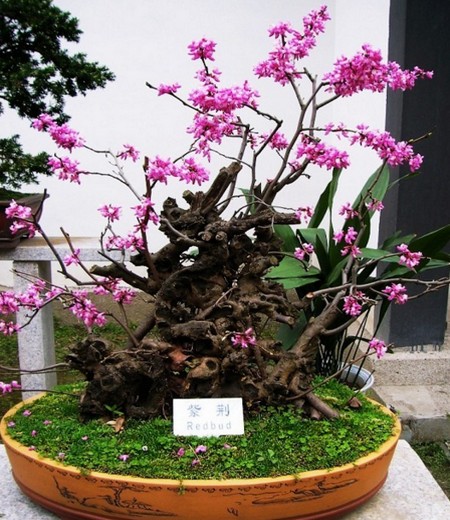
The genus Cercis also includes white-flowered redbud, giant redbud, Canadian redbud, Canadian red-leaf redbud and other species; as long as their form is suitable, they can also be used to make bonsai.
[Material Sources]
Redbud can be propagated by sowing, division, layering, cuttings and other methods. For making bonsai, old stumps that have grown for many years and have peculiar, quaint and rugged forms are commonly used. When municipal landscaping departments expand cities or rebuild parks, redbud old stumps are often discarded and can be collected as material for making bonsai.
Redbud is mostly transplanted in spring before the leaves unfold. When digging, cut off the branches and trunk not needed for the design, and also cut off overly long main roots, keeping more lateral roots and fibrous roots. First plant it in a clay tile pot or in the ground to "nurse the stock." Before planting, carry out one shaping according to the tree's form and the intended design. After planting, water thoroughly and place it in a wind-sheltered, sunny spot for care. When the weather is cold, cover it with a transparent plastic bag to keep it warm. Afterward, observe it carefully; when dry, supply water, but do not let the soil become waterlogged. On clear days, open a small slit in the plastic bag for ventilation and hardening off, and finally remove the plastic bag gradually. During the "nursing the stock" period, if the plant produces flower buds, remove them promptly to avoid excessive nutrient consumption from flowering and to prevent it from affecting growth.
[Potting Process]
Pot selection: For redbud, relatively deep glazed ceramic pots or purple clay pots are generally chosen, with square, round and oval shapes being more common; sometimes a relatively shallow rectangular pot is also used. The color of the pot is best light yellow or cyan, to set off the purplish-red flowers covering the branches.
Soil: It has low requirements for soil quality and can adapt to slightly acidic or slightly alkaline soil. For pot cultivation, it is best to use fertile, loose leaf mold with good water permeability, or pond and river mud after weathering, mixed with sandy soil and rice-hull ash for cultivation.
Planting: Usually planted between February and March in spring. When planting, shorten the main root and overly long roots, and also properly shorten the branches and trunk, keeping only 3- to 4-year-old branches as the main framework branches.
[Shaping Techniques]
Processing: Redbud is mostly shaped by a method that gives priority to pruning and uses wiring as a supplement. Generally, only the main stem and trunk need to be appropriately bent and wired into the required posture; wiring with metal wire is more convenient and free, and it is best done after flowering during the plum rain season. Branch shaping is carried out by combining pruning with wiring, and it is also best to process after flowering.
Tree forms: Redbud bonsai forms mainly include slanting-trunk style, curved-trunk style, weeping-branch style, forest style and so on. The natural form is also good, with purplish flowers covering the branches, very beautiful.
[Bonsai Styling]
Using redbud seedlings as material, they can be processed into different forms of bonsai such as straight-trunk style, double-trunk style, slanting-trunk style and forest style. When the young tree grows to about 2cm, it can be coiled and wired into shape, giving the trunk a certain curvature to increase its beauty.
For redbud old stumps that have grown for many years, styling should be carried out according to the specific form of the stump, producing different forms of bonsai. Because its leaves are relatively large, the crown should adopt a natural style; there is no need, as with bonsai of species having smaller leaves such as Chinese elm and small-leaf privet, to painstakingly wire it into cloud-like pads. This highlights the characteristics of the species.
Redbud branches are soft, easy to shape, strongly sprouting and tolerant of pruning. During the growing season, a method combining wiring and pruning can be used for styling. When bending old branches with wire, be cautious to avoid breaking them. Because redbud flowers on old branches and there are no flowers on new branches, when styling, old branches should be the main body of the crown; pay attention to the direction of the branches so that they are distributed evenly and reasonably, and by no means messy. Do not keep too many branches; sparse openness is better. Unlike other tree species, do not prune the small branchlets into densely packed chicken-claw or deer-antler shapes; larger branches can be presented on the surface layer of the crown so that the flower clusters are not hidden by small branches when blooming. When potting, part of the old roots can be exposed above the soil so that the roots are suspended and the claws are revealed, twisted and quaint.
[Daily Management]
Redbud likes a warm, humid environment with abundant sunlight. The finished bonsai can be placed in a brightly lit, well-ventilated place for care. Even during the high temperatures of midsummer, do not shade it; if light is insufficient, the branches will grow leggy and flowering will be sparse.
During the growing season, water according to "do not water until dry, and when watering, water thoroughly," avoiding water accumulation in the pot soil. Especially during the flowering period, do not water too frequently, to avoid excessively wet soil shortening the flowering period. In spring and autumn each year, apply 1 application of fully decomposed dilute liquid fertilizer about every 10 days. The fertilizer liquid should be mainly phosphorus and potassium fertilizer, with nitrogen fertilizer as a supplement, to meet growth requirements, prolong the flowering period, and promote the formation of flower buds. During the high temperatures of summer, stop fertilizing.
After flowering, shape the plant, cut off excess long branches, and retain a portion of new branches to prepare for flowering the following year and the year after. If fruit display is not a consideration, remove the pods just as they begin to grow, to avoid consuming excessive nutrients and affecting the trunk's recovery and strengthening. If you want to admire the pods, do not remove them, but increase the amount of phosphorus and potassium fertilizer to meet growth needs. Ordinarily, newly grown branches should be wired at any time, overly long branches should be shortened promptly, and branches affecting the tree form should be cut off even earlier, to maintain the perfection of the tree form and increase the ventilation and light penetration in the inner canopy, which benefits plant growth. In late autumn, carry out the final pruning to fix the plant's form.
In winter, move it indoors to a sunny spot or outdoors to a wind-sheltered, sunny spot to overwinter, maintaining the temperature at 0°C?10°C. If the temperature is too high, the plant will sprout early, which is instead unfavorable for growth the following year.
Repot once each year after the leaves fall in autumn or before flowering in spring. When repotting, properly prune overly long roots, and do not tear them by hand, because redbud root bark is highly tough; tearing by hand will cause large wounds, thereby affecting plant growth and, in severe cases, even causing the bonsai to die. The pot soil should be loose, fertile, well-drained, slightly acidic sandy soil.
Redbud does not have many pests and diseases. The main insect pests include slug moths, bagworms, scarab beetles, longhorn beetles and so on, mostly occurring in summer and autumn, and can be controlled with pesticides such as omethoate.