How to make a honeysuckle bonsai? Detailed method and steps
Honeysuckle is a temperate and subtropical tree species. It likes sun but also tolerates shade, tolerates cold, tolerates drought and moisture. It is not demanding about soil and can adapt to both acidic and alkaline soils, but prefers loose, fertile neutral sandy loam. It is vigorous, has a well-developed root system, strong sprouting ability, a light plant body, and a graceful posture, and old stumps are quaint and elegant, making it an excellent material for making bonsai.
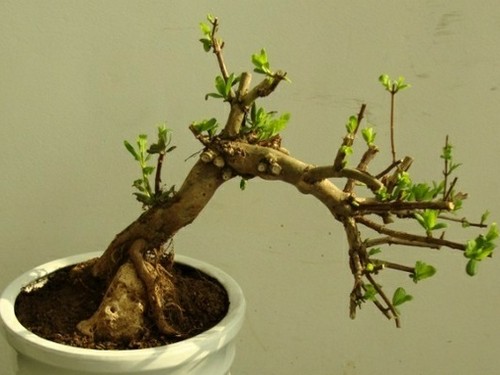
Method/Steps
I. Sources of tree stumps
1. Seed propagation. Collect ripe fruit from August to October, wash off the fruit skin with clean water, scoop out the seeds and dry them, then put them into a cloth bag and stratify them in sand at low temperature until the following spring. Sow from late March to early April. Before sowing, first soak the seeds in 25°C warm water for one day, then mix them with moist sand, put them into a cloth bag and place them indoors, using rice straw (straw, thatch, etc.) for insulation. When more than 1/3 of the seeds have cracked and shown white, sow them in loose, fertile, well-drained sandy soil. Seedlings can emerge about 10 days after sowing. Transplant them to the nursery field in the following spring. Generally, they are potted for cultivation 5 years after sowing.
2. Cutting propagation. In mid-to-late June, cut plump semi-lignified branches of the current year as cuttings, each about 15-20 cm long. Keep the bed soil moist and spray the cuttings. Roots can form in about 25 days. Transplant them to the nursery field in the following spring, and pot them for cultivation 4 years later.
3. Division propagation. In spring and autumn, dig up the suckers sprouting from the roots of the mother plant together with their roots (separate them with a sharp knife), and transplant them with roots to the nursery field. They can be potted for cultivation after 4 years.
4. Layering propagation. In spring and autumn, first take longer branches from the mother plant and bury them in soil to a length of about 5 cm and a depth of 2-3 cm. Keep the soil moist. Roots can form by autumn of the same year. Separate them from the mother plant in the following spring and plant them in the nursery field. They can be potted for cultivation after 3 years. Alternatively, during the plum rain season, choose vigorous and quaint old branches for air layering. After rooting, cut them off from the mother plant and pot them directly for cultivation. This method takes shape relatively quickly.
5. Collection from the wild. Wild honeysuckle stump material is abundant. It is suitable in early spring to dig up old stumps from the wild that have thick and strong rhizomes, are old and peculiar, and are twisted and varied in form, which can achieve rapid shaping. The method of collection is to first cut the trunk and keep the branches, properly prune the aboveground part, retain one or two main trunk branches, then scrape away the surface soil, clarify the growth direction of the main root, and carefully dig along the trend of the main root from far to near. This helps protect the root system and reduce damage. After the stump is dug up, promptly put it into a cloth bag and soak it in water (or wrap the roots with moist rice straw, cattail bag, cloth, moss and other materials to keep them moist), then transport it back for planting.
II. Cultivation of honeysuckle stumps
Honeysuckle is vigorous by nature, and its stems can root when touching the ground. It can be transplanted bare-rooted, and collected old stumps can also easily survive cultivation even without fibrous roots.
1. Root pruning. The root systems of honeysuckle stumps collected from the wild or dug from nursery fields are often very long. When cultivating, do not rush to shorten them; observe carefully and plan the design. The roots can often be coiled and shaped to replace the trunk with roots. Then, according to the size of the pot and cultivation needs, prune the root system appropriately before potting. Never use too much force or coil thick roots drastically, to prevent breakage. Handled this way, after shaping, the roots will be gnarled and interlaced, very pleasing to the eye.
2. Branch and trunk pruning. Honeysuckle grows wild by roadsides, on hillsides in shrub thickets or sparse forests. It is a climbing plant and likes to twine, often spiraling up nearby strip-like objects (such as trees, branches, etc.), and often only the tail end has leaves. Therefore, most dug-back old stumps have no leaves and not many branches. It is only necessary to cut off useless branches, weak branches, and diseased and pest-damaged branches, and moderately shorten the main branches according to proportion and shaping needs. Stumps dug from nursery fields have already been cultivated for many years and have relatively vigorous branches and leaves. They need appropriate thinning of branches and leaves so that density is suitable, gathering and scattering are orderly, conforming to nature and rich in pictorial quality.
3. Post-pruning treatment. Honeysuckle stumps are generally transplanted without a soil ball. After pruning roots and branches, it is best to first soak them in water for 1-2 hours to let them absorb enough water and speed up the sprouting of new roots and new buds. Then apply white latex to the branch wounds, use a new clean brush to dip 0.3%-0.5% potassium permanganate solution and apply it to the root wounds, and then pot and plant them.
4. Potting. Honeysuckle is not demanding about soil, but it is best to use mountain soil or a culture soil made mainly of mountain soil with an appropriate amount of leaf mold, coal cinder, etc. Early spring is the suitable time for potting. Cascade-style and weeping-branch-style honeysuckle bonsai should be paired with tall, deep pots of quaint and beautiful form, which helps the branches and vines spread and drape, showing their graceful charm. Curved-trunk-style honeysuckle bonsai should be paired with relatively shallow round (oval) or rectangular ceramic or glazed pots. When potting, first wash the selected pot clean, then use 2-3 pieces of broken tile (pot shards), staggered and stacked to cover the drainage hole. For tall and deep pots, industrial furnace slag (or broken tiles, small stones, etc.) must also be used to fill the lower layer to create empty space, then fill in culture soil and plant the stump. The depth and position of planting should be determined according to the pot and the shaping needs. After planting, firm the pot soil, water lightly and thoroughly, spread moss on the pot surface or plant small grasses such as Selaginella uncinata, Centipeda minima, Dichondra repens, Dichondra micrantha, etc., which can serve as decoration and also retain moisture. Then move it to a semi-shaded place, keep the pot soil moist, and frequently spray water on the stump, branches and leaves. After one month, full-sun management can be carried out, but the frequency of watering and spraying should be increased. Generally, on sunny days, water 2-3 times a day and spray 4-5 times.
5. Processing and shaping. The shaping of tree stumps should be based on the material and applied according to the material. Honeysuckle is generally suitable for root-exposed style bonsai, and can be planted with exposed roots when potting. Alternatively, when repotting, gradually raise the roots by 3-6 cm year by year. It is also possible to remove a stump that has been planted in a deep pot for many years together with the pot soil, without breaking the soil ball or damaging the root system, and plant it in a shallow pot slightly larger than the deep pot, fill the surrounding gaps with nutrient soil, firm it, then use a water pipe to wash away the soil between the roots above the pot surface, expose the roots, and cut off excess fibrous roots. Honeysuckle bonsai shaping is mainly cascade style or weeping-branch style, which can fully express its innate dynamic posture. Because its stems and vines have left-twining habit, its branch and trunk shaping can also use the curved-trunk style, using the trunk-cutting and branch-retaining method for pruning, but excessive shaping and pruning within one year should be avoided, otherwise it will affect flower bud formation. Branches that are not in place can be properly wired and trained with suitable wire. After the branches become lignified and set in shape, the wire should be removed promptly. Use a natural style for shaping, so that the branches on the stump follow their natural tendency, droop smoothly, and the branches and leaves are well spaced. Also use blank space reasonably to make it rich in pictorial quality and enhance artistic beauty.
Although honeysuckle has various kinds of stumps in nature, not many are suitable for making bonsai. Therefore, try to choose stumps with well-developed roots, thick and strong trunk form, vigorous and quaint age, curved variation, short and compact tree form, thick and short-dense internodes, and natural tapering transition.
Honeysuckle bonsai making techniques:
1. Control water and fertilizer: Potted honeysuckle must limit vine growth, control tree shape, and increase flower quantity. In spring, avoid rain and reduce watering to prevent excessive growth, promote stem and vine maturity, shorten internodes, and dwarf the plant shape. Before flower bud formation, apply little or no nitrogen fertilizer, and increase phosphorus and potassium fertilizers to promote flower bud formation and increase flower quantity. During the branch growth cessation period and bud gestation period, appropriately apply nitrogen fertilizer so that the flowers bloom large and colorful.
2. Repot at the right time: Generally, potted flowers are repotted once every one or two years, while honeysuckle bonsai is repotted once every three or four years. Because the number of repottings is small, the absorption function of the root system is weakened, which promotes plant aging, inhibits excessive growth, moderates tree vigor, promotes thick and strong stems and vines, dense internodes, dwarf plant shape, and abundant flowers.
3. Growth inhibitors to control shoots: When honeysuckle branches sprout to about 5 cm, spray or drench with 700 to 1000 ppm paclobutrazol, or 2000 to 4000 ppm B9, or 1000 to 2000 ppm chlormequat, for several consecutive times, to inhibit vigorous stem and vine growth and dwarf the tree shape.
4. Dwarfing, shaping and pruning: Start dwarfing, shaping and pruning from the time of potting, and cultivate thick trunks and short branches. During the growing season, remove vigorously growing buds, and pinch the tips of strong branches early. When pruning, cut long and retain short. Through shaping and pruning, promote the transformation from a twining vine type to a short-branch, dwarf-trunk, evenly branched, densely planted, clearly layered dwarf shrub type stump landscape.
5. Long-day treatment: Honeysuckle is a light-loving long-day plant. If the environment has poor ventilation and light transmission, and is shady and humid, the stems and vines will grow excessively, branches will be thin and weak, leaves will easily yellow and fall off, and flowering will be reduced. Therefore, honeysuckle bonsai should be placed in a sunny place, preferably with direct sunlight all day, to promote thick and short branches, lush leaves and abundant flowers, and prolong the flowering period.
6. Processing: For honeysuckle shaping, training and binding are the main method, combined with pruning. Training and binding means winding the main branches around each other and weaving them into a trunk so that they grow into one body, then further processing. Small branches are generally processed by pruning.
7. Tree forms: Mainly slanted-trunk style, curved-trunk style, and cascade style, with the roots gradually exposed. Small branches are mostly made into hanging forms to show their natural characteristics. In addition, honeysuckle can also be made into root-on-rock style bonsai.
Note that because honeysuckle has relatively large branches and trunks, although the trunk form is vigorous and quaint and aged, the branches and trunks are extremely brittle and easily broken or rotted. For relatively large branches and trunks, do not easily change their shape and angle, and even less should you twist the shape and angle of the main trunk and main branches as when making other miscellaneous wood bonsai.