How to Make an Apple Bonsai and Detailed Steps
Apples are delicious and tasty, and are one of the fruits commonly eaten in daily life. Their skin is smooth and their colors are bright. Besides being eaten, they can also be used to make bonsai.
For making bonsai, choose apple varieties with small plants, early fruiting, strong self-pollination and fruit-setting ability, medium fruit size, and bright colors. Use crabapple, Malus baccata (Siberian crabapple), or apple seedlings as rootstock, and use vigorous branches or plump buds slightly above the middle as scions. Graft by cleft grafting, cut grafting, or bud grafting. You can also use old stumps that have grown for many years and have peculiar, antique forms as rootstock, and use 1- to 3-year-old branch groups as scions for grafting. This method not only speeds up shaping but also advances fruiting.
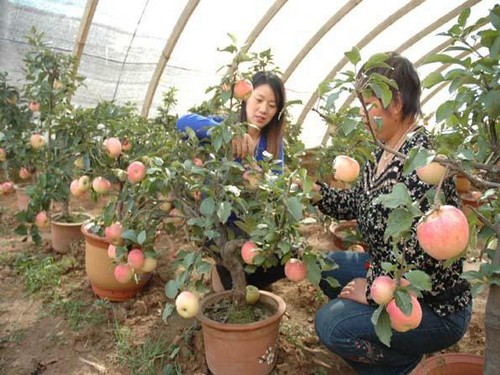
Transplant the rootstock before sprouting in spring or after leaf fall in autumn. First plant it in a clay tile pot of suitable size. Before planting, prune appropriately and cut off branches not needed for the design to reduce nutrient consumption and improve the survival rate.
The root system should also be pruned. Cut off thick main roots and keep more lateral roots and fibrous roots. For roots of suitable thickness and length, you can first coil them into the pot to prepare for future root exposure. In the first year after survival, let it grow freely so that the branches develop fully and the root system becomes complete. In the second year, graft again and cut off the branches on the rootstock to ensure sufficient nutrients are supplied to the scion for growth.
As for potting, first cover the drainage hole at the bottom of the growing pot with a small piece of tile, then fill in a layer of nutrient soil to form a slightly raised mound shape in the middle. Place the fruit tree seedling with pruned roots in the pot, then add nutrient soil, compacting while filling, until it is 2-3 cm below the pot rim. After potting is complete, water thoroughly once.
According to the shape of the stump, apples can be made into many different bonsai forms, such as straight-trunk style, curved-trunk style, double-trunk style, slanting-trunk style, lying-trunk style, and exposed-root style. For young trees, the trunk can be wired and shaped to make it winding and well-proportioned, combining hardness and softness. For stumps lacking an aged appearance, methods such as splitting, carving, or trunk planing can be used to treat the trunk to achieve a clear, peculiar, and antique artistic effect.
After planting, do not carry out trunk heading on the seedling; only perform light pruning. Bend the trunk so that it not only increases the number of retained buds and moderates growth vigor, but also helps nutrient accumulation and flower bud differentiation, while also helping the tree take shape. After sprouting, choose the number of branches to retain according to the tree shape required, and try to keep more branches of moderate growth vigor. Pinch or bend strong-growing branches. For water sprouts and competing branches, combine bending with twisting, pinching, scoring, and ring girdling to cultivate a large number of fruiting branches and promote flower bud formation. Achieve "light pruning, slow release, and retaining many branches."
Apple branches are soft and quite flexible. In May each year, you can wire 1- to 3-year-old branches to give them a certain bending variation. Because wired branches grow downward or extend parallel, their apical dominance can be removed, gradually changing the plant from vegetative growth to reproductive growth, which is beneficial for flower bud formation. You can also expose roots according to the needs of the design and the variety of the rootstock.
Among them, apple bonsai grafted onto arborescent rootstock, because of their well-developed and thick root system, are especially suitable for making exposed-root-style bonsai. Root exposure should be carried out year by year and in stages, not all at once. You can also choose fresh roots of suitable shape, thickness, and length and graft them by the subcuticular insertion method. This makes the roots naturally twisted and vigorous and antique.
Each winter or before sprouting in spring, prune and shape the plant once, cutting off diseased and dead branches, crossing and overlapping branches, water sprouts, and overly dense branches, and shortening overly long branches to maintain a beautiful tree shape. Repot once every 2 to 3 years after leaf fall in autumn or before sprouting in spring. During repotting, tidy and prune the root system, remove 2/3 of the old soil, and replace it with fresh, loose, fertile culture soil rich in humus.