Detailed explanation of the method and steps for making a lotus bonsai
As midsummer arrives, lotuses reach their best viewing period. This year, potted lotus bonsai are also selling briskly on the market, opening up a new path for local farmers to become wealthy. It is reported that lotuses begin to sprout every year after Qingming Festival, bloom in June, and continue until September. Potted lotuses can be used for viewing, and the lotus seed pods can also be picked to make lotus seeds and tea. It is reported that lotus root vegetables have a short sales period and also waste manpower, while planting lotuses requires no manual tending, blooms year after year, and is much more cost-effective than planting lotus root vegetables. This kind of lotus bonsai is a one-time investment, and income is more than ten times that of planting lotus root vegetables. So, how do you make a lotus bonsai?
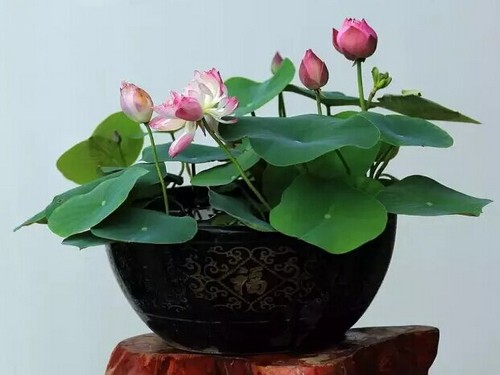
Choose plump, mature, glossy lotus seeds of a free-flowering type suitable for potting. They can be sown from April to June. First, manually crack the seed coat of the lotus seeds. A lotus seed is pointed at one end and concave at the other. Rub the concave end on rough cement ground until it breaks, or crack it with the jaws of pliers, then soak the seed in a thermos with warm water at 20—30~E. Change the water twice a day, and sprouts will appear within 1 week. After sprouting, transfer to a pot, add an appropriate amount of water, and place in a wind-sheltered, sunny spot. After 2 weeks, fine roots grow out and the floating leaves are like threads. At this point it can be potted, with only one seed per pot, and by the middle of the 6th month of that year buds will appear and flowering will begin.
For the growing soil, generally use pond mud or paddy field mud rich in humus. First crush the mud and sift it. If there are impurities, gravel, etc., they need to be picked out so the mud becomes sticky and muddy. Put it into the pot, generally 10-15 cm thick. At the same time, any one of sun-dried chicken or duck manure, dried human manure, soybean cake, rapeseed cake, chicken feathers, hair, or green grass can be used as a base fertilizer.
Potted lotus can be planted around Qingming Festival. Planting 7-10 days before Qingming Festival, that is, in late March, is best. If done too early, the lotus rhizome nodes are prone to rot, and the plant's flowering will be poor. Even if it flowers, the flowers will tend to be below the leaves, affecting its ornamental value.
When planting, first put 3—4 cm of loose soil into the bottom of the pot, then add the base fertilizer. If adding tender green grass, it needs to be cut fine before putting in. Or put in any one of soybean cake, chicken feathers, etc., then add loose soil, and then place the lotus rhizome seedlings on top. Put in 1-2 fat, strong rhizome seedlings. Thin and weak ones can be placed in 3—4 in parallel arrangement. When arranging, the lotus head and lotus tail should face the same direction, and the buds between the nodes should face upward. After arranging them well, cover with soil so that the buds are slightly exposed above the soil surface and the lotus tail is slightly raised, to allow air circulation. Then place it in the sun and let it be sun-dried (if it rains, it can be covered). Wait until the soil dries and cracks before adding clear water. Because the soil is sticky and muddy, it will form clods after drying, which helps fix the lotus rhizome seedlings, and after adding water the rhizome seedlings will not float up. In the future, when new leaves grow, they will not be affected by wind swaying, which would affect the growth and development of the rhizome seedlings. Therefore, the soil must be sun-dried to the point of cracking before water can be added. A water depth of about 5 cm is enough. After adding water, continue sun-drying. Let the moisture dry up. But unlike the first time, do not let the soil crack; just sun-dry until it feels soft but not sticky when you press it with your finger, and then you can add water again. After that, keep the pot water consistently 5—6 cm above the soil. By mid-to-late May, when small leaves extend above the water surface, the pot water can be increased to 10-15 cm deep.
After 30-45 days of potted lotus cultivation, when leaves extend above the water surface, fertilize once. Bury dead fish and spoiled shrimp into the soil beside the lotus rhizome nodes, and after they decompose, the lotus rhizome root system will absorb them. At this time the weather is hot, so the amount of water in the pot must not be reduced. After that, lotus leaves continue to emerge, flower buds also appear above the water surface one after another, and flowering continues. If there are too many floating leaves, the rotten leaves can be pushed into the mud.
After autumn begins, the leaves stop growing and no fertilization is needed. After October, the water can be reduced. After November, it can be moved indoors for the winter. In winter it must not be allowed to freeze or have its water cut off, and around Qingming Festival of the next year it can be moved outdoors.
In August—September, choose late-flowering potted lotus seeds that bloom easily and have relatively strong cold resistance for sowing and raising seedlings. After separate planting, place the flowers in a plastic solar greenhouse, and the temperature inside the greenhouse should be controlled between 20—30~C. When winter begins, use a flat mirror or aluminum foil to form a semicircular reflective surface and place it on the north side of the flowerpot, reflecting sunlight onto the lotus leaves and water surface, strengthening the light, so that the lotus blooms from New Year's Day to Spring Festival. Lotus celebrating the New Year makes it feel especially precious and intimate.
Potted lotuses need to be replanted every year, otherwise growth will be poor, the leaves will not be lush, and it will not flower easily.