Detailed Explanation of the Methods and Steps for Making Cherry Bonsai
Potted cherry is a miniaturized cherry orchard. It allows you to enjoy the beautiful scene of branches full of flowers and abundant fruit, and also to have fine fruit to savor while enjoying the view. In recent years, along with the improvement of potting techniques, it is gradually entering the balconies and courtyards of thousands of households.
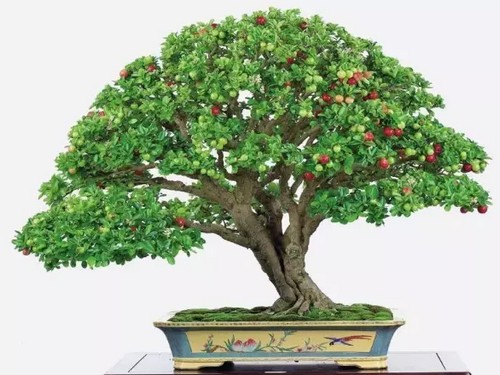
Potted cherry blooms in spring, and the fruit ripens in early summer. The flowers are beautiful and the fruit is bright, with considerable ornamental value. The fruit ripening period is especially early, and the flavor is relatively good, making it an early summer seasonal fruit.
2. Pots and potting soil: Pots come in many specifications and textures. Generally, choose pots with good breathability such as clay pots and ceramic pots. Because the tree body tends to become dwarfed when growing in a pot, and also tends to flower and bear fruit easily with small fruit, most fruit branches and bouquet-like fruit branches can bear fruit. Therefore, small-diameter pots and medium-to-large-diameter pots can all be used; generally a pot with a diameter of 20-25cm is better.
The potting soil is suitable for being prepared from a variety of materials. You can use straw compost soil, garden soil, sandy soil, etc. mixed in a ratio of 1:1:1, and add 1kg of N, P, K three-element compound fertilizer per cubic meter of potting soil and mix well. To kill bacterial crown gall pathogens, white grubs and other pests and diseases, the potting soil should be evenly sprayed with 0.1% formalin solution (500ml of solution per 1 cubic m of soil), then sealed with plastic film and fumigated for 1 full day for disinfection. After removing the film, air-dry it for 4 days before use.
3. Potting: The potting time is during the dormant period of the cherry. Potting in late autumn is beneficial for root recovery. Place 2—3 pieces of broken tile at the bottom of the pot, add a layer of fine sand, fill in part of the potting soil, spread the cherry seedling roots out on the potting soil, then gently fold the pot edge and lightly press the potting soil around the edge. Finally, leave the potting soil several centimeters below the pot rim as a watering space. After some time, when the potting soil settles, add some more potting soil.
There are the following 2 quick production methods.
(1) Direct potting for appreciation: Select cherry trees in the nursery with a small, compact tree shape and beautiful form, and pot them directly for appreciation. For example, “Aizhichui” has branches that naturally droop, with a beautiful and unique tree shape, and can be appreciated after potting with only slight trimming; “Yuchefan”, “Songyue”, etc. have small, compact tree shapes, beautiful flower forms, and bright flower colors, and can also be directly potted for appreciation.
(2) Transforming cherry trees into cherry bonsai. There are three sources of cherry trees used for transforming into bonsai:
a. Cherry trees in courtyards that are weak in growth often have trunks that appear rugged and ancient, making them top-grade material for making cherry bonsai.
b. Cherry trees with poor tree shape that are unsuitable for arrangement in courtyards.
c. Cherry trees whose trunks have died but whose root crown is still alive can also be used to make cherry bonsai. We adopt the method of top grafting and changing the head for transformation. The cherry tree can be shaped first and then have its head changed; shaping is generally carried out by combining pruning and binding. Top grafting and head changing of cherry is generally carried out in early spring before the cherry buds sprout (in Wuhan, generally in mid-to-late March), with the specific time based on the phenology of that year. The scions can also be cut off first and stored refrigerated in a refrigerator, then grafted when the rootstock sprouts; the survival rate is also very high. When using the cut grafting method for top grafting and head changing of cherry, the technical points to note are:
① The cutting method for the scion and rootstock. Cut a long slanted surface at 1cm below the scion bud, about 2—3cm long, and cut a short surface on the opposite side of the long surface, within 1cm long. Cut the scion into small sections with 2 to 4 buds and a length of 5—6cm. On the cherry tree to be transformed, choose a branch with a thickness similar to the scion as the rootstock, cut the short-cut end of the rootstock flat, hold the rootstock with the left hand, and with the right hand make a straight cut at the edge of the rootstock xylem (at 1/4 to 1/3 of the rootstock cross-section). The length and width of the rootstock cut should correspond to the long surface of the scion.
② Insertion. Insert the long slanted surface of the scion toward the rootstock, align the cambium on one side, and wrap the bark of the rootstock cut around the outside of the scion.
③ Binding. Bind with a plastic film strip about 1cm wide (preferably with some elasticity), and the film strip must be pulled tight when binding.
④ Bag covering. After grafting, cover the part above the roots of the grafted seedling with a small white transparent plastic bag, and tie the opening well with packing string, which can play a moisture-retaining role. The size of the small plastic cover bag is about 12cm×8cm. We can graft cherry varieties with similar flowering periods onto one potted cherry to produce a ten-variety brocade cherry bonsai with two kinds of flowers in one pot, or multiple kinds of flowers in one pot.