Detailed Guide to Making a Red Nan (Syzygium buxifolium) Bonsai, Step by Step
Red Nan (Syzygium buxifolium) is a tree species that needs heavy feeding and heavy watering. Its germination period is within 2 months, and there are quite a few care points to pay attention to, but it is not hard to understand or get the hang of, and it is still very suitable for beginners to grow. The plant form of Red Nan has unique ornamental value. Placing a Red Nan bonsai at home can not only raise the quality and beauty of the room, but also improve the feng shui of the room, so that everyone can enjoy a healthy body.
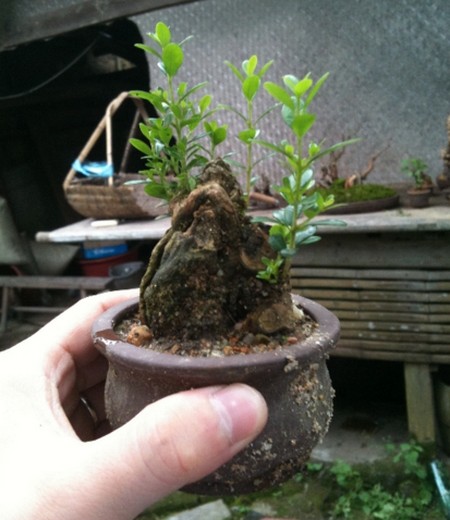
Red Nan is a new tree species discovered in the Huangshi area. Its buds are vermilion red, and its leaves resemble those of the boxwood (Buxus sinica) but are smaller, emerald green, and evergreen all year round; it loves to bloom small white pom-pom-shaped flowers, and in autumn it bears fruit the size of a soybean; the trunk is peculiar and aged, beyond people's imagination, and better than the chaste tree (Vitex negundo); the bark is smooth and thick, like that of the crape myrtle (Lagerstroemia indica); it tolerates pruning, has a high survival rate, and takes shape quickly. Because it combines all these advantages, it is an ideal material for making bonsai.
1. Material Collection and Cultivation Measures
Red Nan is a wild evergreen shrub of the mountains of Jiangnan, and is rarely cultivated artificially. According to its ecological habits and biological characteristics, it can be propagated by sowing and cuttings. However, for making bonsai, wild plants or old stumps are mostly used. Collection in the wild: in the mountains and hills of Jiangnan, you can select old stumps that have sprouted after many years of cutting and have an aged, quaint posture. Collect in spring between March and April, and be careful to keep more lateral roots and fibrous roots. The journey back from the mountains is relatively long, so dip them in mud slurry and wrap them in wet moss or rice straw to reduce water evaporation and help survival. After digging them back, choose loose, moist, well-drained sandy loam to plant them. Before planting, do one pruning, thinning out overly dense branches to help survival. After planting, promptly build a shed for shade, water frequently, and keep the soil moist. In summer, also spray water on the leaves, 2-3 times a day. After October, the shade shed can be removed and light given. After a year of ground cultivation and care, they can be potted and shaped.
2. Potting Process
Choosing a pot: for Red Nan bonsai, purple clay pottery pots or glazed pottery pots are suitable. The pot shape depends on the tree shape; generally, medium-deep rectangular pots, oval pots, or hexagonal pots are best. For pot color, purple or light yellow can be chosen to set off the emerald green branches and leaves.
Soil: Red Nan prefers acidic or slightly acidic soil. For potting, use leaf mold or mountain soil, or use pond and river mud that has been frozen and loosened, then mixed with 20% sand as the growing medium. Loose loam rich in humus and with an acidic reaction is suitable for cultivation.
Planting: potting is best done in spring between March and April. Because Red Nan has well-developed lateral roots but fewer fibrous roots, when planting it must be potted with soil to protect the roots from damage so it can survive. The bottom of the pot should be lined with a layer of coarse sand or vermiculite to help drainage.
3. Shaping Techniques
After the stump is trimmed according to the styling design, plant it in the pot in place as much as possible in one step. Before planting, seal the cut ends of the trunk with wax, then plant it in loose, breathable acidic soil. This is the most important task in the planting step, and it affects the normal growth of the root system later. You can mix 4 parts yellow sand or weathered soil (mountain alluvial soil), 4 parts leaf mold, and 2 parts loess and plant it. After moving it into the greenhouse, water thoroughly to settle the roots.
Processing: in the processing and shaping of Red Nan bonsai, wiring is the main method and pruning is secondary, and it is best done in spring. Because its branches are fine and its leaves dense, metal wire is generally not used for wiring; instead, palm fiber is used for wiring. You can first wire the main trunk and branches to form a rough outline, then combine this with pruning so that the stump specimen gradually takes shape.
Tree forms: Red Nan is suitable for making into the straight-trunk style, slanting-trunk style, curved-trunk style, or cascade style. Through wiring and pruning, the branches and leaves are made into cloud-pad style or steamed-bun shape. For small bonsai, the natural style is best. After many years of cultivation, through repotting, changing pots, and raising the roots, it can form a posture of twisted trunk and exposed claws, aged and simple.
Artistic shaping has no fixed framework, but it should meet certain requirements. Red Nan should be shaped according to the branches, with the rounded form following the momentum; there are several recognized styles that Red Nan can borrow from, such as the large flowing branch of the Japanese white pine in Jiangsu and Zhejiang, the triangular form of Taiwan, China, and the large tree form of Lingnan, etc.; for beautiful stumps, sparse leaves are better, and for poor stumps, the branches and leaves can be highlighted. In short, enhance the strengths and avoid the weaknesses.
Because its roots go very deep, Red Nan is best planted in a deeper pot; in winter, a shallow pot buried in the soil can safely overwinter outdoors. The roots and branches of Red Nan transport nutrients in vertical correspondence. According to this characteristic, you can also follow the density needs of the styling. Carry out platform selection, or divide one Red Nan stump blank into several. When pruning a newly collected stump blank, keep as many branches as possible in a balanced way, and preserve the old roots as much as possible, because damaging the roots correspondingly affects its branches. Damaging a branch correspondingly affects its roots. Sometimes even if only an individual root is damaged, its corresponding branch will also wither and die.