A detailed guide to making Shangshui stone bonsai, easy for beginners to learn too
Dear readers, no more worrying about the indoor dryness caused by long-term use of air conditioning and heating in winter, which adults and children cannot bear. Because you have a "natural humidifier", the Shangshui stone bonsai. A Shangshui stone bonsai is a landscape formed by arranging and combining mountains, stones, grass and trees in a pot, and the material of a Shangshui stone bonsai is landscape bonsai.
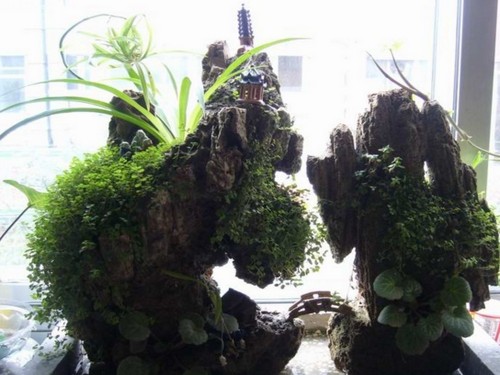
Many friends may find the name Shangshui stone rather unfamiliar when they hear it, but in fact Shangshui stone can be seen everywhere in life. Shangshui stone is also called water-absorbing stone, which, as the name suggests, is a stone with very good water absorption. Place Shangshui stone in a container filled with water, and the water will immediately be absorbed into every part of the stone. This excellent water absorption makes Shangshui stone very suitable for growing moss and plants, and since Shangshui stone is brittle and porous, it is very suitable for carving and chiseling, so it can be said that Shangshui stone is the best choice for making landscape bonsai with stones, grass and trees. As for the so-called Shangshui stone bonsai, it uses Shangshui stone as mountains and stones, and moss and wild grass as grass and trees, and then through ingenious carving and arrangement, lifelike landscape bonsai are completed one after another.
As the saying goes, "a home without stones is not elegant", and stone landscape bonsai have been sought after by literati and refined scholars since ancient times. In addition, as people's demands for quality of life have continued to rise in recent years, green plants have gradually become part of people's home decoration. Shangshui stone bonsai combines elegance and health, not only with unique and beautiful shapes, but the green plants in the bonsai can also purify the air and resist toxins and radiation, so it has naturally become a remarkable flower in the home decoration market.
As the main creative material, Shangshui stone bonsai come in many kinds, most of which are mined from nature, and their texture, color and wrinkled patterns all have a natural essence. When selecting materials, first pay attention to determining, according to the natural characteristics of the stone, what kind of natural landscape shape it is suitable for. If what is chosen is a set of sandy limestone with upright, concise wrinkles, a long strip shape and natural contours as the material for a bonsai, then it is certain that these materials are most suitable for a landscape shape of sharp sword-like peaks, tall and towering. When selecting materials, note that the texture, type and wrinkles of the materials must be unified. For one bonsai, it is best to use only one category of material, and the colors should not differ too greatly.
Shangshui stone is also called water-absorbing stone (a natural air purifier). The reason it is called this is that after water is stored in the pot, Shangshui stone can absorb it to the top in an instant. Wild grass and moss can be planted on the stone, green and lush, making it an excellent stone material for making bonsai. The essence of Shangshui stone is sandy limestone, loose and brittle, with especially strong water absorption. Because Shangshui stone is loose and brittle, it is easy to shape, and grooves can be chiseled, holes drilled, and various shapes carved at will. Shangshui stone has many natural caves, some of which connect with one another for ventilation, and the small caves are like pores, which is the main reason for its strong water absorption. In the caves on Shangshui stone, soil can be filled to plant flowers and grass, and larger caves can be used to plant trees. Because the stone body has strong water absorption, the plants grow luxuriantly and bloom brightly. Shangshui stone can release moisture, and using it to make rockeries or bonsai both has the effect of humidifying the environment.
Chiseling and trimming the outline of the mountain body:
When we select materials for making a landscape bonsai, we must first observe the top contour line of the stone to inspire ideas and repeatedly weigh them. Whether hard stone or soft stone, when the arrangement of the contour line of Shangshui stone is not obvious in its rises and falls, it must be chiseled and trimmed to make the rises and falls distinct and full of rhythm.
Cutting and bonding:
Most of the time, one piece of stone cannot form the complete picture of a landscape bonsai, so multiple pieces of stone must be combined to form a landscape. And stone materials are generally natural and unprocessed, so according to the landscape requirements, the stone must be sawed, cut, connected and bonded. Sawing and cutting stone is done with a cutting machine or a hacksaw, and can also be done by breaking it with a hammer and smoothing it. Then cement, or cement mixed with color, or other adhesives are used to bond it into shape.
Grain arranging and staggered arrangement:
Generally speaking, a landscape bonsai requires the wrinkles on the stone body to be roughly consistent, so that the landscape picture appears more unified.
However, due to differences in the stone itself, on the premise of choosing as much as possible natural lines with consistent texture, sometimes it is necessary to arrange the grain of some stones whose wrinkle patterns are not obvious or whose textures differ greatly. Grain arranging is generally done by picking, gouging, tapping and sawing, depending on the soft or hard nature of the stone. If some textures really cannot be arranged, then stones of roughly consistent color can be used for staggered joining, forming large block surfaces with obvious concave and convex wrinkles, meeting the requirement of a unified and vivid landscape.