How to make a small-leaf privet bonsai? Detailed method explained
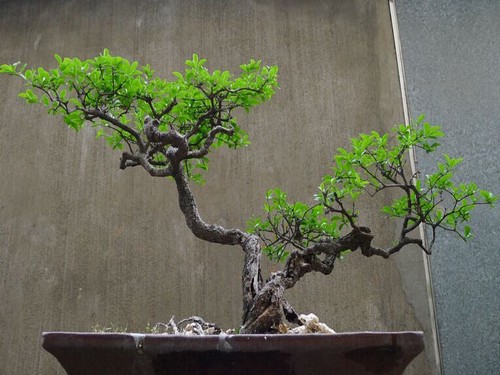
Small-leaf privet has dense branches and leaves, white flowers and purple berries, stays evergreen through all four seasons, and can be enjoyed year-round, but it looks best in spring and summer. Using its old trunk, with ancient roots and a slanting trunk, gnarled and full of varied forms, with branches and leaves styled in layer upon layer, it has even greater ornamental value. Below, let me introduce the method for making a small-leaf privet bonsai.
[Collecting the trunk]
Small-leaf privet trunks can be collected in both spring and autumn, but the best time is in early spring, just before it revives. Choose a trunk that has nodes, bends, or obvious changes from top to bottom (tapering from thick to thin upward from the root, with a bamboo shoot-like shape).
[Potting]
Choosing a pot: Small-leaf privet is commonly grown in purple clay pots or glazed ceramic pots. The pot shape depends on the tree shape, and generally shallower rectangular or oval pots are most common.
Soil: It has no strict requirements for soil. For potting, loose, fertile loam is best. Usually, leaf mold or matured garden soil can be used.
Planting: Potting is best done in spring, in February-March. If planting in a shallow pot, the roots must be tied firmly to the bottom of the pot with wire. The roots should be filled in firmly with sandy loam to allow good air and water movement, and the roots may be slightly exposed above the soil surface.
[Pruning]
Small-leaf privet has extremely strong sprouting ability. To control its growth, promptly remove unwanted buds in spring. After new shoots appear, it is best to cut off the first 1-2 nodes to prevent leggy growth. At ordinary times, pay attention to pruning excess branches and leggy shoots at any time to maintain the tree shape.
[Shaping]
Processing: Small-leaf privet is vigorous and very tolerant of pruning. For styling, the coarse wiring and fine pruning method should be used, that is, appropriately bend and wire the trunk and main branches, using either palm fiber or metal wire, and afterward carefully prune the small branches.
Tree forms: Small-leaf privet has strong sprouting ability and is also quite plastic, so it is generally made into styles such as formal upright, double-trunk, slanting, curved-trunk, and cascade. Its branches and leaves can be styled into cloud-pad or steamed bun shapes, or pruned into a natural tree form.
[Repotting]: It is best done once every 2-3 years, preferably in spring in February-March before budding, or in autumn. Along with repotting, trim the root system, remove 1B2 of the old soil, and replace it with fertile, loose culture soil to promote growth.