How to make a Chinese hackberry bonsai? A detailed explanation of the methods and steps
The Chinese hackberry has strong sprouting ability and roots easily; old stumps are mostly dug from the wild. In southern regions, harvesting is mostly chosen for February and March, when temperatures rise and humidity increases, so the dug stumps are less likely to dry out and are easier to keep alive. When digging, choose stumps that are old, have good tree form, short trunks and naturally transitioning curved trunks. After digging them up, the roots can be coated with yellow clay slurry or wrapped in plastic film, and once transported back they are processed and planted right away. This tree is often cultivated as a bonsai.
The bark of the Chinese hackberry is smooth and gray. Its external features are alternate leaves, long petioles, and leathery leaf blades that are broadly ovate to narrowly ovate, with tips acute to acuminate and bases rounded or broadly wedge-shaped, oblique, with shallow serrations along the margin above the middle, three main veins, hairless on the upper surface, and sparsely hairy along the veins and vein axils on the lower surface. The Chinese hackberry is mainly obtained as a bonsai plant through artificial propagation and collection from the mountains and wild.
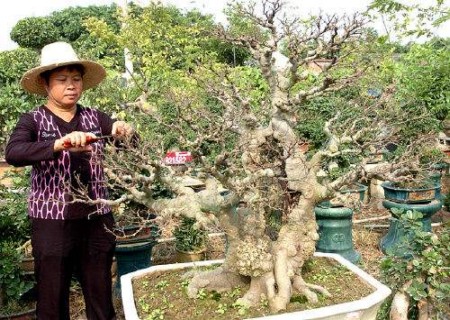
I. Material collection and cultivation measures
1. Artificial propagation: The Chinese hackberry is usually propagated by sowing. The seeds mature from September to October, and the fruit turns reddish-brown. They should be harvested in time, spread out in the shade to dry, and freed of debris, then mixed with sand and soil for storage. Sow in March of the following spring. Before sowing, the seeds must be treated: crack the seed shells with a wooden stick, or rub the outer seed coat with sand, and only then sow; this helps the seeds germinate. The seedbed soil should preferably be loose, fertile, well-drained sandy loam. After sowing, cover with a layer of fine soil about 2 cm thick, then cover with rice straw and water thoroughly once. About 10 days later germination begins; once seedlings emerge, remove the straw in time. During the seedling stage, do a good job of maintenance and management, paying attention to loosening the soil, weeding, and topdressing, and thin the seedlings appropriately. Seedlings in the current year can reach 30-40 cm tall. For young trees cultivated for Chinese hackberry bonsai, pay attention to pruning and shaping, "suppressing the top and promoting the sides", controlling the height growth of the sapling and promoting thickening of the trunk and growth of side branches, so as to facilitate potting and styling.
2. Collection from the mountains and wild: The Chinese hackberry is commonly found growing wild on hillsides and low mountain stream valleys in the Yangtze River basin and areas to its south. The ancient and unusual sprouted old stumps that have been cut back for many years can be collected and "cultivated as pre-bonsai material". After pruning, root development is promoted and new branches sprout, then they are shaped and cultivated. After 1-2 years, they are potted and processed, and a vigorous, ancient-looking Chinese hackberry bonsai can be made in a relatively short period.
II. Potting process
1. Pot selection: Chinese hackberry bonsai is valued for its antique elegance, so purple clay pottery pots or glazed pottery pots are suitable. Rectangular, square or oval pot shapes are good, depending on the tree form. Because the Chinese hackberry has dense leaves, deep green foliage, and grayish-brown, rough bark, pot colors of light yellow or ochre-brown are best, creating a contrasting and complementary effect.
2. Soil: The Chinese hackberry is not particular about soil and has strong adaptability, but it grows better in fertile, loose, well-drained sandy loam. For bonsai cultivation, a growing medium made by mixing garden soil with sandy soil or rice husk ash is generally used.
3. Planting: It is best done after autumn or before spring bud break. When planting, the root system should be properly pruned and arranged, cutting off overly long main roots and keeping more lateral roots and fibrous roots, and mounding loose fertile soil around them; at the same time, the branches and leaves should also be properly thinned. If planting in a medium-shallow pot, the roots must be fixed to the bottom of the pot with metal wire to prevent lodging.
III. Styling techniques
1. Processing: The Chinese hackberry is mostly styled by the method of coarse wiring and fine pruning, while the Lingnan school's large tree style is processed entirely by pruning, imitating Lingnan painting techniques, emphasizing pruning skills, growing branches and truncating the trunk, and valuing the overall compositional effect. Once processed and formed, the stump bonsai can maintain a beautiful form whether in lush leaf or in the bare winter state.
2. Tree form: Chinese hackberry bonsai is suitable for being made into forms such as the straight trunk style, slanting trunk style, curved trunk style, lying trunk style or root-on-rock style. The branches and leaves can be wired into pads or pruned into rounded bun-shaped pads, or processed into a natural tree form.
IV. Maintenance and management
1. The branches of the Chinese hackberry are flexible and not easy to break, making them easy to shape. Besides visible buds, the branches also have many adventitious buds, making it convenient to select branch tiers. Its callusing ability is stronger than that of the elm, and larger wounds can also heal during styling, leaving almost no trace.
2. Because the leaves of the Chinese hackberry are relatively large, in bonsai composition more consideration should be given to designing it as a tall, elegant and unrestrained type. If it is large-tree-style stump material, the positions of the matching branches should be more spread out, so that the appearance does not lose the charm of grouping and spacing because the leaves are too dense.
3. The Chinese hackberry is relatively drought-tolerant, so do not water too much. In spring and summer, keep the pot soil moist frequently, and in autumn watering should be on the dry side.
4. The Chinese hackberry has strong sprouting ability. When new shoots grow to 6 cm-8 cm, keep 2-3 leaves and cut off the rest. Usually, buds and tips should be pinched off at any time to maintain the tree form.
5. Repot once every 2-3 years, best before spring bud break, though autumn is also acceptable. Combine repotting with pruning old, weak and damaged roots to promote the development of new roots.
6. The Chinese hackberry likes light and should be placed in a sunny, well-ventilated spot. Except in midsummer, it generally does not need shading, and in winter it can tolerate a little cold.