How to Make a Moss Bonsai? A Step-by-Step Guide to the Method
Mosses prefer dark, damp environments and generally grow on bare rock faces, or in humid forests and swamps, with remarkably tenacious vitality. Moss is a top-grade base material for making bonsai. Mosses are among the most primitive plants: they have no flowers, no seeds, and reproduce by spores. Their structure is simple, consisting of only two parts, stems and leaves; sometimes they are just a flat thallus, with no true roots or vascular bundles. Pairing a patch of fresh, tender green moss with a traditional indoor potted plant allows you to design many novel bonsai, and the drippingly green moss is a delight to the eye.
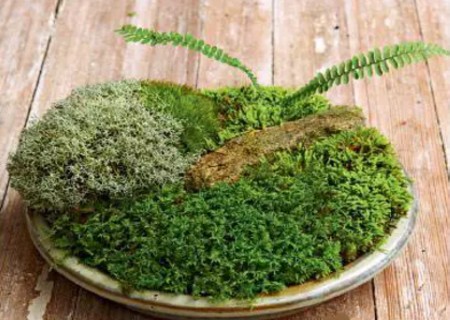
The moss bonsai is now a fairly common form of bonsai, and it is loved for its high ornamental value and low cost. "Moss traces green the steps, grass color blue the curtain." This is the beauty of the mood that moss brings. Transplant moss into glass or tile-and-stone vessels and add decorations to form a microscopic world, adding a great sense of serenity to a space and filling it with Zen. So how should a moss bonsai be made?
In a busy life, if a touch of green could refresh your eyes, what comfort and tranquility that would be. So let us take a look at how the editor's little moss bonsai is made.
1. Drill a drainage hole
Use a porcelain drill bit to drill a drainage hole in the center of the plate. Add enough water to cover the bottom of the plate to prevent dust from rising during drilling and to cool the drill bit. Drill in at a 45-degree angle to create a groove as an entry point, and steady the drill bit. Slowly lift the drill bit, rinse the plate with water, then continue drilling. Repeat this process until the hole is drilled.
2. Add the base material
Line the bottom of the plate with a layer of gardening landscape fabric to prevent small stones and potting soil from clogging the drainage hole, then add a thin layer of small pebbles to help with drainage.
3. Fill the plate
Fill with well-draining potting soil, not higher than the rim of the plate. To build the main framework of the bonsai, here we used a stone and a black-stemmed spleenwort (Asplenium), using a spoon to dig holes and plant the vascular plants. Lay moss and lichen over the potting soil and press them down firmly. The order for adding design elements is from largest to smallest.
4. Trim the moss
Cut a piece of moss slightly larger than the area to be covered, and carefully trim it with pliers to a little larger than needed, so that the edges of the moss can be tucked in.
5. Tuck in the moss
You can use any handy tool to tuck in the moss; here we used a bamboo pick, then removed leaf debris with small tweezers or medical forceps. The mosses used in the end were Brachythecium moss, Dicranum moss, reindeer moss and black-stemmed spleenwort.
Points to note when making a moss bonsai:
1. Choose a container for your moss bonsai, but do not use a metal container, because moss is very sensitive to metal and chemicals.
2. Use soil as the top-layer filler, unless you are also going to plant vascular plants; otherwise the very shallow top layer is the part you need to fill, namely the soil.
3. Buy moss from a flower market or an online store.
4. When collecting moss, use a small shovel or trowel to lift it from underneath; there should be a thin layer of soil beneath the moss. Take only as much as you need each time; there is no need to dig up too much at once.
5. Try combinations of different moss varieties. If a single kind of moss does not grow well, return it to where it was collected to recover, or replace it with a well-growing moss variety.
6. Water the finished moss bonsai thoroughly, and press down so that the mosses are in close contact with each other.
In addition, you should master the following key technical points:
1. For moss, watering not only replenishes moisture but can also carry away waste substances accumulated in the soil, making the soil cleaner. All plants follow one principle: water thoroughly every time, and moss is no exception. Excess water will drain out through the drainage hole. Therefore, the vessel used to hold the moss bonsai should preferably have a drainage hole; if it is glassware or the like, it is best to place some small stones or small shells in the container. Standing water will affect the health of the moss. You should also choose the right time to water moss. Early morning is best; never water under high-temperature sunlight. As for when to water, you can decide by observing the growth state of the moss, mainly by observing whether the moss's "buds" are plump, whether new buds are bursting out, and whether the color is on the yellow side.
2. The environment suitable for moss growth is very similar to the environment suitable for human habitation: a stable microclimate, a certain humidity, ventilation and breathability, and moderate light. Its best living environment is outdoors or close to outdoors, preferably a semi-shaded, semi-sunny spot facing southeast.
3. Morning dew and weak sunlight are what mosses love most. Many people think that moss likes dark, damp environments, but this view is actually not correct. If you want moss to grow well, you must give it a certain amount of sunlight, but preferably weaker scattered light rather than direct strong sunlight. For example, let the moss enjoy a morning "sunbath."
4. Moss is very different from other plants. First, its roots basically only serve to cling to and anchor the plant, and it mainly relies on its leaves to absorb water and meager nutrients from the air. Second, when the air humidity is insufficient, it automatically enters a dormant state. At this time the color becomes grayish green, but this does not mean the moss has "died." In fact, moss in dormancy is very robust, unafraid of cold or heat, and can endure for months; once it comes into contact with water, it turns green again.
5. Growing moss does not require special soil; ordinary soil will keep it alive, and it does not need special fertilizing either. When displayed indoors, it should be placed in a ventilated and bright spot. Be sure to ensure ventilation, but the wind speed must not be too high. Besides the green of the plant itself, you can also choose some green flower vessels to add a touch of spring color. The effect of green filling the eyes can sometimes be stunning.
6. Moss in a moist state needs careful tending. Avoid drastic short-term changes in temperature and humidity, avoid repeated drying and wetting, and avoid exposure to overly hot sunlight, dry cold winter air or air-conditioning vents, otherwise the cells of active moss are easily damaged. Remember that moss fears sauna-like high temperature and humidity most of all.
7. In daily care, it is better to keep it a little dry than too wet. Moss that has naturally dried out and gone dormant can still recover after being soaked through with water, but moss that stays wet for a long time is easily damaged once the temperature is not well regulated.
Care notes:
1. The environment suitable for moss growth is very similar to the environment suitable for human habitation: maintain a certain humidity, ventilation and breathability, and moderate light.
2. Mosses are not suited to growing in dark places; they need a certain amount of scattered light or a semi-shaded environment. During the care period, a certain amount of light should be provided, preferably weaker scattered light rather than direct strong sunlight.
3. Spray water multiple times a day; do not pour too much water at once, just keep the moss surface moist. The optimal growing temperature for moss balls is around 25°C, and in winter they should be placed indoors.
4. Moss is very different from other plants. First, its roots basically only serve to cling to and anchor the plant, and it mainly relies on its leaves to absorb water and meager nutrients from the air. Second, when the air humidity is insufficient, it automatically enters a dormant state. At this time the color becomes grayish green, but this does not mean the moss has "died." In fact, moss in dormancy is very robust, unafraid of cold or heat, and can endure for months; once it comes into contact with water, it turns green again.