How to make a kokedama moss ball bonsai yourself? DIY method illustrated
Kokedama, fresh and elegant, evergreen all year round, more ornamental than succulents. Currently, it is very popular in Europe, America, Japan and South Korea.
Kokedama is both a plant and a planting method, an ancient Japanese art evolved from bonsai, originating in the Japanese Edo period, and is a type of Japanese-style bonsai with a very long history. The special feature of kokedama bonsai is that when shaping it, no rigid materials are used; instead, only the plant's roots are wrapped in soil and formed into a ball, then covered on the outside with moss. It can either be hung in the air or placed on a table as decoration.
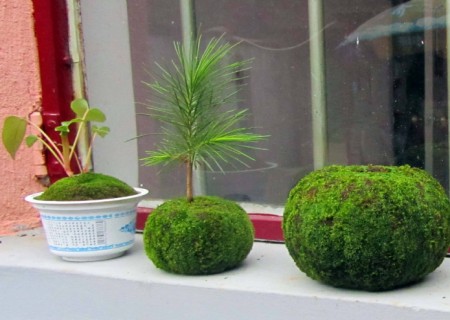
There are more than 20,000 species of moss, but fewer than 10 are suitable for making kokedama. So the key is to find the right moss. The moss used to make kokedama is collected from rocks on steep cliffs deep in the mountains. This moss has extremely strong vitality and excellent water retention, and also has good air permeability. Even after drying, it keeps its natural green color, and after spraying with water it quickly revives and once again blooms with the fresh green unique to moss. Kokedama is made entirely by hand, combining natural beauty and craftsmanship in one, paired with various small plants, letting you experience the unique mood of "one flower, one world"!
The method for making kokedama is very simple. To make kokedama, you only need to prepare a sheet of moss, a small tropical plant, mixed soil and fine hemp twine. The difficulty in making kokedama lies in creativity, making the whole thing look distinctive in style. Here is a brief description of the making process. Because every gardener's conditions and tools are different, the making method does not have to be exactly the same; as long as the goal is achieved, it is fine, so use it flexibly.
What you need to prepare: a small tropical plant (tropical plants are chosen because they like high humidity), peat, akadama soil, moss, fine hemp twine or fishing line
Step 1: Clean the soil off the roots of the small plant you plan to use for the kokedama, trying not to damage the roots. Choose a small tropical plant and wash the soil off its roots.
Step 2: Use a mixture of 70 percent peat and 30 percent bonsai soil (akadama soil) to wrap the plant's roots, squeezing and shaping it into a ball with your hands.
Step 3: Wrap a layer of moss around it and secure it with hemp twine, fishing line or the like. Of course, other methods also work.
Step 4: Below is the semi-finished kokedama; it still needs a container.
Care tips:
Soak once in water and it can retain moisture for 10-15 days. In summer and autumn, when indoor air is dry, spray water twice a day to keep the moss moist. Rainwater is rich in various natural nutrients needed for moss growth. When it rains, you can place the kokedama in the rain to make the moss grow even more vigorously.
Kokedama is suitable for growing all kinds of foliage plants and small flowers, carnivorous plants, succulents, hydroponic plants and ferns, such as Anthurium, golden pothos, pothos, small asparagus fern, dwarf coconut palm, dianthus, pennywort, strawberry, jasmine, spider plant, snake plant, rabbit's foot fern, Sempervivum, etc. It can be placed on the dining table, by the window, on the computer desk, on the office desk, on the bedside table, on the bookshelf, in the bathroom…… all with unexpectedly wonderful effects, letting you experience unusually fun planting. If you are itching to try it, why not get hands-on!
The planting method for kokedama bonsai is simple. First soak the kokedama in clean water for 2-3 minutes, then peel back the moss at the opening at the top of the kokedama, and transplant the cultivated small plant with its soil into the hole. You can also first place the plant into the hole in the prepared moss ball, then take a small amount of leaf mold to fill the inner cavity, and cover the area near the opening with the excess moss so that the kokedama looks natural and beautiful as a whole.
Suitable for growing all kinds of foliage plants and small flowers, carnivorous plants, succulents, hydroponic plants and ferns, such as Anthurium, golden pothos, pothos, small asparagus fern, dwarf coconut palm, dianthus, pennywort, strawberry, jasmine, spider plant, snake plant, rabbit's foot fern, Sempervivum, etc. It can be placed on the dining table, by the window, on the computer desk, on the office desk, on the bedside table, on the bookshelf, in the bathroom…… all with unexpectedly wonderful effects, letting you experience unusually fun planting.
Precautions:
1. The environment suitable for moss growth is very similar to the environment suitable for human living: maintain a certain humidity, ventilation and air permeability, and moderate light.
2. Moss plants are not suitable for growing in dark places; they need a certain amount of diffused light or a semi-shaded environment. During care, a certain amount of light should be provided, preferably weak diffused light rather than direct strong sunlight.
3. Spray water multiple times a day; do not pour too much water at once. Just keep the moss surface moist. The best growing temperature for kokedama is around 25°C, and in winter it should be placed indoors.
4. Moss is very different from other plants. First, its roots basically only serve to cling to and anchor the plant, and it mainly relies on its leaves to absorb water and trace nutrients from the air. Second, if the air humidity is insufficient, it will automatically enter a dormant state. At this point the color becomes grayish green, but this does not mean the moss is "dead." In fact, moss that has entered dormancy is very robust, resistant to cold and heat, and can endure for several months; once it comes into contact with water, it turns green again.