Detailed Guide to the Methods and Steps of Making Camellia sasanqua Bonsai
Camellia sasanqua is an evergreen shrub of the genus Camellia in the family Theaceae. Because its flower shape combines the characteristics of camellia and plum blossom, it is called "tea plum". Gao Lian of the Ming Dynasty once wrote a poem titled "Plum Blossom Tune · Tea Plum": “The flower is, after all, one with the plum” - with just a few strokes, he captured the spirit of the tea plum, which resembles both camellia and plum blossom.
However, we often confuse Camellia sasanqua flowers with Camellia japonica flowers. Camellia japonica also belongs to the genus Camellia in the family Theaceae. Although from a botanical standpoint there are many differences between the two - flowering period, fragrance, fruit shape, and so on - when you actually see Camellia sasanqua and Camellia japonica, you will surely be baffled and unable to tell them apart. But I rely on just one trick: the way the two shed their flowers. Camellia sasanqua scatters petal by petal; Camellia japonica drops its flowers whole.
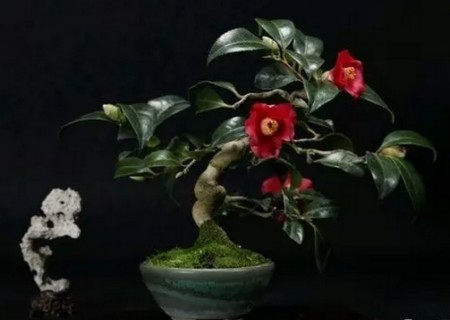
Camellia sasanqua, a member of the Theaceae family, gets its name because its flower shape combines the characteristics of camellia and plum blossom. Camellia sasanqua has a delicate form, elegant leaves, and brilliant flower colors, making it a famous ornamental known for both its flowers and foliage. Although Camellia sasanqua is a shrub or small tree, its beautiful appearance has attracted many flower enthusiasts, who choose to use Camellia sasanqua for bonsai.
1. Material Selection
Camellia sasanqua that is short in stature, slow-growing, small-leaved, and soft-branched is more suitable for shaping, such as the spreading, low-growing winter Camellia sasanqua.
Common Camellia sasanqua varieties that are relatively upright can also be tried as tall-style bonsai, but it is best not to use varieties that are tall in stature, fast-growing, and have large flowers and leaves.
2. Material Sources
It is best to use 2-3 year old cuttings or seedlings, because the branches and trunks of young plants are easier to shape. During cultivation, they can be continuously shaped, pruned, wired, and wrapped according to styling requirements to develop various tree forms.
You can also dig up old plants such as wild golden-center camellia or oil tea with curved trunks and twisted branches, and use the trunk-chopping and grafting method, or use old remnant stumps that sprout new branches, and after continuous shaping, create aged Camellia sasanqua bonsai.
3. Styling
Usually the natural posture of the Camellia sasanqua plant is taken as the main basis, or artistic treatment is added, to shape it into a straight-trunk style, slanting-trunk style, or double-trunk style. Metal wire or binding can also be used to cultivate curved-trunk style, cascade style, semi-cascade style, and so on.
4. Later Care
1) Generally, repot once every two to three years. When repotting, besides choosing a pot whose color, size, and style match the plant, the pot should preferably be a little small rather than large - about one-half the size of the canopy.
2) Properly cut away damaged roots and some old roots to help the shallow root system develop better and also help dwarf the plant. When planting, the base of the trunk should be slightly higher, extending beyond the edge of the pot. Plants with exposed roots should be protected from wind and strong sunlight.
3) As long as growth and development are not affected, fertilize as little as possible. To maintain a balanced and natural tree posture, do not casually cut the top. During the growing season, light pruning can be done, using the pinching method to remove the growth buds of unwanted or overly long branches. More intensive pruning and shaping should be done before bud break. Apart from water sprouts, if there are branches that are too long or out of proportion, the longer part of the tip can be cut off, or metal wire can be twisted from bottom to top to shorten them. Do not keep it indoors for too long, as this will affect the growth and development of Camellia sasanqua.
Camellia sasanqua has a little more toughness than camellia and a little more simplicity than plum blossom, filling the gap of winter when there are no flowers to enjoy. Walking along the forest path through a sea of Camellia sasanqua, you will be attracted by the beautiful flowers all over the mountain, and even more moved by the petals all over the ground! “Fallen red is not a heartless thing; turned into spring mud, it protects the flowers even more!” It turns out that withering can also be this beautiful! This warm!