How to Make a Stone Acorus Bonsai, Easy for Beginners to Learn
The elegant sweet flag grass, especially the coin acorus and the tiger-whisker acorus, has a small and lovely plant form, condensing the feel of the countryside into the palm of your hand. Acorus stays green in all four seasons, as green as jade, plain and natural, with a wild and fresh fragrance that refreshes the heart. It is loved not only by literati and refined scholars of past dynasties, but also by ordinary people today who love acorus. The Seven Customs of Jiangnan: “playing the guqin, tasting Pu'er tea, wearing Tang-style clothing, listening to Kunqu opera, burning agarwood, practicing Tantrism, and growing acorus, these are the so-called seven customs. For acorus, nine-jointed ones are considered treasures, tiger-whisker ones are considered beautiful, and Jiangxi varieties are considered precious.
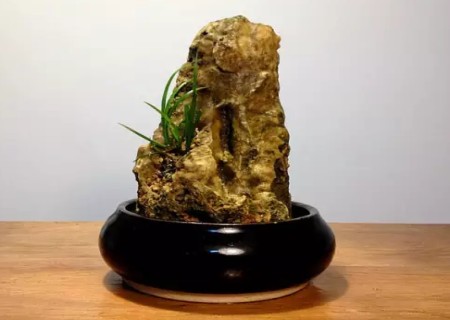
Planting acorus, small grasses and moss on water-absorbing stone creates a lush, verdant and moist look. When you are busy, you can look at the green plants to relieve stress. The water-absorbing stone has extremely strong water absorption and releases moisture quickly, instantly filtering indoor air, absorbing carbon dioxide and giving out fresh air. In summer it keeps the room cool, and in winter it keeps the room humid. It is absolutely a natural humidifier. Placing a water-absorbing stone acorus bonsai indoors not only purifies the air and beautifies the environment, but is also said to bring a flourishing family and gathered wealth. This article will introduce a simple way to make a water-absorbing stone acorus bonsai.
Materials to prepare: water-absorbing stone, making tools (scissors, tweezers, screwdriver, carving knife, file, saw, hammer, nails, spray bottle, steel chisel, etc.). Choose tools according to your own operation; there is no fixed set, just whatever feels handy.
According to your own design idea, friends with an interest and hobby can draw a design sketch in advance, then choose the acorus type, size, and so on.
Once you have a rough idea, start making the stone. I first make the bottom surface, sawing it flat, with the standard being that it can stand steadily.
Next, start digging the cave for planting acorus. For planting acorus, choosing a horizontally lying water-absorbing stone is simpler and easier to plant. I use a steel nail and hammer to chisel out the rough shape, then use a carving knife to refine the details.
These past few days have been rather cold, and my hands turned red from the cold. The making process is hard work, but of course hobbyists take pleasure in the hardship. After it is made, try to smooth the base a bit more with a file; the steadier it is, the better.
Once carved, wash away the stone debris and the powder in the crevices. Then soak it in water. Next, start planting the acorus.
Prepare tweezers (very useful for planting acorus and other decorative elements), a spray bottle, planting medium, moss, other small plants, and so on. This spray bottle is quite handy, with a very good atomizing effect and strong support for care.
Planting medium (I prefer mixing volcanic stone [1~3mm] and mountain soil at 1:1, loose and breathable)
The planting process is very simple
Next comes planting the decorative elements, such as moss and other plants with similar habits (rabbit's-foot fern, miniature coconut palm, thousand-leaf spider plant, Buddhist pine, ivy, strawberry begonia, and many, many more; just choose whatever you like)
In addition, for plants I like to use pennywort as an accent; it looks cute and also smells fresh. With the help of tweezers, the planting process is completed smoothly.
Then find a suitable water-holding vessel and place it on top. Placed on a table or bookcase, it is a beautiful scenery.
Care is simple: make sure there is water in the water-holding vessel, and regularly mist the stone and plants to keep them humid~
Below, let's talk about the natural moss-growing method on water-absorbing stone. Moss that grows naturally on the stone is easier to care for and more pleasing to the eye.
One method is the surface-covering method. Take moss blocks dug from shady, damp places, cut them into appropriate sizes, and press them directly onto the concave grooves of the rock. They should be pressed firmly so that they fit closely against the rock, then water them and shade them to keep them moist. They will soon take hold, and afterward the moss will be supplied with water by the rock's own water-absorbing power and will grow very well.
Another method is to remove impurities and soil from the collected moss, tear it into fragments, add water and mash it into a juice, then add a small amount of flour as an adhesive (or clay) to make a thin slurry. Soak the water-absorbing stone thoroughly with water, then use a soft-bristled brush to apply the thin slurry onto the rock, and cover the entire rock with plastic film. Place it indoors in a shaded spot, and always keep plenty of water in the basin. It takes about more than one month for the spores to grow into green moss.
The key to successfully cultivating moss is that it must not be exposed to blazing sunlight, and high humidity must be maintained regularly. Above all, it must not be placed in a draft or at an air vent. Especially in summer, prevent it from drying out, and do not immerse it in water either.
Now that you have seen the bonsai-making and moss-growing methods, let's also enjoy a few simple water-absorbing stone acorus bonsai!
Before growing acorus, my knowledge of acorus was limited to the Dragon Boat Festival every year, when my parents would surely buy acorus and mugwort to hang on the front door of our home, saying it could ward off evil and prevent disease. At that time I only thought acorus and mugwort were a kind of Chinese herbal medicine. Then two years ago, I accidentally saw a shop online selling acorus. After reading the relevant introduction about acorus, I learned that because of its tenacious vitality, acorus was worshipped by ancient Chinese ancestors, who regarded it as a sacred grass and even endowed it with human personality. It was deeply loved by people, especially by literati and refined scholars, and became a clear plaything and ornament on study desks. It is praised as ”the finest elegant grass under heaven“, and together with orchid, narcissus and chrysanthemum is called the ”four elegant flowers and grasses“. So I fell in love with acorus, and so these acorus bonsai came to be.