Sharing the Techniques and Methods for Making Chinese Trumpet Creeper Bonsai
Chinese trumpet creeper was recorded as early as the Spring and Autumn period in the Classic of Poetry, where people called it "lingshao"; the line “the flowers of the tiao, how luxuriant and noble they are” refers to Chinese trumpet creeper. The name "lingxiao flower" first appeared in the Tang Materia Medica, which under the entry for “Ziwei” says: “This is the lingxiao flower, and its stems and leaves are all used.” The beauty of the Chinese trumpet creeper flower has won over many flower lovers. Some flower lovers ask whether Chinese trumpet creeper can be grown in pots. We can tell them that Chinese trumpet creeper can indeed be grown in pots, and some flower lovers have even made it into bonsai.
From June to September is the peak blooming period of Chinese trumpet creeper. At this time, the Chinese trumpet creeper bonsai has green leaves as green as jasper and red flowers as bright as the morning sun. Its branches droop and its vines trail at a slant, like a woman wearing a gorgeous bridal veil, delicate and lovely, beautiful beyond words! So, how do you make a Chinese trumpet creeper bonsai? Here is an introduction.
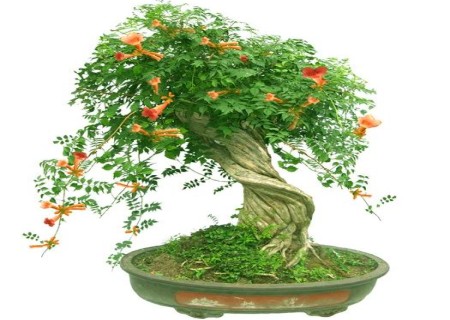
If Chinese trumpet creeper is planted directly in a pot as a seedling, it grows rather slowly. It is best to first plant it in the ground for three to four years, and after its stems and vines have grown thick, cut it back hard in early spring leaving 40 cm, then move it into a pot with the soil, or buy a relatively thick potted plant at a flower market. There are three methods:
The first is to build a frame on the pot and guide it to grow around the frame. The advantage is that it is easy to repot and change the soil, and easy to move and prune; the disadvantage is that ventilation and light transmission are slightly poor, and the inner leaves tend to turn yellow.
The second is to place it on an open balcony and use ropes to pull and guide it to climb upward; part of the stems and vines can also be allowed to hang down naturally, forming a continuous whole from top to bottom, elegant and unrestrained. The disadvantage is that repotting and changing the soil are rather difficult and require two people working together, and pruning is also rather difficult, so attention must be paid to safety.
The third is to make it into a tree-trunk-style or cliff-style bonsai after potting, and place it on a balcony or a high shelf.
Soil:
For potted Chinese trumpet creeper, it is best to choose a relatively deep and large clay pottery pot or wooden bucket with good permeability. It likes fertile, loose, well-drained neutral or slightly acidic sandy loam. An equal mix of leaf mold and garden topsoil can be used as the growing medium.
Obtaining materials:
In October, after the Chinese trumpet creeper seeds mature, pick the seed pods, harvest and dry them in the sun, take out the seeds, remove debris, dry them in the shade and store them dry, then sow them in the following spring. Before sowing, the seeds can be soaked in clean water for 2 to 3 days to promote germination. Alternatively, in the third month of spring, take branches of Chinese trumpet creeper and insert them as cuttings in loose sandy soil, and after several years when the roots are deep and the leaves are lush, pot them up.
Potting:
Potting or repotting and changing the soil every other year should preferably be done in early spring, and a layer of crushed charcoal blocks or hard plastic foam blocks should be placed at the bottom of the pot to facilitate air and water drainage and prevent root rot. The roots must not be bare; about 1/3 of the original soil should be retained, the roots must not directly touch the base fertilizer, and a layer of plain soil must separate them.
Pruning:
During the growing period, the tips should often be pinched to control branch growth and encourage side branches, and axillary buds and adventitious buds sprouting from the branches and base should be removed promptly. After the flowers fade, the remaining flowers should be cut off promptly so that flower buds can form again. Because potted Chinese trumpet creeper sometimes has limited space, it should be pruned promptly; in early spring, cut off some dead branches, thin and weak branches, and overly dense branches.
Shaping:
The shaping of Chinese trumpet creeper bonsai is different both from pine and cypress bonsai (which mainly use wiring and bending) and from other miscellaneous-wood bonsai (which combine trunk chopping and branch cultivation with pruning and wiring). In spring, it can be allowed to grow freely; even if it is “disheveled,” there is no need to use scissors. Starting in mid-May, keep only two to three buds and cut the branches short. It should be pruned multiple times to maintain the ideal branch length, until late spring and early summer, when pruning stops only once flower buds appear at the branch tips. Before and after budding, more phosphorus and potassium fertilizer should be applied to encourage bright flowers and lush leaves.
Repotting:
Flowering plants can be repotted every year in spring after the weather warms up. When repotting, retain as much of the soil around the roots as possible, prune the branches and aged roots, apply sufficient organic fertilizer at the bottom of the pot, water thoroughly after planting to settle the roots, provide shade, and keep the pot soil moist without waterlogging; after the plants recover, resume normal care.
Management:
1. Chinese trumpet creeper likes strong light and also tolerates light shade, but it must not be too shaded, otherwise it grows slowly and blooms very little.
2. Chinese trumpet creeper likes light and dislikes waterlogging. Therefore, the Chinese trumpet creeper bonsai should be placed in a relatively high, wind-sheltered, sunny spot.
3. Chinese trumpet creeper also likes fertilizer. After sprouting in spring, apply organic fertilizer once; before blooming in June, apply a topdressing once more; after leaf fall in autumn, apply organic fertilizer once more; and every year when repotting, rotted manure must also be applied as base fertilizer.
4. The main pests and diseases of Chinese trumpet creeper are powdery mildew, gray leaf spot, and root-knot nematodes. Once the above pests and diseases are found, chemicals such as chlorothalonil and dichlorvos can be used to kill them.