Detailed Explanation of the Techniques and Methods for Making Chinese Elm (Ulmus parvifolia) Stump Bonsai
The Chinese elm (Ulmus parvifolia) has a straight trunk and a round, full crown. Its leaves are smaller than those of the common Siberian elm (Ulmus pumila) but very dense, making it excellent both as a landscape tree and as a street tree. It is just that in the past people did not know it well enough and only regarded it as bonsai material, without paying attention to its use in landscaping. At present, the stock of Chinese elm in nurseries, especially Chinese elm suitable for use as street trees, is still not large, and the market potential is huge. I believe that capable practitioners can develop it appropriately. Compared with some other elm varieties, the Chinese elm is more refined and more malleable, and he is very optimistic about the development prospects of this tree species.
The Chinese elm is produced in the central and southern provinces and regions of our country and is a suitable tree species for subtropical areas. Chinese elm bonsai has small, emerald-green leaves, is elegant and bold, full of vitality, with clear layers, well-spaced density, twisted roots, and exposed claws of roots. These qualities are deeply loved by the vast number of bonsai enthusiasts. The Chinese elm itself is a very ordinary tree species, but after careful shaping by bonsai artists it displays the unique temperament of Chinese elm bonsai: vigorous and ancient, strangely twisted, and showing the appearance of great age. So how is the bonsai made? Below, the editor will introduce the production methods of Chinese elm bonsai.
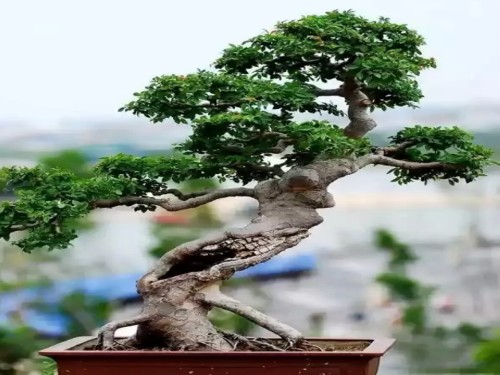
1. Selecting the stump
The selection of stumps must be strict. The stump material must be fresh; do not take dead, rotten ones or ones without root fibers. Select as carefully as possible and do not seek quantity, so as to ensure that all selected stump material can survive.
2. Selecting the pot
The Chinese elm has an ancient and simple tree form and strong vitality, so it is suitable to be planted in a purple clay pottery pot or a glazed pottery pot, and it can also be planted in a porcelain pot. The pot shape is determined by the tree shape. For the straight-trunk style, use a shallow round pot, rectangular pot, or oval pot; for the slanting-trunk style, curved-trunk style, lying-trunk style, and forest style, rectangular or oval pots are suitable; for the waterside style and cliff style, square or round pots with a certain height are suitable. Plain and elegant colors are best.
3. Planting
Plant in pots before budding in spring from February to March, or in autumn. Before planting, prune the root system and branches and leaves. Apply white latex or sulfonamide ointment to the cut wounds, then sprinkle some dry fine soil. When planting, apply an appropriate amount of poultry manure or mud as base fertilizer, and plant with slightly moist soil. After planting, place it where there is no direct sunlight (there should be sufficient scattered light). Do not water, but spray clean water on the tree body 2 to 3 times a day, just enough to moisten it, and after 2 to 3 days water thoroughly once. After that, keep the pot soil moist, and after half a month gradually move it to a place with half shade and half sun.
4. Shaping
The processing and shaping of Chinese elm can be carried out by combining pruning and wiring. Palm fiber or metal wire can be used for wiring. Because Chinese elm branches grow relatively quickly, after shaping by wiring the wire should be removed in time to avoid wire bite, which affects appearance. During the growth period, for newly sprouted branches, the new shoots can be cut off to promote branching, and the branches can be twisted into shape. The Chinese elm is highly malleable and can be processed into many forms. Common ones include the straight-trunk style, slanting-trunk style, lying-trunk style, cliff style, and root-over-rock style. The branches and leaves can be pruned and wired into pads, or pruned into a natural crown. In particular, for root-over-rock Chinese elm bonsai, a certain degree of exaggeration is allowed in the shaping. The tree can be placed above the rocks, with the tree as the main element and the rock as secondary, not restricted by "a zhang of mountain, a chi of tree."
When shaping the Chinese elm, trunk chopping to build branches is combined with pruning and wiring. The branches of the Chinese elm are relatively soft, so metal wire or palm fiber can be used for wiring; the branches and leaves can be pruned and wired into cloud pads or cloud clusters, or pruned into a natural crown. Because Chinese elm branches grow relatively quickly, wiring materials should be removed in time to avoid "wire bite," which affects appearance. For old tree stumps collected from the mountains and fields, overly thick main trunks can be carved and cut to reduce their bulk and match the side branches, while also adding an ancient flavor. The shaping of the Chinese elm is preferably carried out before budding in spring or during the plum rain season.
5. Tree form
The Chinese elm is highly malleable and suitable for processing into many kinds of tree forms. Common ones include the straight-trunk style, slanting-trunk style, lying-trunk style, cliff style, root-over-rock style, and group planting style. The branches and leaves can be wired into pads or pruned into a natural crown. In particular, when creating a root-over-rock Chinese elm bonsai, when conceiving the design one can take a corner of the natural world, and a certain degree of exaggeration is allowed. In order to heighten the charm of a certain part, the tree can be placed above the rocks, with the tree as the main element and the rock as secondary, not restricted by "a zhang of mountain, a chi of tree." In Chinese bonsai, the Lingnan school, Su school, and Yang school often use the Chinese elm as the main tree species.
The author believes that the reason the Chinese elm is so favored by people is, relatively speaking: first, the material is easy to obtain; second, it grows quickly; third, management is extensive; fourth, it can be appreciated with or without leaves; and fifth, it costs little. But whether it can be well made and maintained, the author believes the following 6 issues should be noted and solved:
1. Solve the problem of "sap bleeding"
Japanese bush cherry fears "branch dieback," while the Chinese elm fears "sap bleeding." Therefore, anyone who cultivates Chinese elm will be very cautious in handling the wounds from digging, sawing, and chiseling and the "sap bleeding upon contact with water" at the cut sections. The solutions for "sap bleeding" generally include air-drying, applying plant ash, coating with mud slurry, applying latex, dripping hot beeswax, and applying erythromycin ointment, and care should be taken not to immediately water with "settling-in water" at planting time; wait 2-3 days before watering. As long as "sap bleeding" can be completely prevented, there is no threat to the survival of the Chinese elm, and the result will be twice the effect with half the effort.
2. Solve the problem of "branches and trunk not being in place"
"The Chinese elm is of superior grade, but poor branches and trunk hinder appreciation." Although this problem is not fatal, it is somewhat spoil-sport, affects appreciation, and is a blemish on otherwise fine work. For this reason, the author has also many times imitated the position-selecting "hammering to promote growth method," but it was difficult to make it work, so I had to pull nearby branches and trunk and bend them to make up for the missing parts. In fact, branches and trunk not being in place is not only a problem for Chinese elm bonsai, but also a common problem of all tree stump bonsai.
3. Solve the problem of "taking off clothes and changing to brocade"
The best viewing period of Chinese elm bonsai should be during [missing]. For this reason, the author has several times about 2 months before an exhibition or an auspicious day carried out heavy pruning on the Chinese elm, removing all leaves to prompt it to again present its best viewing period. There are three ways to remove the leaves: first, use flower scissors to cut off the leaves one by one; second, place the plant in a corner of the hall to cause the leaves to fall naturally; third, "withhold water" for 5 to 7 days, causing a short-term interruption of water supply and forcing the leaves to fall. The first method, although time-consuming, labor-consuming, and energy-consuming, is safe and reliable. The second and third methods both belong to forcing the plant to shed leaves on its own, but the "heat" must be well controlled, otherwise it will affect the normal growth of the plant.
4. Solve the problem of water and fertilizer management
Watering should follow the principle of watering when dry and keeping it dry and wet alternately, and when dry, water thoroughly. Too much watering makes the roots too wet, affects root respiration, and causes root rot and plant death. Too little watering makes the pot soil dry up and the plant stop growing. Long-term water cutoff makes the plant dry up. Spray less water on the leaf surface to prevent the leaves from becoming too large and the new branches from growing leggy, which affects appreciation. In severe heat, sprinkle water on the ground to increase air humidity,
so as to benefit plant growth. In ordinary watering, follow the "six looks": look at the soil when watering, do not water if not dry, and water thoroughly if watering; look at the tree when watering, water more for large trees and less for small trees; look at the pot when watering, water more for small pots and less for large (deep) pots; look at the weather when watering, water more on sunny days, less on cloudy days, and do not water on rainy days; look at the plant's growth condition when watering, water more when growth is vigorous and less when growth is weak; look at the bonsai's placement location when watering, water more in sunny places and less in shady places. In short, avoid watering in a uniform way and avoid "too frequent" watering.
The Chinese elm avoids heavy fertilizer. Usually, one should apply thin fertilizer frequently, avoid "strong fertilizer," and avoid applying undecomposed organic fertilizer. Every year from April to October is the growth period of the Chinese elm. On the evening of a sunny (or cloudy) day, apply dilute cake fertilizer or "compound fertilizer" liquid 1 to 2 times a month (do not fertilize during the plum rain season and in severe heat). Before the Start of Winter, it is best to apply one additional phosphorus fertilizer -- bone meal -- to enhance the plant's cold resistance. Fertilization should follow the principles: apply less fertilizer to old stumps and more to strong, healthy stumps; apply less fertilizer to styled stumps and more to developing stumps; apply more fertilizer to vigorously growing stumps and less to weakly growing stumps. Do not fertilize during the dormant period. In short, avoid "strong fertilizer" and prevent "fertilizer burn."
5. Solve the problem of pot soil and repotting
The Chinese elm tolerates poor soil and is not strict about soil requirements. For homemade pot soil, generally take ordinary field soil (mountain soil or pond mud) and freshwater sand (coarse sand) at 40% each, coal cinder (sterilizing and breathable) or sawdust (loosening) at 20%, and add some dry poultry manure or compound fertilizer, mixing them into growing soil. When using it, spray water on the growing soil and stir it (it can be formed into a ball when squeezed and scatter when dropped), fill and cover the root area of the Chinese elm and press it firm, and after 2 to 3 days water with "settling-in water" to avoid "sap bleeding upon contact with water" at the root wounds, which would endanger survival.
The Chinese elm has strong vitality and grows quickly, so it should be repotted about once every 2 years, preferably before budding in spring. When repotting, cut off rotten roots, dead roots, and some old roots and leggy roots, remove 1/3 to 1/2 of the old soil, and fill in new fertile, loose, well-drained growing soil.
6. Solve the problem of pest and disease control
Common pests of Chinese elm bonsai include: aphids, red spiders, elm leaf beetles, etc., which can be sprayed and killed with a 2000-fold dilution of 30% insecticide king emulsifiable concentrate, with very good results. The larvae of the "heart-boring worm" (longhorn beetle) lurk inside the bored holes. First insert an iron wire into the hole to stab them to death, then use a cotton ball soaked in malathion to plug the hole, and coat the outside with yellow mud. For adult longhorn beetles, they can be caught and killed manually. If root rot is found (manifested as leaf drop and branch dieback), repot and change the soil in time, cut off and burn the rotten root fibers and branches, apply a 1000-fold dilution of carbendazim, and pot it again after the liquid dries.