How to make a sago palm bonsai, easy enough for beginners to learn
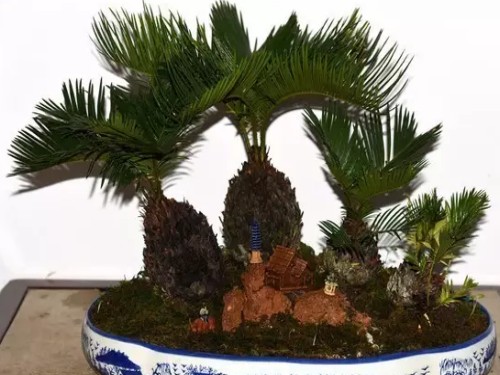
The sago palm is properly named Cycas revoluta, also known as iron-armored pine, phoenix-tail banana and so on. It is an evergreen small tree of the genus Cycas in the family Cycadaceae, and a precious ancient relict plant. The main type cultivated in China is the Cycas revoluta native to the mountains of Fujian. In recent years, Cycas panzhihuaensis from Panzhihua, Sichuan, Cycas siamensis from Yunnan and others have also been introduced and cultivated in various places. The sago palm has a graceful form, and its large terminal feathery fronds are glossy green and lovely, evoking a southern tropical scene. It is a precious foliage tree species and is suitable in all four seasons. Old trunks used to decorate bonsai are covered with leaf scars, mottled like fish scales, with a distinctive charm. A clump-planted sago palm bonsai, paired with cleverly arranged stones, is even more elegant and refined.
1. Obtaining material
The sago palm is usually propagated by sowing, separating offsets, burying cuttings and so on. The sowing method is best done in late autumn, sowing as soon as the seeds are collected, or the seeds can be stored in sand until the following spring before sowing. For open-field sowing in the south, the seedbed soil should be fertile, loose, well-draining sandy soil; sow sparsely and cover with fine soil. Under moist, high-temperature conditions, germination is easy. During the seedling stage, management must be strengthened; watering should be moderate and the soil should not be too wet, as excessive moisture easily causes root rot. After 2 to 3 years of cultivation, they can be transplanted. The offset-separation method involves cutting off small offset buds that sprout from the base of an old sago palm plant and cultivating them. If the offset buds do not readily produce leaves, an upside-down flower pot can be placed over them to block light and encourage leaf growth. After new leaves emerge, remove the covering pot, build a shade frame, and gradually increase light. When cultivating sago palms in the colder regions of the Yangtze River basin, the stems should be wrapped in straw in winter as an insulation measure. For ordinary home cultivation without greenhouse conditions, this method should be used.
2. Choosing a pot
Potted sago palms should be planted in flower pots of different sizes according to the size of the plant, using a slightly acidic sandy culture soil rich in humus, loose, fertile and highly permeable. The bottom hole of the flower pot (or wooden tub) should be made large, and a layer of broken tiles should be laid at the bottom of the pot as a drainage layer to prevent root rot. It is not necessary to repot every year, but organic liquid fertilizer should be applied frequently as a top dressing, preferably sesame paste residue or soybean cake water, which can make the leaves glossy and emerald green.
3. Potting
Pot selection: The sago palm is an evergreen foliage tree species, so either purple clay ceramic pots or glazed ceramic pots can be used, with colors such as dark purple, light green or pale yellow being preferable. Pot shapes are mostly oval or rectangular; for a single plant, a relatively shallow round pot or hexagonal pot can also be used.
Soil: For potting soil for sago palms, a fertile, loose, well-draining, acidic or slightly acidic sandy loam is preferable. For home potting, you can use seven parts humus soil or weathered pond mud, mixed with two parts sandy soil and one to two parts cake fertilizer to make an enriched culture soil.
Planting: The sago palm is a warmth-loving plant, so transplanting and potting are best done in April in spring. When planting, lay a layer of broken tiles and coarse sand at the bottom of the pot to facilitate drainage, then place decomposed cake fertilizer or organic fertilizer as a base fertilizer. If several plants are planted together, the arrangement should be combined with shaping at the time of potting, with the planting positions and angles determined in advance, so that the sizes and heights are varied and well-arranged.
4. Shaping
When making a bonsai from a sago palm, its block-like or cylindrical stem cannot be processed for shaping; the key lies in selecting the material. Materials with multiple heads, stems that lie prostrate and creeping, that crisscross and lean at angles, and that have naturally strange and odd forms are best for decorating a bonsai. You can also choose several sago palm plants of different sizes and heights and arrange them ingeniously in the pot to form a clump-planted bonsai, which also has a distinctive flavor.
Processing: When a sago palm is used for bonsai, its trunk generally cannot be processed for shaping, so the key lies in selecting the material. Usually, materials with multiple heads, prostrate and reclining trunks, crisscrossing and slanting forms, and odd and strange shapes are best. The main processing method for the sago palm is pruning, that is, cutting away overly dense leaves or leaves that affect the appearance at any time.
Tree form: For bonsai, the sago palm should not be planted as a single upright specimen; a slanting or lying posture is better. Two plants are often planted together in one pot, choosing one large and one small, one upright and one slanting for the arrangement. Multiple plants can also be planted in a clump, but attention must be paid to variations in primary and secondary, sparse and dense, slanting and upright, and so on, to achieve a unified yet varied effect.
5. Care
During the spring and summer growing season of the sago palm, the pot soil should be kept moist, but it must not become waterlogged. In the high temperatures of midsummer, the leaves should be frequently sprayed with New High-Fat Film to reduce water evaporation, prevent pathogen infection and keep the leaf color fresh green. In winter, the pot soil should be kept appropriately on the dry side; if the pot soil is too wet, it will cause root rot, so the amount of watering must be controlled. During the vigorous growing season, top dressing should be applied frequently, mainly nitrogen and potassium fertilizers, with decomposed cake fertilizer water being preferable. Fertilization should be done lightly and frequently, and must never be too concentrated. To promote deep green and glossy leaf color, an appropriate amount of ferrous sulfate solution can be added to the fertilizer.
To keep the sago palm bonsai looking neat, overly dense or overly long leaves, as well as yellowed and withered leaves, can be pruned appropriately to maintain a well-proportioned tree shape. After pruning, promptly spray Tree Guardian General to destroy the nutrient source for harmful pathogens, eliminate viruses by penetration, and block the pathways of virus replication and spread. When repotting or changing pots, cut away dead and damaged roots and replace with fresh, fertile, loose culture soil so that the plant grows vigorously.