Detailed Guide to the Production Methods and Steps of the Fortunella hindsii Bonsai
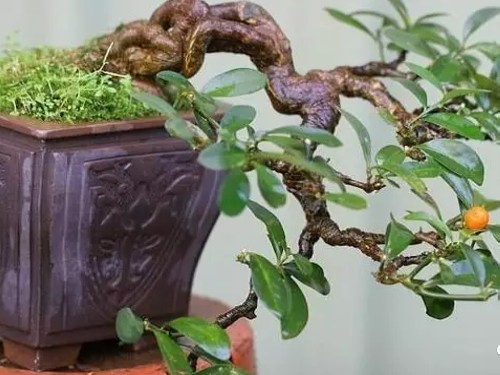
Fortunella hindsii and kumquat both belong to the Rutaceae family. Fortunella hindsii is the variety that bears the smallest fruit among Rutaceae plants. It originated in the Taizhou area of Zhejiang and is a wild shrub. Fortunella hindsii is highly vigorous by nature, preferring slightly acidic soil, sunlight, and a warm, humid environment. It is easy to cultivate anywhere south of the Yangtze River. The Fortunella hindsii plant is short and small, making it suitable for bonsai. Its flowers are fragrant, it bears abundant fruit, and the fruiting period is long. The fruit is dark green in the early stage, turns yellow over winter, and then turns orange-red. Its leaves remain evergreen through winter. During the New Year and Spring Festival, with red fruit and green leaves, it is very beautiful and is an excellent fruit-viewing plant for winter.
The fruit of Fortunella hindsii is golden yellow and delicately fragrant, and it remains on the plant for a long time, making it an excellent fruit-viewing flowering plant. It is suitable both as a potted plant for viewing and as a bonsai, and its taste is sweet and sour and pleasant, with various nutritional values. Potted kumquat stays evergreen through all four seasons, with luxuriant branches and leaves and a graceful tree form. It blooms in summer, with jade-white flowers whose fragrance carries far. In autumn and winter, the ripe fruit is either yellow or red, set off among the green leaves, truly like green leaves and golden pellets, lush and flourishing, with extremely high ornamental value.
I. Material Selection and Propagation Measures
1. Artificial Propagation
Cuttage, grafting, and other methods can be used. Cuttage is best carried out from late May to late June. For the cuttings, select fully developed branches from the previous year, or use current-year semi-lignified tender branches with shorter internodes. The cuttings should be about 10 cm long. Remove the branches and leaves at the lower end, keep two leaves at the upper end, and cut each in half. Insert them into the soil to a depth of about 23, firm the surrounding soil, water thoroughly, and thereafter just keep the soil moist. After insertion, a shade frame must be built promptly, and misting should be done frequently. Roots will develop after about 30 days. After that, careful maintenance and management are still required, and transplantation to cultivate larger seedlings can be done after the weather warms in the following spring.
Grafting can be carried out from early April to early May, mostly using cut grafting or cleft grafting. If bud grafting is used, it can be done from June to September. Rootstocks are mostly seedlings of the trifoliate orange type, and bergamot, lemon, and trifoliate orange can also be used. Cultivation method for potted Fortunella hindsii that is grafted and bears fruit in the same year:
Use rooted cuttings of bergamot or lemon, maintain them vigorously, and from May to August, when the branches are semi-lignified, graft by the cleft method. The scion should use current-year semi-lignified robust branches. After grafting, cover with a bag for maintenance, and remove the bag after about 1 week. After the graft takes, keep 1 vigorous branch, cut off the remaining grafted branches, and remove rootstock shoots at any time. After 20 days, remove the tying string and strengthen fertilizer and water management. Fertilization should mainly use phosphorus and potassium fertilizers, applied once every 10 days. Pay attention to water restriction and increase light. With proper maintenance, it can bloom and bear fruit in the same year.
II. Potting Process
1. Potting Time
It is best carried out in April in spring. When the rough stock has produced new branches and leaves, it can be potted as early as the second half of the same year. If time permits, generally more than 2 years of maintenance are needed. For later repotting, the most suitable time is after Qingming (April 5), and another more suitable time is late August to early September.
2. Choosing the Pot
For Fortunella hindsii, a medium-deep purple clay pottery pot is suitable, and a glazed pottery pot can also be used. A relatively shallow pot should not be used. The pot shape may be square, rectangular, or round. The pot color is best chosen as begonia red or deep sunflower yellow, to set off the green leaves and golden fruit and enhance the ornamental effect.
3. Potting Soil Preparation
The soil should be somewhat fertile, and some cake fertilizer and leaf mold can be added appropriately. For Fortunella hindsii, acidic sandy loam with good water permeability is most suitable for growth. For potting, weathered pond mud or garden soil is mostly mixed with sandy soil.
4. Potting Method
Fortunella hindsii can be potted with original soil or bare-rooted. When planting, arrange the root system so that the fibrous roots spread out in the potting soil, appropriately prune old roots, and place crushed bone, rapeseed cake, bone meal, etc. at the bottom of the pot as base fertilizer. When potting bare-rooted, overly long thick roots can be appropriately shortened to help promote new roots.
5. Post-Planting Management:
(1) Water and Weed Management
Water management is the same as for common flowering plants: water when dry and let dry between waterings, alternate dry and wet. Fortunella hindsii bonsai can easily die if the water is too dry. Weeds need to be pulled by hand; try not to use herbicides. Even a slightly higher concentration of herbicide can cause the death of Fortunella hindsii.
(2) Fertilizer Management
Newly potted plants must not be fertilized. Generally, if the potting soil is fertile, no additional topdressing is needed. If the potting soil has poor fertility, a small amount of quick-acting compound fertilizer may be lightly applied as appropriate. Generally, a flower pot with a pot diameter of 25 cm can have more than 10 granules of compound fertilizer broadcast on the surface. The topdressing time is before Fortunella hindsii sprouts, preferably around Qingming. Fortunella hindsii sprouts above 25°C, generally sending out new buds in early May. The number of topdressings should preferably be 1.
III. Shaping Techniques
1. Processing
Fortunella hindsii is mostly processed by pruning, and wiring is generally rarely used. Only the trunk and large branches need to be wired appropriately; the rest can be pruned. Processing and pruning are best carried out in rainy weather in April in spring.
2. Tree Form
The styling of Fortunella hindsii should win by simplicity and must not be overly complicated. The main tree forms include the straight-trunk style and the slanting-trunk style.
It is generally pruned into a natural large-tree shape or a semicircular spherical shape.
IV. Maintenance and Management
1. Placement Location
Fortunella hindsii loves light and should be placed in a sunny, warm, and ventilated place. In summer, it should be appropriately shaded and must not be exposed to scorching sun. The placement location should preferably be fixed and should not be moved often. During the full-bloom period, care should be taken to avoid rain, and in winter it should be moved indoors to overwinter to prevent cold damage.
2. Watering
Usually keep the potting soil moist. During the spring growth period, water frequently. During the high-temperature period in summer, the "water restriction" method can be used to suppress the growth of summer shoots and promote flower bud differentiation.
3. Fertilization
Fortunella hindsii likes fertilizer, and it is best to apply thin fertilizer frequently. Fertilizers should mainly be phosphorus and potassium fertilizers, such as chicken or duck manure or fishy water, applied once every 7 to 10 days. During the plum rain season, some cake fertilizer crumbs can be broadcast on the pot surface. During the flowering period, apply little or no fertilizer, and after the fruit has set firmly, apply 2 more light fertilizer applications.
4. Pruning
It is generally carried out in early spring from February to March. Mainly prune dead and weak branches, overlapping branches, crossing branches, and diseased and pest-infested branches. According to the tree form, the principle of strong branches lightly pruned and weak branches heavily pruned can be adopted, and the main branches should be shortened. Generally, keep 4 to 5 buds on thick and strong branches and 2 to 3 buds on thin and weak branches, and cut off the rest. After new shoots sprout, overly dense branches and tender branches that disrupt the tree form should be removed early.
5. Repotting
Fortunella hindsii can be repotted once every 2 to 3 years, preferably from March to April in spring. When repotting, 12 of the old soil can be removed and replaced with loose and fertile cultivation soil, and at the same time some rotten roots and old roots should be cut off.
6. Pest and Disease Control
The main disease of Fortunella hindsii is black mold, for which Bordeaux mixture can be sprayed or 5% alcohol can be used to wipe the mold stains clean. The main pest is scale insects, for which 40% omethoate 1000-times solution can be sprayed, or the insects can be removed with a small brush or knife.