How to make a fringetree-grafted osmanthus bonsai
Fringetree, also known as April snow or shredded radish flower, blooms in early summer every year, with the whole tree covered in white flowers, as if covered with frost and snow. The fringetree flower is pure white and flawless, like a fairy who does not eat the food of the mortal world, transcendent and beyond the dust. The flower shape is elegant, like the tassels on the clothing of ancient ladies, hence the name, extremely beautiful, both graceful and holy!
Fringetree is a precious ornamental greening tree species unique to China, and is also a good material for making bonsai. Because when the small flowers of the fringetree are in bud, their shape, size and color are all similar to glutinous rice, and the flowers and tender leaves can also be used to make tea, so it is also called glutinous rice flower and glutinous rice tea. Fringetree is a national second-class protected plant; in early summer the whole tree is covered in white flowers, as if covered with frost and snow, clear and pleasant, suitable for planting around buildings, or beside ponds and along roadsides in parks. It can be potted and made into stump bonsai, and is the best rootstock for grafting osmanthus.
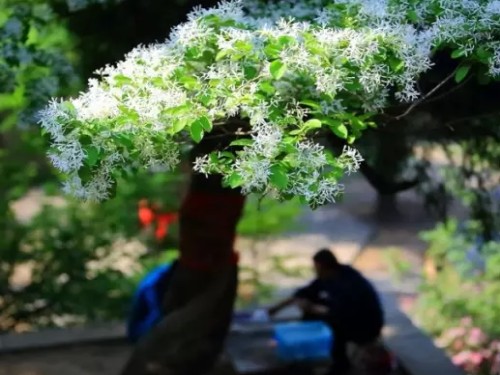
Osmanthus approach grafting is done using fringetree. Choosing fringetree for grafting has the following advantages:
Good affinity: the ancient osmanthus trees in royal gardens such as the Forbidden City and the Summer Palace were all grafted onto fringetree; strong cold resistance, which can effectively solve the problem of growing southern osmanthus in the north; good ornamental value: fringetree, having endured rain, snow, wind and frost for many years in deep mountains and old forests, is itself a scenic sight, and when matched with various fine osmanthus varieties, the effect is good whether for fragrance or for scenery! The following are the specific grafting methods.
1. Select a well-grown fringetree mother plant and scion.
Scion (this scion is 3 cm in diameter), fringetree mother plant (generally not grafted in the year it is collected from the wild)
2. Select a suitable position and cut a groove
3. Process the scion (the cut surface must be smooth, and must not go deep into the pith.)
4. Prepare for tying at the ideal position (the cambium of the scion and the mother plant must be aligned and pressed close.)
5. Tying (it is best to wrap with leaves before tying.)
Inlay approach method—— after healing, the appearance is better and the joining ability is strong.