How do you make a bonsai by grafting sweet osmanthus onto Chinese ash?
Sweet osmanthus has dense branches and lush leaves, stays evergreen all year round, has gnarled roots and an elegant posture, bright flowers and fruit, and a rich fragrance; it also combines biological traits such as strong sprouting ability, tolerance of pruning, and a long lifespan, making it an excellent tree species for making tree bonsai. The process of making sweet osmanthus bonsai is intricate, learning from nature, and wonderfully subtle; high-level bonsai benefit from the bonsai artists' profound artistic conception and skilled techniques.
Principles for making sweet osmanthus bonsai: the conception and composition should be profound; learning from nature should be genuine; enhance strengths and avoid weaknesses to build momentum; combine movement and stillness for agility; unify and harmonize for visual appeal; see the large within the small for insight; density should be appropriate and fitting; primary and secondary should be distinct and eye-catching.
In the north, it is relatively difficult to create and cultivate medium to large sweet osmanthus bonsai. In recent years, some flower enthusiasts have used Chinese ash stumps grafted with sweet osmanthus to make bonsai that are very popular among bonsai lovers. Although Chinese ash and sweet osmanthus are not in the same genus, they are in the same family, and the two can be grafted to produce medium to large sweet osmanthus bonsai. The method for making sweet osmanthus bonsai by grafting onto Chinese ash is now introduced for the reference of bonsai enthusiasts.
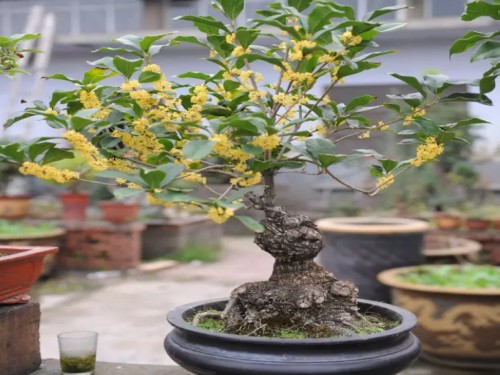
1. Obtaining and cultivating Chinese ash
Chinese ash belongs to the genus Fraxinus in the family Oleaceae. It is a deciduous tree and is widely planted in China. It likes sunlight and tolerates slight shade. It can be propagated by sowing seeds, and also by cuttings, division, and layering. Chinese ash has strong sprouting ability, a high survival rate, and fast growth, making it a good material for making grafted sweet osmanthus bonsai. You can use discarded Chinese ash stumps, or buy Chinese ash stumps suitable for making bonsai from a nursery, cultivate and shape them, and then graft sweet osmanthus onto them.
The selection of Chinese ash stump material is the same as for other bonsai stump material: choose stumps with good form and vigorous growth that are suitable for making bonsai. After the stump is dug up, cut off the large roots, keep the fibrous roots, retain the needed branches and trunks according to the requirements of bonsai shaping, and remove the excess branches and trunks. Depending on the condition of the stump, plant it in the ground for 1-2 years, then pot it and graft. If the stump has a good root system and the branches and trunks are of suitable thickness and length, it can be potted and grafted in the same year it is dug up. The time for digging and potting is after leaf fall in early winter and before the sap flows in Chinese ash and sweet osmanthus in spring.
2. Grafting
The grafting methods used are approach grafting and cleft grafting. In North China, approach grafting can be carried out from May to August, and the best time is from before the dog days to the third dog days, with outdoor maintenance; it generally succeeds in a little over two months. Cleft grafting is carried out in late March when Chinese ash and sweet osmanthus begin to sprout; after grafting, place it in a sunny shed to prevent wind from causing water loss. After grafting, the Chinese ash stump will grow new shoots, which should be cut off promptly to prevent nutrient consumption. If the scion is found to have died, cut off the dead scion promptly, cultivate new Chinese ash branches, and after cultivation, grafting can be done again. The cleft grafting method has a higher survival rate and better growth than the approach grafting method. For sweet osmanthus scions, choose varieties with short branches and close leaf spacing, so that the sweet osmanthus branches are compact. If sweet osmanthus branches with long leaf spacing are used, after the graft survives and grows a certain number of branches, pinch the tips promptly to control the height.
Small-leaf privet, glossy privet, small-leaf ash, and others can be used as rootstock. Before sprouting in spring, cut them off 5 cm above the ground and then graft by cleft grafting. In northern regions, potted sweet osmanthus can be propagated by approach grafting in summer. In early spring, first pot the small-leaf privet, then approach graft it with branches of similar thickness on the sweet osmanthus tree. After it survives, cut the scion away from the mother plant, and at the same time cut off the branches above the rootstock graft union. Air layering is carried out before buds sprout in spring; select 2-3-year-old branches, girdle them, and wrap them with moisture-retaining materials such as moss for propagation.
3. Care and management
Chinese ash and sweet osmanthus have somewhat different habits, and both must be taken into account in care and management, especially winter management; a slight mistake can undo all the previous work. There are two main problems in winter management: first, ensuring temperature; second, preventing wind. Sweet osmanthus bonsai grafted onto Chinese ash should be placed in winter in a sunny shed with a temperature not lower than 0°C, so that the grafted sweet osmanthus is not damaged by freezing or wind and can overwinter safely, but the temperature must not be too high, as too high a temperature will prevent the Chinese ash stump and sweet osmanthus branches from entering dormancy. In spring, do not move it out of the shed too early; if too early, wind and dry air will affect the sweet osmanthus branches, especially the graft union. A gradual method can be used to open the shed until it is fully opened.
Potted sweet osmanthus should be repotted in the autumn of the second year, and a clay jar or a clay pot one size larger is suitable. When repotting, do not damage the roots when lifting the plant, remove part of the old soil, replace it with new growing medium, and add a small amount of base fertilizer. When planting, make sure the root system spreads out in the pot and is not bunched in one place. After planting, shake the pot to make the growing medium closely contact the root system, then water thoroughly once. At Frost's Descent, place the pot indoors. In the early stage after potting and repotting, do not water too much, to prevent root rot. The indoor temperature should be kept at 5-10°C; too high a temperature is not conducive to winter dormancy and will produce leaf buds and weak branches, affecting normal growth and development after spring; if the temperature is too low, it is prone to freezing damage.
Precautions:
1. Sweet osmanthus likes slightly acidic soil
For potting, you can use a mix of 5 parts mountain soil, 3 parts humus soil, and 2 parts sandy soil, or use half leaf mold and half sandy loam as the growing medium. If the soil is too acidic, growth will be slow and the leaves will wither and turn yellow. If alkaline soil is used, after 2-3 months the leaves can wither and even the plant can die.
2. Water at the right time
For watering sweet osmanthus, master "two less, one more," namely: water less before new shoots appear, water less on cloudy and rainy days, and water more during dry weather in summer and autumn. Usually, watering should keep the pot soil at about 50% moisture content. On cloudy and rainy days, drain promptly to prevent water accumulation in the pot from causing root rot; otherwise, it is easy for the plant to be "drowned."
3. Apply topdressing skillfully
Sweet osmanthus likes pig manure. There is a flower proverb: "If you want sweet osmanthus fragrance, prepare more pig manure vats." If, after the sweet osmanthus is moved outdoors in early spring, you apply decomposed dilute pig manure liquid, about once every 10-15 days from April to May, once every 7-10 days from June to July, and the last application in early August, then the sweet osmanthus will grow luxuriantly, bloom abundantly, and smell fragrant. In cities where there is no pig manure, decomposed cake fertilizer liquid can be used. If fertilizer is insufficient, there will be fewer branches, fewer flowers, and no fragrance.
4. Prune appropriately
A mature sweet osmanthus tree sends out new shoots twice a year. Therefore, to make sweet osmanthus bloom abundantly and grow lush, appropriate pruning is needed. Generally, water sprouts, thin and weak branches, and diseased and pest-infested branches should be cut off to improve ventilation and light penetration and concentrate nutrients, encouraging the sweet osmanthus to form more flower buds and bloom abundantly.