How to make a Chinese pine bonsai? Detailed production method shared
The Chinese pine is tall and vigorous, evergreen all year round, long-lived, and unafraid of wind, snow and severe cold. People regard it as a symbol of unyielding integrity and longevity. Its forms are endlessly varied, becoming more fantastic with age, making it an ideal material for bonsai. After the Chinese pine is planted, water it twice within one week; afterwards you may loosen the soil and preserve moisture, and water once more in early May. After that, do not water unless the weather is dry; in June apply fertilizer once, and in August apply ferrous sulfate once. Apply by digging pits at the edge of the plant. For loosening soil and hoeing weeds, do it once every 20 days, and it must be done carefully and thoroughly, generally to a depth of 4 to 5 cm, with even hoeing, loose soil free of clods, and weeds completely hoed and picked clean.
1. Digging up the tree stump:
Shandong Province has many hills and mountains, and the Chinese pine is widely distributed there. Mount Tai, Mount Lao, Mount Culai and others all have very ideal pine stump material. The "old man trees" in forest areas that cannot become timber, or tree stumps damaged by animals or people, are short in stature, with dense branches, shortened internodes and smaller needles, and graceful in form; they can be dug up in spring or early winter during the tree's dormant stage. The Chinese pine has a well-developed root system, and both vertical roots and horizontal roots grow very well. When digging, follow the principle of "cut the main root and preserve the lateral roots and fibrous roots; cut the vertical roots and preserve the horizontal roots", using a sharp knife to first cut away excess roots so that the size and length of the root system match the size of the pot. The crown can be roughly processed on site, and branches that do not affect the composition should be cut off or shortened. The Chinese pine should be transplanted with a soil ball; in places such as cliffs and ridges where a soil ball cannot be taken, it can be wrapped in cattail bags after being coated with mud slurry.
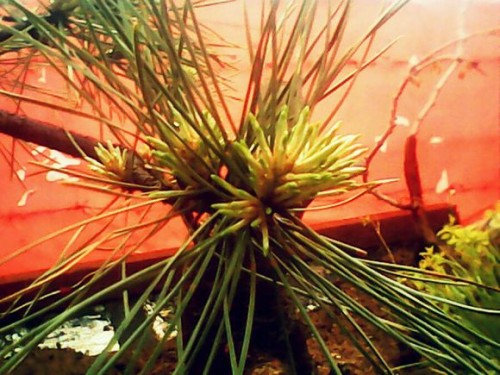
2. Examining the tree and determining the style:
Base this on the form of the main trunk, and observe repeatedly from the base, roots, main trunk, secondary trunk and side branches, front and back, left and right, above and below, carefully examining it, conceiving the shape of the stump bonsai, and determining which branches need to be retained and which need to be transformed. You may also draw a sketch and design the various possible patterns. For example, if one base divides into two main trunks, or if two plants can be planted in combination, a double-trunk style stump can be created, requiring the two main trunks to have a clear primary-secondary relationship, with the main leading the secondary and the secondary setting off the main. If the pine trunk droops and extends outward in a swooping posture, possessing a soaring, suspended charm, a cascade style stump can be cultivated; if the trunk is upright and the tiers are distinct, a formal upright style can be cultivated; if the main trunk leans to one side and the crown forms a posture of twisting branches stretching across the sky, a slanting style can be cultivated.
3. Pruning and shaping:
After determining the stump's styling, according to the design requirements, take an overall view and make coordinated arrangements. Following the principle of first pruning the main branches and then the branch twigs, first rough-pruning to set the shape and then fine-pruning, trimming and wiring, determine from the spatial structure which branches should be kept, and then cut off all the remaining branches. Generally, first remove useless miscellaneous branches and leaves to expose the branches and trunk, so as to facilitate a comprehensive observation of the tree's vigor. Parallel branches, inner-canopy branches, water sprouts, duplicate branches, tillering branches and diseased or damaged branches should be cut off from the base; for stiff, straight branches in better positions, they can be shortened at the branching point to make them send out new shoots again. The retention of side branches should take all directions into account. With the main trunk as the center, retain good branches so that it has an open, sparse posture and forms a natural shape. At the same time, also consider the room for future growth and development.
4. Processing and shaping:
Shaping and pruning is a necessary management technique aimed at ensuring the Chinese pine's tree form is graceful, uniform and consistent, grows well, and does not affect the construction of urban public facilities and people's lives. Which measures to take should be determined according to the specific purposes such as the greening site, location, occupied space and artistic styling. Generally, it is inseparable from removing redundant branches and diseased or pest-infested branches, and thinning out vigorously growing branches whose growth direction is unsuitable. For the Chinese pine's pagoda-shaped tree form, it is generally appropriate to properly ensure that the apical dominance of the central leader is relatively low, and for shaping craft-type branches, techniques such as branch pulling and pinching should also be applied.
Stump bonsai must be artificially shaped on a natural basis, to highlight its characteristics more intensively and enhance its ornamental value.
(1) Thin out overly dense branches;
(2) Cut back overly long branches;
(3) Fill in missing branches on a lopsided crown.
In the management of the Chinese pine, attention should be paid to shaping and trunk replacement. During the growth of the Chinese pine, some heavy branches may cause the leader to be damaged or weakened; a strong side branch must be pulled up and tied well to later become the central dominant one. This process is trunk replacement.
5. Fertilizer and water management
This is an important measure to ensure the normal growth of the plant and resistance to pests and diseases. In the 1a after transplanting and survival, water once every 2 months on average during the growing season. When fertilizing, for plants below 3.5m in height, use tray feeding, fertilizing 2 to 3 times in 1a, with feeding after the soil thaws in early spring, during the spring shoot rapid growth period and during the autumn shoot growth period being better; for plants above 3.5m in height, this fertilizing method can be used within 1 to 2a after survival, after which foliar topdressing is more suitable. The fertilizing tool can be a motorized sprayer, and spraying once a month during the growing season is sufficient.
6. Pest and disease control
For the pest and disease control of greening Chinese pines, the principle of "timely discovery, active prevention and control, and controlling it while small and finishing it off" should be followed. After pests and diseases are found during the growing season, pesticide control should be organized promptly. In winter, the trunk should be whitewashed or sprayed with lime-sulfur mixture to eliminate insect eggs and pupae on the trunk.