Detailed guide to the quick method for making peach tree bonsai, quickly master the key techniques of creation
A pot of peach tree bonsai with red flowers blooming in competition welcomes spring and blooms, red as fragrant beads, brilliant as rosy clouds, adorning the home, conveying the meaning of spring. Give it to leaders, give it to bosses, wishing them great prospects; give it to elders, give it to seniors, wishing them health and longevity; give it to young men, give it to young women, wishing them a bountiful harvest of love; give it to relatives, give it to friends, wishing them constant good luck.
The peach has always been very popular in China. Besides the peaches being very delicious, in fact the gum secreted from the peach tree trunk, commonly known as peach gum, can also be used as an adhesive and so on. Peach blossoms are also one of the commonly used colorful nursery plants, with a very good beautifying effect, and are also a relatively common variety among the plants placed indoors in homes today. Below, let us introduce the quick method for making peach tree bonsai.
I. Variety selection
Bonsai peaches are mainly grown for ornamental purposes, mainly selecting excellent late-maturing varieties that bear fruit early, are easy to flower, have large fruit, and good quality, such as Zhonghua Shoutao, Yangtun Jutao, Xinchuan Zhongdao, Zhongtao No. 21, Ruipan No. 4 and other varieties. There are many varieties of peach, and when growing in pots one should choose varieties with large fruit, good color, small tree body, good natural form, late maturity, and a long ornamental period. Common ones include Shouxing Tao, flat peach (Pan Tao) and snow peach (Xue Tao), etc. Peach tree bonsai seedlings are usually obtained through grafting. Generally, rootstocks mostly use mountain peach (Shan Tao), wild peach (Mao Tao) and Nanking cherry (Mao Yingtao), etc.
II. Flower pot selection
Generally choose a clay pot with a diameter of 30 cm and a height of 25 cm, because clay pots are loose and porous in texture, easy to drain excess water from the pot and allow air circulation, suitable for root development, and are cheap, light, and convenient to use.
III. Potting soil preparation
The nutrient soil must not only be rich in nutrients but also have good air permeability. There are generally two preparation methods. One method is 4 parts garden soil, 4 parts humus soil, 2 parts cinder and sand; this nutrient soil is suitable for newly transplanted small seedlings. The other method is 6 parts garden soil, 2 parts humus soil, 2 parts cinder; this formula is mostly suitable for cultivating mature seedlings.
IV. Potting and planting
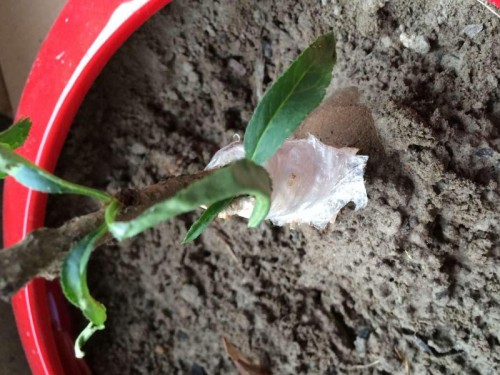
The peach has a very strong sprouting ability. Generally, a one-year-old small seedling potted will bloom in the same year. In the second year it can bear fruit for ornamentation. For the pot, one can choose a plain glazed pot, a purple clay pot, or a wooden pot, etc. The potting soil should preferably be loose, breathable, and slightly acidic or slightly alkaline soil with a pH value of 4.5-7.5.
1. Planting time: Potting should be done after sprouting in spring or after leaf fall in autumn. At this time the plant's growth is in a relatively slow state, with more stored nutrients; after potting it is easy to root and easy to survive.
2. Seedling selection: Choose seedlings with well-developed root systems, many fibrous roots, appropriate trunk thickness and trunk height, beautiful tree shape, uniform branching, and robust growth.
3. Potting method: First check whether the bottom of the flower pot is unobstructed, then use a broken pot piece with its convex side facing up to cover the hole, so as to avoid soil leakage or blockage. When planting, the roots should be spread out and in close contact with the soil. The planting depth should be just enough to cover the original soil surface of the seedling; the graft union should be exposed above the soil surface, and the potting soil should be filled to 80% to facilitate watering. After potting, water thoroughly.
V. Peach tree shaping: The tree shape should mainly be peculiar, novel, beautiful, and elegant, with exposed roots, dense branches, and a compact plant shape as the standard. There are generally three tree shapes, namely the straight-trunk style: a single main trunk, tall and upright, with distinct layers, evenly distributed fruit, giving a sense of towering stand; the curved-trunk style: the trunk curves upward in a zigzag shape, mostly with two layers, shaped like a swimming dragon; the slanting-trunk style: the main trunk is slanting, generally slightly curved, with the crown leaning to one side and tilting outside the pot, with a unique charm.
1. Understand the physiological characteristics of the peach
In North China, the flower bud differentiation period of potted peaches is approximately in early July. The flower buds are pure flower buds, growing in the leaf axils, and compared with leaf buds, they are larger in appearance. If it is a compound bud, that is, when two or more buds grow side by side, the middle one is a leaf bud and the two sides are flower buds. These leaf buds that sprout in the same year are called secondary branches or tertiary branches. Usually, the quality of flower buds on primary branches is good, followed by secondary and tertiary branches. Only by mastering these characteristics well can one effectively preserve flowers and fruit.
2. Training and pruning
Training and pruning includes winter pruning, summer pruning, and flower and fruit thinning, etc. The main purpose of winter pruning is to maintain the tree shape, prevent it from becoming too sparse or developing too large, and determine the fruiting branches; the pruning amount often reaches more than half. Commonly used techniques include thinning, removal, and heading. The purpose of summer pruning is to prevent excessive growth and promote flower bud differentiation. Common methods include bud removal (removing competing branches and buds, latent buds, and one of the double buds sprouting at a node), pinching (suitable for vigorous trees and vigorous branches, and can be carried out multiple times depending on their growth), bending and twisting shoots (suitable for strong and vigorous upright branches), ring cutting, and root pruning. Flower and fruit thinning is mainly aimed at overly dense flowers and fruits. Potted peaches have a very large number of flowers; if flower and fruit thinning is not carried out, it will cause excessive nutrient consumption, weaken the tree vigor, cause flower and fruit drop, and even result in flowers but no fruit.