Detailed Guide to Making a Winter Red Fruit Bonsai
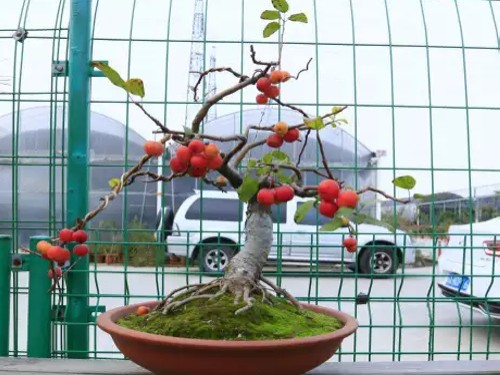
Winter red fruit, also known as longevity fruit, is a deciduous shrub or small tree of the genus Malus in the rose family (Rosaceae). Its branches are grayish-brown, with alternate single leaves that are oval to broadly oval, green, and have rounded blunt serrations along the edges. The inflorescence is a corymb, with light pink flowers that bloom in March-April. The fruit is oval-spherical, initially green, later gradually turning yellow, and bright red when mature, with a single fruit weighing 10-20g. The skin is smooth, the fruit is brightly colored, crystal-clear and petite, and the fruit-viewing period is long. The whole plant is laden with fruit that does not drop through winter, and it is easy to shape, making it an excellent plant material for making fruit tree bonsai.
For propagating winter red fruit, seedlings of apple, Siberian crabapple (Malus baccata), or crabapple can be used as rootstock, with plump buds from slightly above the middle used as scions. Bud grafting is carried out from early August to late September, or branch grafting can be done in March-April of the following year. The grafting site should not be high, generally 4-6cm above the ground.
In the spring of the year following grafting, promptly cut back the rootstock and remove rootstock shoots, strengthen nursery management, and promote vigorous growth of the scions. During winter pruning, leave stubs of 6-10cm; the following year, increase the plant spacing or replant, and cultivate side branches according to the shaping design to complete the basic form.
At this point, the timing for potting should be decided according to the cultivation direction of the bonsai. If cultivating mini or small bonsai, potting can be done earlier; if a medium or large bonsai needs to be cultivated quickly, the potting year should be delayed, and dwarfing control and shaping cultivation should continue in the field.
For winter red fruit used to make bonsai, seedlings of crabapple, Siberian crabapple (Malus baccata), or apple tree stumps that have grown for many years, are short in stature, and have peculiar and ancient shapes can be used as rootstock, with full branches or plump buds from slightly above the middle used as scions, grafted by cleft grafting, cut grafting, or bud grafting.
Transplanting of the rootstock is generally carried out after leaf drop in late autumn and early winter, or before sprouting in spring. First plant it in a clay pot or in the ground to "nurture the stock"; in the first year after it survives, let it grow freely so that its root system develops fully and its branches become full. Wait until the second year to graft, and cut off excess branches on the rootstock to ensure sufficient nutrients for the scion to grow.
If the rootstock is a tree-type apple tree, the roots can also be raised above the soil surface in stages when repotting as needed, making the roots exposed and claw-like for greater ornamental value. Because the leaves of winter red fruit are relatively large, the crown mostly adopts a natural-style shape, and attention should be paid to ventilation and light penetration in the inner canopy so that the fruit grows normally.
Winter red fruit can be made into different forms of bonsai according to the shape of the tree stump, such as upright trunk style, slanting trunk style, cascade style, root-on-rock style, forest style, and water-and-land style. Its branches are soft and can be trained and bent into any shape; this method is especially suitable for young trees newly potted. For tree stumps lacking an aged and ancient appearance, techniques such as carving and splitting can also be used to process the trunk to make it more perfect.