What are the techniques for making pine and cypress bonsai?
Shandong is one of the birthplaces of ancient Chinese culture. On Mount Tai, the first of the Five Great Mountains, there are ancient pines of every conceivable form at Duisongshan and Houshiwu; in the ancient temple of Zhongjunzhang on Mount Culai there are ancient pines several hundred years old; at the Dai Temple in Tai'an there are Han-dynasty cypresses known as "ancient cypresses braving the cold"; and at Lingyan Temple and the Confucius Forest in Qufu there are even more ancient cypresses with old trunks and gnarled branches that have weathered countless vicissitudes. In these places, the Guest-Welcoming Pine spreads lush and canopy-like, the Sister Pines tower rugged and vigorous, the withered-top pines look old and imposing, and there are also the "flag pines" with multiple trunks from a single root and a twisted, wind-defying, sun-seeking bias, while the pine forests on the cliff tops and mountain summits are lush and verdant, majestic and upright.
Because the foliage of cypress differs from that of pine, its layers should not be too distinctly defined when styling. Cypress wood resists decay, so dead branches and dead trunks can be created; dead trunks can be made by the peeling method, and dead branches can be shaped from live branches and then peeled after the form is set. Cypress bonsai mostly use Chinese arborvitae (Platycladus orientalis), but the branches and foliage of Chinese arborvitae are coarse and tangled, the styling is generally monotonous, and once formed it gives a cluttered impression that reduces its ornamental value; this is its shortcoming. The branches and trunk of Chinese arborvitae are aged and highly variable, and the large branches are easy to shape; this is its strength. In creating Chinese arborvitae bonsai, if one can maximize the strengths and avoid the weaknesses and return to plain, unadorned authenticity, using the natural forms of the ancient cypresses of Qufu and Lingyan Temple as blueprints, and emphasize the aged trunk; and in developing the main branches and secondary branches adopt a scattered-flake style so that the proportions of trunk and branches are harmonious, twisted and varied, and the amount of messy twigs and foliage is reduced, then the drawback of coarse foliage can be overcome and the ornamental value of Chinese arborvitae raised.
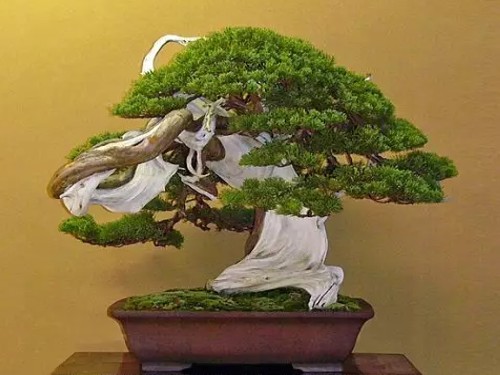
When styling pine and cypress bonsai, based on the characteristics of the above cultural landscapes and combined with the thick, dwarfed character of Shandong's mountain pines and cypresses, the old trunks and thick branches are thinned and pruned to lower the trunk and reduce the crown; then the method of coarse wiring and fine adjustment is adopted, guiding according to the tree's tendency so that the crown follows its natural form and the layers connect and interlock. Between each large layer there are also small variations, giving both an overall sense and an absence of clutter, preserving the beauty of natural formation, and making full use of dwarfed wild stump resources: black pine stumps are used with grafting techniques such as high-branch side grafting and bud grafting to change the crown into five-needle pine. The abundant Chinese arborvitae stump resources are used with * grafting to change the crown into dragon cypress, emerald cypress and other cypress bonsai, forming the distinctive Shandong pine and cypress bonsai style.
When digging stumps in the mountains and wilds, choose ones with thick, evenly distributed surface roots and a trunk with a certain degree of curvature and variation, and with branch thickness, especially the thickness of the main branches, in harmony with the thickness of the trunk. When digging up a wild stump, do not transplant it with the roots spread apart; when planting, it is best to use the original mountain soil. After planting, place it in a ventilated, sunny spot, frequently spray water on the foliage, and water again only when the surface of the pot soil is slightly dry. New pine stumps must not be fertilized in the same year.
On the basis of the original techniques, the strengths of other places are also absorbed: the metal-wire binding and shaping method is used, choosing metal wire of a thickness corresponding to the thickness of the branch, and branches in improper angular positions are wound, twisted and hung to conform to the needs of shaping. Before shaping, repeatedly examine the tree's vigor, and guide according to its tendency in view of the straightness or curvature of the trunk and the positions of the main branches; the concept must come first, and shaping can proceed from bottom to top in sequence. The vertical planes between layers must not overlap too much, so as to favor growth and light penetration; otherwise, over a long time, the shaded parts will naturally die off and the situation will become uncontrollable.
Pines and cypresses in natural mountain settings and famous temples have generally passed their prime age, that is, they stop growing taller. The lateral growth of branches increases, branches grow densely and extend in length, and because of weight and rain and snow the branches droop, while the small twigs on the branches grow sideways. Therefore when shaping, upright branches and branches should be kept at a horizontal or drooping angle, the size of the angle depending on what is needed, and branches may have lateral curvature. If the branches at the top can droop, the tree appears even more aged. Because of styling, it is not excluded that lower branches and upward-growing branches coexist, but this must conform to the patterns of growth in the natural environment.
The lengths of the upper and lower branches are generally long below and short above; viewed from the front for appreciation, the front branches are short and the rear branches long, and the trunk and main branches should be revealed. The proportions of the lowest main branch on the trunk should be harmonious.
For trunks and thick branches that are difficult to bend with metal wire and the hanging-binding method, the finger interlocking method, successfully tested over many years, can be used to bend them. If it is a large thick branch, a knife can be used to cut deeply into the upper side of the part to be bent, to a depth of half the diameter, with the length depending on what is needed. Cut several such slits, and cut one of every other one horizontally at its top, while the other end is the opposite. If force is used to bend it, the horizontally cut ends will tilt up, just like two hands interlocking diagonally. After the main branch or trunk is fixed in place, the tilted-up parts can be embedded into the grooves and wrapped with adhesive tape, and after two or three years they will have healed well.
Cypress is native to China and is a temperate tree species. It likes light but has a certain tolerance for shade. It likes warm, humid climates but also adapts to dry-cold and warm-humid conditions. It resists severe cold and can grow at -25 degrees; under cold conditions the leaves turn brown. It is not demanding about soil and can grow under acidic, neutral and alkaline conditions. Its salt resistance is very strong, and it can grow in soil with a salt content of up to 0.2%. It tolerates drought and poor soil and can also grow in mountain rock crevices. But it also has a certain tolerance for moisture. Its root system is well developed with many fibrous roots, and it tolerates transplanting. It is long-lived and slow-growing; in places such as Mount Tai and Qufu there are many cypresses over two thousand years old. Cypress is mainly propagated by sowing. Seeds remain viable for about 2 years; they are generally collected in November, dried in the sun and stored, and must not be allowed to get damp. In spring the seeds are soaked and then sown, germinating after 2 weeks. The first leaves produced by cypress are needle-like, later scale-like leaves appear, and after 2 years all are scale-like. Growth is generally faster in the juvenile and young stages, medium to somewhat slow after maturity, and even slower in old trees.
How do you make a cypress bonsai? Making a cypress bonsai is divided into the following steps:
1. Material selection: There are two sources of cypress bonsai material. One is to use the sowing method, starting cultivation and shaping from the seedling stage. Since young seedlings tolerate transplanting and are easy to shape, they can gradually be worked and styled according to the design requirements. Although it takes a long time, the resulting bonsai is relatively ideal. The other method is to dig them up in the wild. In nature there are some old cypress stumps that, after years of wind and rain, lightning strikes and damage by animals or people, have formed grotesque shapes, some broken, some hollow, some with exposed roots, some with dead trunks; all of these are ideal material for making bonsai. Cypress has a well-developed root system, especially abundant fibrous roots; when digging, the main root can first be cut and the fibrous roots retained. The above-ground part should have the branches and trunk shortened, and the tangled branches and foliage clustered on the branches and trunk should be cut away, as well as long stalks and parallel branches, while taking care to retain dead trunks. Because cypress grows slowly, as many branches as possible should be retained. The best digging time is after early winter and before early spring, before growth has begun. When transplanting, take a soil ball to protect the roots. When a soil ball cannot be taken, do everything possible to keep the fibrous roots intact, and use measures such as spraying water and shading; pot it as soon as possible to reduce the time out of the soil. Bare-root transplanting can be done in the rainy season.
2. Assessing the tree and determining the style: Cypress does not fear severe cold; beaten by snow and frozen, it remains as green as ever, hence the praise of "pines and cypresses ever green." In making cypress bonsai, the characteristics of rugged uprightness and majestic grandeur are mostly emphasized. Some ancient cypresses have bark that has already split, or are hollow, yet still have luxuriant branches and foliage and undiminished majesty; such ancient cypresses can be made into the dead-trunk style. Some have naturally leaning trunks and mottled bark full of an aged, ancient air and can be made into the slanting-trunk style, and depending on the condition of the branches and trunk a single trunk or double trunk can be decided. Some ancient cypresses grow on cliffs, in mountain streams or in rock crevices, with the trunk bending greatly from the root crown, like a waterfall plunging straight down with magnificent momentum, and can be made into the cascade style. Some cypress stumps have branches and trunks coiling and twisting, bending left and turning right, like a roaming dragon, with a strange, natural form, and can be made into the reclining-trunk style or the coiled-trunk style. Some have root systems exposed or lifted, with old roots crisscrossing, and can be made into the exposed-root style bonsai. In short, one must follow the natural form of the cypress stump, go along with its tendency, capture its spirit, and highlight its inner character.
3. Pruning and fixing the form: Because cypress grows slowly, heavy pruning is generally not done; the method of mainly cultivating, combined with pruning and adjusting, is mostly used so that it has a natural bearing yet is not stiff or rigid. Ancient cypress stumps have the characteristic of spiraling and twisting, with a natural rhythm and a unique grace. Therefore, in styling cypress stumps, the spiral-binding method is not used; instead the trunk is made to form spiral vertical fissures, presenting elegant arc-shaped curves. Some stumps have branches, trunks and roots that are withered and eroded; one can guide according to the tendency, give form according to the category, and carry out appropriate hand carving to achieve an effect that follows nature yet surpasses it. Newly dug stumps have relatively tangled, long branches; for overly dense branches, retain the drooping ones and those on the lower part of the crown, suppress strong branches, make the trunk and side branches compact in structure and natural in distribution, and one may use the traditional binding and hanging-pulling techniques to work according to the patterns of natural growth.