Detailed steps for making a winter jasmine bonsai, beginners can learn it too
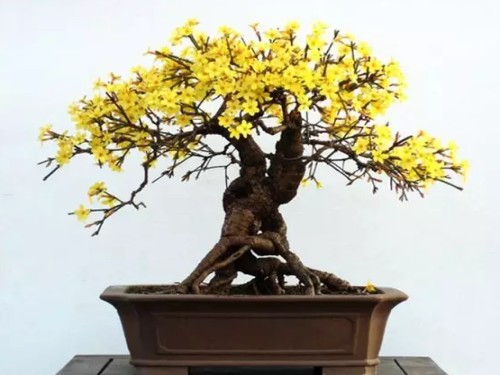
The branches of winter jasmine are thin and supple, with a well-developed root system and strong sprouting ability. It tolerates pruning well, with golden flowers and green calyxes, gorgeous and delightful, making it a good bonsai material. A winter jasmine bonsai has twisted branches and trunks, green trailing vines in the wind, golden flowers dazzling the eyes, full of antique charm. It is an excellent ornamental flower for late winter and early spring. Moreover, winter jasmine has strong branch sprouting ability and tolerates pruning, so it can be pruned and shaped regularly to keep it in the most perfect posture for all to admire.
Winter jasmine not only has dignified and beautiful flowers, but also has the fine quality of defying the cold. It is one of people's favorite plants. Next, let us take a look at the steps for making a winter jasmine bonsai!
1. Material selection
The materials for making a winter jasmine bonsai are mainly artificially cultivated plants and thick old stumps dug from the wild, because it tolerates pruning and has strong sprouting ability. When digging in the wild, the priority is to preserve the roots, keeping the root system as intact as possible, removing damaged and dead roots, straightening out the roots, planting them deep in a pot, and gradually carrying out root exposure.
2. Pot selection
Winter jasmine bonsai generally should use purple clay pottery pots or glazed pottery pots in medium-dark colors. The shape of the pot is determined according to the winter jasmine bonsai's styling. For a cascade-style winter jasmine bonsai, a deep cylindrical pot can be used; sometimes, to highlight the beauty of the roots, a shallow pot is also used. The pot color should be one that sets off the beauty of the winter jasmine's small yellow flowers, such as deep blue, light blue, jet black or purple-red.
3. Cultivation
After a period of cultivation, the root system develops normally, fibrous roots grow in the culture soil, and the plant has deep roots and lush leaves. At this point, the fine sandy soil can gradually be removed, so that the upper roots slowly become exposed. After another period of cultivation, the exposed roots have gradually aged, and the lateral roots are also relatively thick. At this point, the plant can be moved into a shallow pot. When transplanting, the root system must be fully protected, and the original culture soil should be kept. In this way, a winter jasmine bonsai with exposed hanging roots and claws, quaint and vigorous, can gradually be cultivated.
4. Watering
Winter jasmine likes moisture, especially in the hot summer. Besides watering once every morning, it should also be watered appropriately in the afternoon. To maintain the humidity of the small environment, water should often be sprayed on the ground. Winter jasmine is afraid of water accumulating in the pot. During the plum rain season, when rain continues for days, the pot should be laid on its side or moved to a place where it will not be rained on. In winter, when the temperature is low and water evaporation is small, it should be watered less.
5. Fertilizing
When planting a winter jasmine bonsai, a few pieces of animal hoof should be placed at the bottom of the pot as base fertilizer. During the growth period of winter jasmine, apply 1~2 times of decomposed dilute liquid fertilizer each month. July to August is the flower bud differentiation period of winter jasmine, so liquid fertilizer containing more phosphorus should be applied to facilitate the formation of flower buds. If, before the flowering period, one application of decomposed dilute organic liquid fertilizer is given, it can make the flower color more gorgeous and prolong the flowering period.
6. Pruning
The branches should be heavily pruned. Apart from the selected branches to be kept, all the other branches should be removed. After digging up the winter jasmine, cut off the branches, because too many branches will cause death when the roots are damaged, and if the branches are too short, the branches and buds are not easy to sprout. Plant it with one third of the roots exposed. After it survives, look at the winter jasmine's shape and prune appropriately. The growth of winter jasmine branches should be controlled; if too long, it will affect the handling of the overall shape. The retained branches should also be cut back. According to the growth characteristics of winter jasmine, it can be trained into a cascade-style or semi-cascade-style bonsai.
7. Styling
Winter jasmine branches droop naturally like willow branches, and the roots have distinctive features, so it is very suitable for processing into a weeping-branch style and exposed-root style. In daily bonsai making, the above two bonsai styles are often combined. The winter jasmine's roots are coiled and exposed, while the main trunk is made into a prostrate-trunk style or curved-trunk style, with small branches drooping and brushing, having a unique charm. A winter jasmine bonsai can be shaped once before flowering, and during the growth period it should be pinched often to promote thicker branches and more branching, which is beneficial for styling. Branches that affect the tree shape should be cut off in time to maintain the bonsai's beauty. After the shape is set, excess branches and leaves should be thinned every year to keep the tree shape unchanged.
8. Repotting
Winter jasmine generally should be repotted once every two years, preferably in spring or after leaf fall in autumn. When repotting, root pruning can be combined, cutting off dead roots and overly long roots to facilitate the development of fibrous roots. Bean cake crumbs can also be placed at the bottom of the pot as base fertilizer. For winter jasmine that needs root exposure, the roots can be appropriately lifted when planting, and soil can be mounded around the roots; later, as watering leaches the soil away, the roots will naturally become exposed.