Detailed Explanation and Key Points of the Art of Making Landscape Bonsai
To make a landscape bonsai, you must first carry out an artistic conception and determine the theme, then, according to the natural character of the rock, select all or part of the stone material suitable for shaping, and use plants and necessary accessories for artificial carving to configure a rockery. Natural scenery such as strange peaks and grotesque ridges, high gorges with flying mist, a hundred barriers and a thousand peaks, and secluded caves with wondrous views is condensed into a shallow basin and placed on a table, looking just like a three-dimensional landscape painting, making people feel as if they are before blue waves and green waters, among famous mountains and great rivers, full of delightful charm.
Landscape bonsai uses rocks as the main material. Through processing methods such as sawing and carving, as well as means such as laying moss and adding ornamental plants, it reproduces in a shallow water basin the great natural scenes of countless rugged peaks, hills and valleys with woods and springs, and rivers and lakes, making people feel as if they are before blue waves and green waters, among famous mountains and great rivers, and suddenly filled with delightful charm. So, let us first make a rockery.
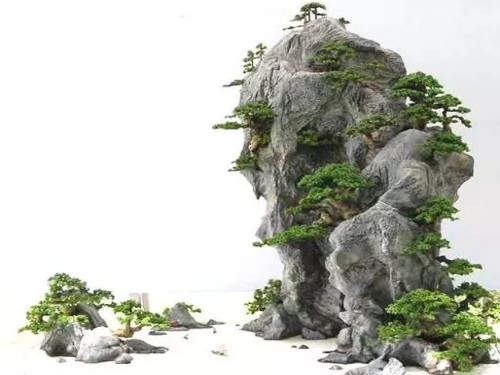
Preparatory work:
Tools: saw, chisel, pliers, hammer, embedding board, brush, etc.
Materials: shallow basin, rocks, cement, sand, etc.
Steps/methods:
1. Conception and design: Before making a rockery, you must have a clear plan in mind. You must determine what kind of bonsai you are making and what kind of bonsai shape it will be, otherwise you will not know where to start. According to the conception, initially arrange the shape of the mountain body in a sand tray. Note: the height and size of the rockery must be coordinated with the size ratio of the shallow basin.
2. Bonding and cementing the rockery: cementing the mountain body
The first step is to mix the cement mortar well. Note that the mortar should be mixed as it is used, and also pay attention to its consistency.
The second step is stone processing. Use tools such as a hammer, chisel, and saw to process the mountain body that needs to be cemented, creating textures and relatively unusual shapes.
The third step is bonding the mountain body. Apply cement mortar with an embedding board separately to both sides of the rocks that need to be bonded, so that the rocks fit together as one. When bonding, pay attention to trying to make the joints of the rocks show no traces of breakage, and also pay attention to cleaning off excess mortar from the joints.
3. Maintaining the rockery: After the mountain body is completed, it must not be touched or moved immediately. It should be sprayed with water and maintained for two or three days, and only then will the mountain body basically become firm.
Rock landscape bonsai can also have two rockeries appearing in one basin at the same time, one as the host mountain and the other as the guest mountain. (The host mountain is relatively tall and large, while the guest mountain is relatively low and short.) At this time, two rockeries must be made for one bonsai.
After the mountain body is completed, it must not be touched or moved immediately. It should be sprayed with water and maintained for two or three days, and only then will the mountain body basically become firm. Below, let us introduce the taboos in making a landscape basin:
1. Avoid inconsistent texture and color
The texture and color of the rocks in the same bonsai should be as similar as possible so that the whole scene is harmonious, natural, and integrated as one.
2. Avoid an overcrowded basin
The layout of landscape should emphasize etherealness and breathability. Pay attention to the mutual generation of emptiness and solidity, with appropriate spacing and density.
3. Avoid disproportionate scale
Landscape bonsai is an artistic reproduction in a basin of reduced natural landscape scenes. Appropriate exaggeration is allowed, but a certain proportional relationship should still be followed.
4. Avoid each part acting on its own
The main peak, secondary peaks, and planted plants and other scenes in a landscape bonsai are all constituent parts of a whole. They should complement one another and bring out each other's brilliance, rather than being a makeshift patchwork where each acts on its own.
5. Avoid an unstable center of gravity
When a work pursues dynamism, improper handling often causes the mountain peak to have an unstable center of gravity and appear about to topple.
6. Avoid straight and flat mountain feet
In addition to the steepness and unique beauty of the peak, a landscape work in a basin must also have winding and turning variations at the mountain foot, so that the entire pictorial scene can be rich and varied. The mountain foot connects with the water surface, and through the winding and changeable line of the mountain foot, the water surface can be made to swirl and produce a sense of movement.