A Complete Guide to the Key Techniques for Making Fujian Tea Bonsai
Fujian Tea, also known as Jijishu or Maozaishu, is an evergreen shrub in the Boraginaceae family. Its leaves are small, oblong-elliptical, deep green and glossy. In spring and summer it bears small white flowers, and its drupe is spherical, initially green then turning red. Its trunk is rugged and gnarled, full of twisted grace, with an elegant tree form, making it one of the 4 major Lingnan bonsai tree species, and also one of the 5 species of bonsai plants (namely boxwood, Fujian Tea, Buddhist pine, Sageretia, and Serissa) exported to the United States after China's entry into the WTO.
Fujian Tea bonsai bears small white flowers in spring and summer, and its drupe is spherical, initially green then turning red. Its trunk is rugged and gnarled, full of twisted grace, with an elegant tree form, making it one of the 4 major Lingnan bonsai tree species, and also one of the 5 species (namely box) exported to the United States after China's entry into the WTO.
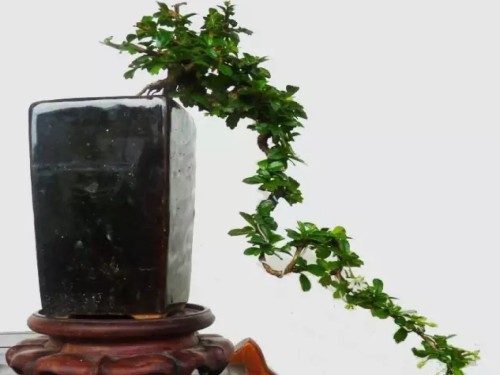
I. Material Selection and Cultivation Measures
1. Artificial propagation: Cutting propagation is usually adopted. In spring or the plum rain season, select vigorous one-year-old branches or semi-mature branches of the current year as cuttings, cut them into 8-12 cm lengths, with a flat cut surface, retaining only a few leaves at the upper part and removing the rest. Insert to a depth of 1B2. The seedbed soil is best a loose, fertile acidic sandy loam. After inserting, press firm, water thoroughly, and set up a shade frame. In summer and autumn, management should be strengthened with frequent watering, loosening of soil, and weeding; the survival rate is generally fairly high. In southern China, thick-trunk cuttings or root cuttings are often used, and the survival results are also quite good.
2. Collection from the wild: In the evergreen broad-leaved forests or shrublands of the low hills and mountains of the south, Fujian Tea is scattered in distribution; wild tree stumps or regenerated young trees can be selected. After digging them out, cultivate them in a fairly shady spot with deep, fertile, loose soil, or in sandy loam rich in organic matter. Once the root system has developed and the new branches and leaves are luxuriant, then pot them and shape them. Lingnan-school Fujian Tea bonsai mostly uses old tree stumps, shaped through the "branch-storing and trunk-cutting method" to create large-tree style or forest-style bonsai.
II. Potting Process
Transplanting and potting are most suitable in early summer. Choose glazed ceramic pots or purple clay pots. Medium-deep rectangular or oval pots are more common for the pot shape; for cascade-style shaping, tall deep cylindrical pots that are round or square are preferable; for forest-style shaping, shallower rectangular pots are preferable. The potting soil should be a loose, fertile, well-drained slightly acidic sandy loam, or prepared by mixing garden soil with farmyard manure and river sand in equal amounts. Use a tile or stone to cover the drainage hole at the bottom of the pot, then put in a layer of river sand or vermiculite to facilitate aeration and drainage, and then fill in the potting soil and plant. When planting, the root system must be spread out, with the main root slightly exposed above the soil surface. Newly potted tree stumps should be kept in a shady place for about 15 days, then moved to a semi-shady spot with good ventilation.
Pot selection: Fujian Tea can use glazed ceramic pots or purple clay pots. For the pot shape, medium-deep rectangular or oval pots are generally used; for cascade style, deep round pots or relatively tall square cylindrical pots are used; for forest style, shallower rectangular pots are used.
Soil: Fujian Tea likes fertilizer and acidity. When potted in the south, pond mud rich in humus is often used, weathered and dried in the sun, loose and fertile, then mixed with an appropriate amount of river sand to increase water permeability; leaf mold mixed with rice husk ash can also be used.
Planting: Fujian Tea is generally planted in early summer, and should not be done in the cold season. When planting, the fibrous roots must be spread out, mound with fertile soil, and the main root may be slightly exposed above the pot surface. It is best to line the bottom of the pot with river sand or vermiculite to facilitate aeration and drainage.
Pruning: Pruning is generally carried out in May of spring and September of autumn, removing excess branches that affect the appearance. For branches that need to be retained but have grown too long, prune according to the "branch-storing and trunk-cutting method" to maintain a certain tree shape.
Repotting: Repot and change the soil once every 2 to 3 years, carried out in late spring. Remove 1/2 of the old soil, cut off dead roots and rotten roots, and shorten overly long roots, then plant with new culture soil to promote the development and growth of new roots.
III. Shaping Techniques
To make Fujian Tea bonsai, in spring or the plum rain season, select vigorous one-year-old branches or semi-lignified branches of the current year for cutting propagation; seedlings can also be obtained by root cutting propagation from early summer to early autumn; in the south, one can also go into the woods to select and dig wild tree stumps or young trees, and after cultivating the stock to survival, process and pot them. Fujian Tea has extremely strong growth vigor and is extremely tolerant of pruning, suitable for the "branch-storing and trunk-cutting method" adopted by Lingnan bonsai, using repeated pruning and processing to make the branches and trunk achieve a naturally twisted, vigorous and powerful effect.
1. Processing: Fujian Tea has strong growth vigor and is extremely tolerant of pruning, most suitable for shaping with the "branch-storing and trunk-cutting" method; for the specific method, refer to the section on processing Orange Jasmine. If cultivating bonsai in the north, appropriate bending and tying for shaping can also be carried out.
2. Tree shape: Fujian Tea is suitable for making into a natural large-tree shape, and is one of the commonly used tree species in China's Lingnan-school bonsai. Common forms include upright-trunk style, double-trunk style, multi-trunk style, slanting-trunk style, cascade style, forest style, and root-over-rock style, among various tree shapes. For the production method of the root-over-rock style, refer to the section on shaping Chinese Elm.