How to make a Chinese holly (Ilex cornuta) bonsai? Detailed method explained
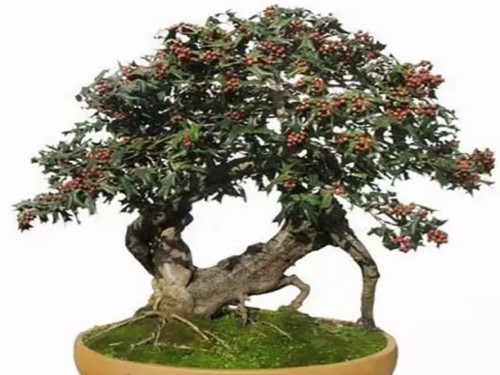
The Chinese holly (Ilex cornuta) has dense branches and peculiar leaf shapes, and its red berries are bright in autumn. It is an excellent tree species for foliage and fruit appreciation. Old-stump bonsai have an elegant, antique posture and remain evergreen through all four seasons, making them suitable for viewing year-round. For decorative applications, it can be planted as a hedge in courtyards or grown in pots, displayed in halls and placed on stands. Because it has thorns, do not let children touch it to avoid injury.
In today's society, more and more people enjoy appreciating and growing bonsai, which not only beautifies the home but also purifies the air. So, do you know about Chinese holly bonsai? Today let's take a look together at how to make a Chinese holly bonsai.
[Material collection and cultivation measures]
Artificial propagation: mainly by seed sowing, but cuttings and tiller division can also be used.
The fruit ripens in November. After harvesting, pile them up, and once the fruit skin softens, mash them, rinse them clean, and take out the seeds. Chinese holly seeds require 2 years to germinate. They can be treated with low-temperature moist sand for one year. During sand storage, stir and turn them once every two months to maintain a certain humidity and prevent the seeds from deteriorating. Sow the seeds in the winter of the following year, with a row spacing of 15-20 cm and a sowing depth of 2-3 cm, covering with 1.5 cm of burnt soil, then covering with rice straw.
They will sprout and emerge in March. Remove the straw promptly and set up a shade frame. Usually pay attention to watering, topdressing, weeding, and loosening the soil. The seedlings grow relatively slowly; leave them in the seedbed for 1-2 years before transplanting separately.
For cutting propagation, in mid-to-late June (plum rain season), select semi-mature shoots of the current year as cuttings. The length should be enough to include a heel (a portion of last year's old branch), keep 4-6 leaves, insert to a depth of 12-23, water thoroughly after insertion, set up a shade frame, water frequently, and keep the soil moist. After rooting, strengthen seedling management, leave them in the seedbed for 1-2 years before transplanting. Spring transplanting has a higher survival rate. Digging up root tillers for propagation is also possible.
Collection from the wild: Wild Chinese holly plants are commonly found along mountain ditches in the middle and lower reaches of the Yangtze River basin. You can select old stumps that have sprouted for many years, dig them out, trim the main roots, protect the lateral roots, and cultivate them in a shaded, moist place. After the root system develops and new branches sprout, pot them and shape them to create elegant and unusual foliage bonsai.
Chinese holly bonsai
[Potting process]
Pot selection: For Chinese holly, glazed ceramic pots or purple clay pots are both suitable, and carved stone pots can also be used. Because the leaves are dense and the leaf color is deep green, avoid choosing deep green pot colors, otherwise they will be close to the leaf color and fail to provide contrast. Pot shapes such as rectangular, square, or oval are best. For making Chinese holly bonsai, glazed ceramic or purple clay pots are often used, and carved stone pots can also be used; pot colors of purple, blue, pale yellow, and gray are all acceptable; deep green should not be used, because it is similar to the leaf color and cannot provide color contrast. Pot shapes such as rectangular, square, oval, and drum-shaped are suitable.
Soil: Chinese holly is suitable for fertile, loose soil with good water permeability. Slightly acidic, neutral, or calcareous soil is all acceptable. For potting, leaf mold soil and garden soil can be used, mixed with an appropriate amount of sand.
Planting: It is best done after autumn or before spring budding. Because Chinese holly has well-developed lateral roots but fewer fibrous roots, it is best to plant with a soil ball to protect the fibrous roots, and at the same time properly prune the branches and leaves.
[Shaping techniques]
Processing: Chinese holly leaves have sharp thorns, making processing inconvenient. First cut away all kinds of unnecessary branches and leaves, then bend and tie the remaining branches, combining this with pruning. Because its leaves are relatively large and hard, metal wire is generally not used for bending; palm fiber is better. Processing is best done during the plum rain season.
Tree forms: Chinese holly is suitable for formal upright, slanting, curved-trunk, and cascade styles. For large bonsai, branches and leaves can be formed into pads, while for small ones, the natural style is better. Stump bonsai should highlight the beauty of exposed roots and bent trunks.
Shaping: Chinese holly branches are hard and brittle, so processing is usually carried out during the plum rain season, when sap flow is vigorous. Because its leaves are large and hard, palm fiber is generally better for bending; metal wire should not be used, otherwise branches and leaves are easily broken. Chinese holly leaves are hard and have sharp thorns. When shaping, unnecessary branches and leaves can be cut away first, and the remaining branches can be bent and pruned. The tree forms of Chinese holly can be made into formal upright, slanting, curved-trunk, and cascade styles. For small bonsai, the natural style is better, while for large bonsai, branches and leaves can be tied into cloud-like pads. Old stump bonsai appear with the beautiful posture of exposed-root and bent-trunk styles.