A detailed guide to making maple bonsai, easy for beginners to learn
Maple trees are widely found in the wild, and for making bonsai, old stumps or young trees are usually dug up from the mountains and wilds. Maple's new branches are long and flexible, and can be wired into various styles of bonsai. Common ones include the straight-trunk style, slanting-trunk style, curved-trunk style, double-trunk style, and waterside style. Maple styling is mainly based on pruning, with wiring as a supplement. Maple leaves are relatively large, so it is not easy to form them into cloud-pad or cloud-cluster shapes; the branches and leaves are often pruned into a natural style with well-balanced heights and appropriate density.
Maple has strong sprouting ability and often grows new buds on the trunk. Any buds not needed for the design and overly dense branches should be pruned away in time, which not only saves nutrients but also helps ventilation and light penetration. The best viewing period for maple is when the new leaves have just unfurled. At the end of summer, remove all the leaves, apply 1 application of well-rotted dilute liquid fertilizer, and in about 20 days the new leaves will grow out, adding another best viewing period.
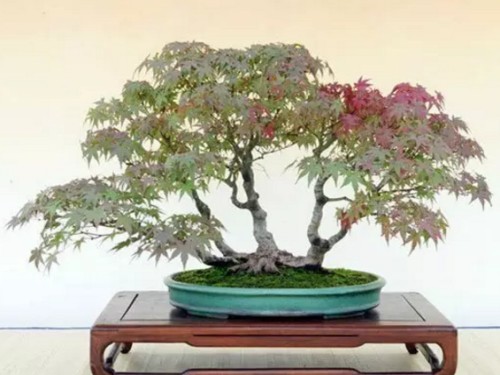
For making maple bonsai, besides the handling methods, what is more important is the choice of tree shape and making a natural bonsai according to the original form, and a certain amount of time is needed for shaping. Every maple bonsai should have its own characteristics. This article mainly discusses the process of making maple bonsai.
1. Tree shape creation
Maple trees are widely found in the wild, and for making bonsai, old stumps or young trees are usually dug up from the mountains and wilds. Maple's new branches are long and flexible, and can be wired into many styles of bonsai; common ones include the straight-trunk style, slanting-trunk style, curved-trunk style, double-trunk style, waterside style, and forest style. Maple styling is mainly based on pruning, with wiring as a supplement. Maple leaves are relatively large, so they are not suitable for making cloud-pad or cloud-cluster shapes; instead, the branches and leaves are often pruned into a natural style with well-balanced heights and appropriate density. After frost, the maple leaves turn red, dazzling and delightful.
2. Planting and pot selection
Maple is best planted in February to March before spring budding. Before planting, prune the branches and roots once, remove half of the old soil, replace it with new soil, and place well-rotted bean cake at the bottom of the pot as a base fertilizer. Maple likes loose, fertile, and moist soil, and grows poorly in barren land. For planting maple, use 2/3 humus soil mixed with 1/3 sandy soil. The leaves of most maples turn from green to red after frost in late autumn, so when choosing a pot, be careful not to use purple clay pots or glazed ceramic pots in red or green. For forest-style maple bonsai, a shallow pot of white marble or marble can be used, processing the pot soil into an uneven natural mountain-and-wild shape. If a few turtle-vein stones or Yingde stones are placed in appropriate spots on the pot surface, dotted with a few small figurines of people or animals, the bonsai will have a stronger sense of life.