Detailed Explanation of the Correct Methods and Techniques for Exposing Roots in Bonsai
Roots are an important part of tree-stump bonsai; the distribution and shape of the roots directly affect the ornamental value of the bonsai. Through planned cultivation of the tree stump's roots, repotting, changing the soil, and changing the pot year by year, the roots are arranged during this process, the direction of root extension is controlled, and planting continues, gradually exposing the roots above the soil surface. Create an environment that allows the roots to take shape, such as a tall cylinder environment; the soil in the cylinder must be breathable, and you can choose coarse sand as the soil, or for something more refined use large-particle perlite, vermiculite, or small-particle orchid stone, all of which are very breathable.
In nature, some old trees by streams and ravines in deep mountains and old forests have their roots often exposed on the ground because the soil has been washed away by water, coiling like dragon claws, very peculiar. In order to enable tree-stump bonsai to also produce this form and improve the ornamental effect, the root-exposing method can be used to achieve this purpose.
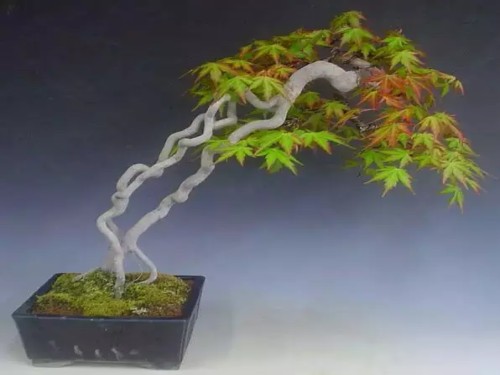
Through planned cultivation of the tree stump's roots, repotting, changing the soil, and changing the pot year by year, the roots are arranged during this process, the direction of root extension is controlled, and planting continues, gradually exposing the roots above the soil surface. The commonly used root-exposing methods include the following:
1. Root-lifting and root-exposing method: If you want the root system of a tree-stump bonsai to be exposed on the pot surface to add antique venerability to the bonsai, you can lift the roots upward year by year when repotting, so that the lower new roots grow deep, and appropriately thin out the root system exposed on the pot surface, removing the fine and keeping the coarse; some soar like dancing claws, some show their heads and drill their tails, like a coiled dragon entering a cave, each displaying its own strengths.
2. Mound-soil root-exposing method: For tamarisk species whose trunk bases easily sprout adventitious roots, you can slightly score the trunk in spring, mound moist root-cultivating soil over it, and after 2-3 years when the new roots have aged, remove the soil to expose the roots, then according to your wishes carry out artistic trimming of the exposed root system.
3. Sleeve root-exposing method: For some tree species that are difficult to sprout adventitious roots, such as pomegranate, after the crown has been pruned into shape, at a trunk position relatively high above the pot surface, carry out ring bark removal for one circuit, then ring bark removal of the trunk for another circuit, use a section of a plastic cola bottle with a broken opening as a sleeve, fill it with root-cultivating soil, water occasionally to keep it moist, and after 2-3 years remove the sleeve to expose the roots, thin out and shape them, with root heads emerging upward, root tails drilling downward, and fine roots flying to the sides, each embracing the terrain, like dragon claws.
4. Ring-knot root-exposing method: For tree species whose roots and branches are soft and can be looped and knotted, such as ginkgo, edgeworthia, and daphne, you can knot the elongated side roots into rings to expose the roots, then bury the root tails in the soil to stabilize the base. Also thread the elongated trunk and main branches into arched knots, approach-graft them into shape, so that the branch rings and root rings echo each other above and below, giving a unique charm.
5. Crab-claw root-exposing method: On the base of a formed tree stump, carry out ring cutting for one circuit, mound soil to bury the trunk, and cause a ring of adventitious roots to sprout; after the new roots have lignified, select ten of the roots to form a crab-claw shape, that is, two large ones as the crab pincers and eight small roots as the crab legs, raised in a crab-leg shape and then buried. In this way the root system can not only be renewed, but the artistry of the bonsai's exposed roots can also be increased.
6. Stone-embracing root-exposing method: If you want to cultivate a rock-attached bonsai, you can choose tree species with an inconspicuous main root but long and numerous side roots as stump material, such as winter jasmine and orange jasmine, cut off their main roots, wrap the side roots around an oblong natural ornamental stone, and then insert the root tails into the pot soil. It is like the posture of a golden rooster embracing an egg.
7. Stone-piercing root-exposing method: First use a natural ornamental stone with artificially drilled holes as the rock attachment for the tree stump, then choose a stump material with elongated roots, insert the root heads through the holes in the attached stone, coiling around the attached stone now visible and now hidden, and finally drill into the pot soil to develop into a root system
8. High-grafting root-exposing method: If you want to cultivate a pot of root-exposed bonsai with a coiled dragon winding around a pillar, you can choose elongated dragon-shaped roots of the same tree species as grafting roots, graft them onto the upper end of the trunk, wind the grafted roots around the trunk in twists and turns, then put a long cylinder of root-cultivating soil over the trunk to maintain the moisture level of the grafted roots, while the root tails are planted in the pot soil. After the grafted roots have healed, remove the sleeve and the cultivating soil to expose the posture of a coiled dragon winding around a pillar.
9. Root-art root-exposing method: This is a form of tree-stump bonsai combining natural root art with bonsai; choose underground tuberous roots such as ginseng or fleeceflower root shaped like a human figure, as well as other pictographic root materials, as stump material, expose them on the pot surface, plant the lower main roots and fibrous roots in the pot soil, and after they survive, new roots sprout from the pictographic root heads to form the crown, among which vine species such as fleeceflower can be given supports for shaping.
10. Hanging-root root-exposing method: Choose banyan, which can sprout aerial roots, as the stump-scenery material, plant it in a rectangular pot, and after the branch crown has formed, cover it together with the pot using a rectangular glass cover to increase the humidity inside the cover and prompt the bonsai's lateral main branches to sprout downward-hanging aerial roots; after entering the soil they form new root systems, and at this time the aerial roots will become new trunks; after several years, a pot of multi-trunk shared-crown forest bonsai can be cultivated.
The root-exposing methods mainly include three kinds: the deep-pot high-planting mound-soil root-exposing method, the deep-pot flat-planting water-flushing root-exposing method, and the cylinder sand-cultivation root-exposing method.
1. In the deep-pot high-planting mound-soil root-exposing method, after the tree stump is planted in a deep pot, it must go through 2-3 years, and then in combination with repotting, the roots are lifted upward year by year, so that the tree roots can be exposed.
2. In the deep-pot flat-planting water-flushing root-exposing method, each time you water, raise the watering can so that the water flushes the roots, gradually washing away the soil at the roots and exposing the roots. Then in combination with repotting, raise the cultivation position of the roots, so that the exposed portion of the roots gradually increases and their shape gradually becomes more perfect.
3. In the cylinder sand-cultivation root-exposing method, after the roots have grown well, take the tree stump out of the cylinder, plant it in a shallow pot, and during planting carry out appropriate trimming and shaping, so that the roots are exposed on the pot surface.