A detailed guide to making Chinese fringetree bonsai, beginners can easily learn it too
Chinese fringetree bonsai is mainly based on red-flowered Chinese fringetree and white-flowered Chinese fringetree. When sunlight shines on the back of the Chinese fringetree leaves, a wonderful little world immediately lights up. The leaves of Chinese fringetree are like peach blossoms in spring, giving people a sense of vitality; and they are also as elegant and unrestrained as lotus flowers in summer; even more like osmanthus in autumn, making people feel relaxed and happy; yet also like plum blossoms in winter, fearing no severe cold.
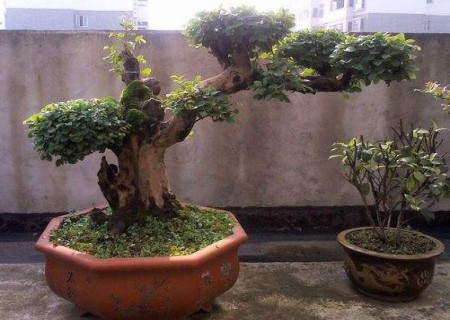
It can be seen that the world of Chinese fringetree is a miniature of nature, sometimes giving the feeling of flying birds landing on branches, and sometimes carrying the momentum of wind stirring the grass, just like vivid pictures. The beauty of Chinese fringetree is naturally self-evident, but after making it into bonsai, it offers yet another kind of beautiful enjoyment. So, how do you make Chinese fringetree into bonsai? Below, the editor will share the method for making Chinese fringetree bonsai with everyone!
1. Material collection
Chinese fringetree stump bonsai can be obtained through artificial propagation methods such as sowing and cuttings. For sowing, mature fruits need to be harvested in autumn, dried in the sun, then put into cloth bags and hung in a dry and ventilated place, and sowing can be done in early spring of the second year; cuttings are best done during the plum rain season, choosing semi-lignified sturdy branches about 15 cm long as cuttings, inserting them into culture soil and watering thoroughly, then just pay attention to the soil at ordinary times.
In addition, if you want to use old Chinese fringetree stumps to make bonsai, you can obtain stump material by digging in the wild. You can choose old stumps that have been cut many times and have peculiar shapes, and dig them in March. When digging, in addition to protecting the roots, it is recommended to attach moss to retain moisture, and transport them back promptly for cultivation. During cultivation, in order to ensure the survival rate, management work must be done well.
2. Potting
The potting of Chinese fringetree is roughly the same as that of other tree species, but some details need attention, and these details may be the key factors for successful bonsai making, so we need to treat them seriously.
1. Choosing a pot
For potted Chinese fringetree, purple clay pottery pots or glazed pottery pots can be chosen. The shape of the pot needs to be determined according to the shape of the tree, and deeper rectangular or oval shapes are mostly preferred. In terms of pot color, in order to highlight the characteristics of the formed Chinese fringetree with luxuriant branches and leaves, purple-blue or light yellow can be chosen to set it off.
2. Soil mixing
Chinese fringetree is not very strict about soil environment, because although it also relatively likes loose, fertile, slightly acidic loam, it is quite tolerant of poor soil. For potted bonsai management, decomposed garden soil, leaf mold + sandy soil, or rice husk ash can all be used.
3. Planting
Collected Chinese fringetree stumps can usually be planted before they sprout in spring. When planting, excessively long roots need to be cut off, especially redundant tangled roots. But when trimming roots, the cuts need to be smooth, without a blunt feeling, and then apply some sterilizing and disinfecting medicine to prevent root wounds from molding, which is more conducive to growth. If the pot is very deep, some broken tiles can be placed at the bottom of the pot, then covered with a layer of coarse sand, which is more conducive to drainage. Then place the trimmed collected stump vertically into the pot, and pot it according to the planting methods of other tree species. I will not go into detail one by one here!
3. Styling
When we choose Chinese fringetree, the collected stumps already have a certain styling effect, but in order to achieve a perfect artistic presentation, we still need to carry out artificial styling treatment.
1) Processing
Chinese fringetree is a plant that is relatively tolerant of pruning. When processing and styling it, pruning is mostly used, supplemented by wiring. Pruning can be done according to your own design ideas combined with the tree shape, while wiring can use metal wire, which is easier to control than palm fiber. But in order to prevent the metal wire from sinking into the branches and affecting the ornamental effect of plant growth, the metal wire needs to be removed in time once the wiring purpose is achieved.
During operation, the branches and trunk need to be twisted according to your own design direction, then cut off excessively long branches and leaves growing above and below, keeping only the side branches. When new buds sprout, use this method again, so that the posture of the tree body can become fuller. Of course, during styling and processing, you can also only prune without using wiring, but pruning requires long-term frequent cutting and must not leave too many traces of human intervention, trying to make the bonsai present a natural state, which makes it more ornamental and artistic.
2. Tree shape
Like most tree species, Chinese fringetree can be made into display forms such as slanting trunk style, curved trunk style, withered peak style, lying trunk style, cascade style, and so on. In the pruning of branches and leaves, they can be kept in a semicircular cloud-like layered shape. Of course, every creator's design ideas are different, so the styling methods and expression forms are also different, but one principle that needs to be grasped is to present the tree shape to people in as natural a way as possible.
The above are the technical key points for making Chinese fringetree bonsai. After completion, the next work is daily care and management. In terms of care and management, in addition to daily water and fertilizer management, the most used method is pruning. In order to let the bonsai maintain a good posture for everyone to enjoy, everyone must work hard on pruning. The editor will not go into detail here, please refer to related articles.