A Complete Guide to the Techniques for Making Crape Myrtle Stump Bonsai
There are quite a few species of crape myrtle, and their forms vary greatly. More importantly, they change into different postures and colors with the seasons, making them a very beautiful type of tree. In addition, crape myrtle has thick, sturdy branches and trunks, fine leaves and dense twigs, and exposed roots and stems, making it easy to train and bend. Using it to make bonsai gives it very high ornamental value. When the flowering season arrives, the crape myrtle flowers bloom in competition with one another, and the blossoming crape myrtle bonsai presents itself before people in a thousand charming and enchanting postures.
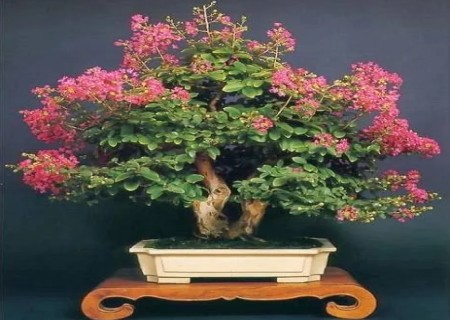
So how do you make a crape myrtle bonsai? In fact, crape myrtle bonsai are relatively easy to make. Now let's follow the editor and learn the techniques for making crape myrtle stump bonsai!
1. Sourcing material for the bonsai
We can obtain crape myrtle bonsai material through grafting, and the crape myrtle stumps propagated this way are relatively easy to plant and easy to keep alive. In addition, we can also obtain them by digging up old stumps in the wild. Generally, they can be collected and dug from early October through spring. When digging, try to choose stumps with unusual shapes. First cut out the main root and trunk, then dig out the fine root hairs, taking care not to damage the root system as much as possible.
2. Treating the old stump
Give the collected crape myrtle wild stump a simple clean-up. First cut off dead branches and withered leaves, and also thin out branches and leaves, removing redundant branches. At the same time, trim the roots, especially overly long old roots. The soil on the roots should be retained and tamped firm.
3. Growing the stump in
Plant the treated wild stump in the ground or directly in a temporary pot. If planted directly in a pot, the soil in the pot should be fertile, loose and breathable. Only after the old crape myrtle stump's root system has resumed growth and sprouted many new branches can it be repotted and transplanted.
4. Potting and transplanting
Before potting, first choose the pot, with the specific choice depending on the plant's form. Then dig up the cultivated old stump once again, give it a little treatment, and it can be planted in a new pot. After positioning the old stump, fill in loose, breathable humus soil, then press the soil close to the old stump firm, and finally water thoroughly once. After watering to settle the roots, cover with a layer of sandy soil, and it can be placed in a shaded spot for normal care.
5. Pruning and shaping
Once the old crape myrtle stump has entered normal growth, pruning and shaping can begin. During the growing season, the focus is on pruning branches, cutting away overly dense branches and leaves and branches that affect the shape. For shaping, it should be done according to the creator's design ideas. For pruning ordinary branches, usually keep 1-2 buds on each branch and promptly remove vigorous water sprouts. In addition, to prevent the crape myrtle from setting fruit, promptly pick off the remaining spent flowers after blooming. Through the above measures, you can not only make the crape myrtle bonsai bloom multiple times a year, but also encourage its branches to become thicker and shorter, thereby improving its ornamental value.
6. Care and management
The care and management of crape myrtle bonsai mainly involves water and fertilizer management. Because water evaporates quickly during the growing season, you must ensure timely watering so that the potting soil stays moist for a long time. But in the early stage of crape myrtle growth, water should still be controlled appropriately, and you cannot water heavily. The purpose of controlling water is to ensure normal growth while also making the branches grow thicker and sturdier and the leaves smaller, making the shape easier to control. Water use is greater during the flowering period and in summer, so watering should be increased. As for fertilizing, mainly apply organic fertilizer as a top dressing during the growing season; spray foliar fertilizer before and after budding; and after flowering, some organic fertilizer can likewise be added.
For a crape myrtle bonsai that has already been made, you only need to appropriately prune and shape it and correct its posture. After 2-3 years, it can be repotted and the soil changed. After removing the stump from the pot, remove part of the old soil, prune overly dense branches and roots, and after tidying it up, plant it in a new pot. Then fill in new soil, press the soil firm, and water thoroughly.
After completing the above steps, the crape myrtle bonsai can be moved into normal daily care and management. Has everyone learned it? Friends who like the delicate and graceful crape myrtle bonsai might as well follow the above method and try making a crape myrtle bonsai of your own!