A Detailed Guide to Boxwood Bonsai Making Techniques and Methods
Boxwood, also known as Chinese boxwood or pearl boxwood, has a graceful tree form, thick and glossy leaves, and most importantly, it stays evergreen all year round and can be enjoyed throughout the year, making it a precious material for bonsai. It can be made into fine bonsai works for people to admire. If you collect old boxwood stumps from the wild to create bonsai, their form will appear even more ancient, natural, and exquisitely beautiful. Since old boxwood stumps are such excellent material for making boxwood stump bonsai, how can such beautiful boxwood bonsai be created?
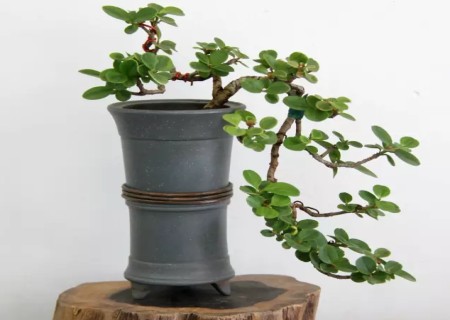
Below, the editor will explain the techniques for making boxwood bonsai, hoping everyone can learn this bonsai-making method.
1. Sourcing material for bonsai
Boxwood bonsai material can be obtained through seed sowing or cuttings propagation, but these two methods take too long to cultivate, and their roots are difficult to shape. So here we can obtain material by digging up stumps.
Usually, old boxwood stumps can be dug up in all four seasons, but the best season for digging is summer. When collecting, damage the roots as little as possible; after digging, put them in plastic bags to retain moisture.
2. Treating the stump material
Before planting, cut off the main root below, then apply previously purchased latex to all wounds; at the same time, cut away most of the branches and leaves to prevent the plant from dying due to dehydration.
3. Cultivating the stump
Before potting and planting, the treated stump needs to be grown in the open ground. How long to cultivate depends on the growth of the stump. Usually, after 2 years of cultivation, the stump can be transplanted into a pot.
4. Transplanting into a pot
1) The potting time is usually chosen between spring and summer, because boxwood is more likely to survive when potted during this period.
2) Before transplanting into a pot, we first need to choose a pot of suitable size. What counts as suitable size? The choice of pot should be determined by the size of the stump and the styling method.
3) When potting, trim the root system that has grown too long and too dense. Of course, this requires adjusting the roots according to the needs of shaping, ultimately allowing the roots to spread out naturally; since this is a stump bonsai, the planting depth should not be too deep, then cover with soil and water thoroughly once. Finally, move the planted boxwood pot to a shady place, while paying attention to spraying water on the leaves and keeping the pot surface soil moist. After about one month, once the plant has clearly grown, normal care can begin.
5. Styling process
The styling time for boxwood bonsai is best chosen in summer or autumn, and styling can be done by pruning and wiring. But whether for daily pruning or styling, branches that do not meet the requirements should be treated with "short pruning to force buds," so that all branches grow into place, which is conducive to styling.
6. Care and management
1) Watering: Since boxwood likes a moist environment, it should be watered frequently. Long-term water shortage can cause leaf drop.
2) Fertilizing: During the growing season of boxwood, nutrients can be appropriately supplemented during watering, using thin decomposed cake fertilizer.
3) Pruning: In addition to water and fertilizer, we should also prune it appropriately, mainly cutting off leggy branches, overlapping branches, and excess branches that affect the plant's shape.
4) Repotting: Of course, during care and management, in order to let the boxwood bonsai grow better and present itself to the world in the most beautiful posture, we also need to repot it. Usually, after 2 years of growth, it can be repotted. Repotting can also be combined with pruning to give it a better shape and better reflect the ornamental value of the boxwood bonsai.