Detailed Guide to Making Vitex Bonsai: Easily Create Beautiful Shapes
Vitex is a common plant in the wild hills and mountains of the north. What we call jingtiao (vitex) usually refers to the Chinese chaste tree (Vitex negundo). Its trunk is often cracked and rough, giving it a very ancient and vigorous look. Moreover, its regenerative capacity is extremely strong: it can withstand heavy pruning, and its branches are also very soft and easy to shape, making it very suitable for bonsai. With old stump material dug from the wild, just a little processing makes it easy to produce an excellent bonsai specimen.
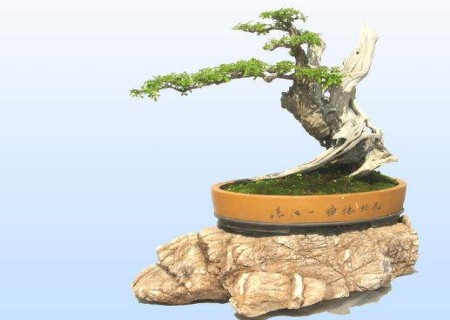
Vitex is an excellent material for cultivating and making bonsai, and can be used to create fine stump bonsai works in all sorts of forms. Below, the editor will introduce the techniques for making vitex bonsai, hoping it will be of help to everyone.
1. Obtaining material
Vitex can be propagated by sowing seeds, division, and other methods, but for making bonsai, the method of cultivating nursery stock is usually adopted. Vitex stumps can be dug from the wild hills and cultivated.
1) When digging old vitex stumps in the wild hills, you must choose the right time; it is usually done during the period after leaf fall in early winter and before bud break in early spring. Digging up the stump also requires great care: first, you must repeatedly examine and carefully study the selected vitex stump, and work out the best excavation plan.
2) When digging up the stump, we should bring along some of the original soil, and must not let this soil fall apart; keep it clinging tightly to the stump roots as much as possible. The stump material dug up also needs to be processed. Before cultivating the stump material, we need to clean up the stump, remove the thick coarse roots, and keep only the small roots and fibrous roots; at the same time, the excess branches should also be pruned off.
2. Cultivation
First, plant the prepared stump in the ground. After the roots of the newly planted stump spread out into clusters, you can see that the newly planted stump has survived. At this point, we can dig the stump out again and plant it in a pot for final establishment. We can see that the ornamental focus of a vitex bonsai is concentrated at the root area, so when transplanting it into a pot, we should choose a relatively shallow pot. Of course, before transplanting it into the pot, we also need to prune it once more. Next, we can begin the operation of the following stage.
3. Production process
The production process of a vitex bonsai is mainly pruning and shaping. First, prune the established vitex stump. The pruning time is generally in early spring, that is, during March.
Pruning methods:
1) For the trunk part, we can cut off most of the original branches on the stump, but at the basic position, that is, the trunk part, a certain length of thick branches must be left. After the stump sprouts some new branches, a new crown will gradually form. At this time, we need to prune the branches and trunk, but pay attention to the position and direction of the buds on the new shoots.
2) We also need to prune the root system. But when pruning the roots at this stage, we likewise need to keep the fibrous roots and fine hair roots. Note that if the current root system does not quite match our concept for making the bonsai, then we can use palm fiber to bend and bind the roots into an undulating shape. Of course, during the bending and binding process, some bark may be damaged, but please do not feel distressed; we can disregard this. Because the injured bark will slowly heal its wounds over time in the future, forming scars of various shapes, which can better display the ancient and simple posture of the vitex stump; would that not make it even more charming?
Shaping methods:
During the stump's growth period, we need to repeatedly pinch the tips and remove buds. This not only gradually makes the tree's leaves smaller and shortens the internodes, but the branches also become denser and denser, thereby forming a more compact crown, making it more shapely and more ornamental.
In the process of making a vitex bonsai, we can create various bonsai shapes according to our own ideas, and each shape can have different forms of expression. However, the branches of a bonsai will not grow entirely according to human wishes, so this requires us to frequently prune and shape the finished vitex bonsai, so that it can maintain a good shape over the long term. Of course, in order to improve the ornamental value of the vitex bonsai, we can also use palm rope and related tools to shape it more rigorously, and after the bonsai has re-set its form, we then remove the palm rope from all parts of the bonsai.
4. Care and management
After the vitex bonsai is made, we can carry out normal care and management of it. According to the growth habits of vitex, we need to place the vitex bonsai in an environment with plenty of sunlight and good ventilation for care, and it is also recommended to rotate the pot in a different direction at intervals, so that the entire bonsai work can receive the "care" of light, ventilation, and other conditions at every position.
In addition, in daily management, we need to appropriately control water and fertilizer for the vitex bonsai. This not only inhibits excessive growth of the bonsai, but also improves its ornamental value.