Detailed guide to rockery bonsai making techniques, easy for beginners to learn too
Rockery bonsai is a miniature of beautiful scenery made by hand based on real mountains and real water in nature. As people's living standards continue to rise, the grade demanded for interior decoration is also constantly rising, and interiors need an environment full of greenery even more. The only thing that can create a satisfactory effect for people is a rockery bonsai similar to nature. It incorporates mountains and rivers, real flowers and real grass, and you can even see the natural landscape of fish swimming in the water, making it a rare home decoration nowadays.
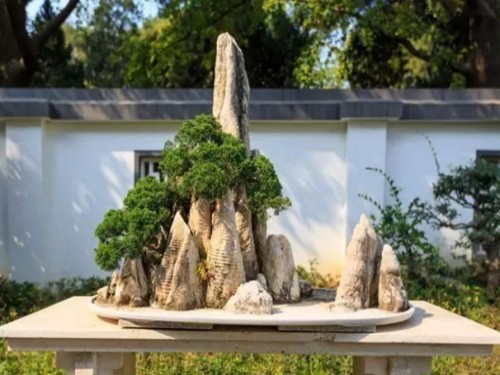
The shapes of rock-and-stone bonsai are roughly divided into five types: independent style, offset-weight style, opening-and-closing style, scattered-placement style and overlapping style. Bonsai making can be divided into the following steps:
(1) Choosing the pot
Bonsai pays great attention to the setting off provided by the pot and the stand. Pots generally include purple clay pots, porcelain dishes, marble trays, stalactite “cloud trays”, terrazzo trays and so on. The shallow trays commonly used for rock-and-stone bonsai are mostly rectangular or waist-rounded, with four feet at the bottom, and the tray rim protrudes outward with many edges to enhance the decorative effect; white or light blue can show the water surface. At present, white hard plastic shallow trays and white cement terrazzo trays are sold on the market at low prices and can also be chosen. As for the stands displaying the pots, local materials can be used to create stands rich in local characteristics.
(2) Layout within the pot
Rock-and-stone bonsai is a highly generalized processed artwork, so it must be carefully combined, thoroughly weighed and reasonably laid out. Therefore, when combining and modeling, several principles must be followed.
1. Originate from nature and create an artistic conception.
2. Primary and secondary are distinct, and they look toward each other.
3. Layers are clear, with contrast and setting off.
4. Virtual and solid are appropriate, appearing partly hidden and partly visible.
5. Rich in variation, unified and coordinated.
(3) Processing the stone material
1. Sawing and cutting: According to the already drawn pattern, determine the position and size of the main body. Then use a small saw to slowly saw the bottom flat. Next, choose the side with clear texture and many caves as the front, and process it according to the imagined effect. Soft stone can be sawed with a steel saw, while hard stone needs to be sawed with an electric emery saw blade.
2. Carving: Carving must start from the big picture, using tools such as a hammer and chisel to carve out the general outline of the mountain peaks, and then carry out fine processing. Remember: when processing, try as much as possible to preserve the natural beauty of the absorbent stone.
3. Gluing: Gluing can play a role in perfecting the work. Its key points: ① The stone quality, texture, color and momentum of several pieces of stone material must all be similar. ② In order not to affect the water absorption of the stone peaks, they should be assembled by horizontal overlapping, and must not be joined vertically.
(4) Small-scene embellishment
Small-scene embellishment is intended to achieve the artistic effect of many stars surrounding the moon. Its methods include:
1. Moss-planting method:
Scrape off the green moss growing on the outer walls of flower pots in a shade shed or greenhouse with a knife, gently rub it into pieces, then use a brush dipped in the broken moss to spot-plant it into the crevices of the mountain peaks, then place it in a shaded place and spray water frequently; the green moss will soon cover the stone peaks.
2. Tree-planting method:
Following the requirement of “mountains in zhang and trees in chi”, choose suitable tree species and plant them according to the growth laws of nature. In stone crevices, it is suitable to plant tree species with exposed roots, curved trunks and exquisite tree forms, and plants with thin branches, small leaves and shallow roots. For large bonsai, small five-needle pines, Buddhist pines, crown-of-thorns and so on can be planted. For small and medium bonsai, some fine-leaved evergreen herbaceous plants of the Crassulaceae family are often used to replace trees.
3. Ornament-placement method: Follow the shape and take advantage of the situation, go along with nature, skillfully combine with the terrain, whether beside a mountain, by water, against a cave, or soaring in the air, and coordinate with the natural scenery in the bonsai to express the artistic conception of the landscape. You can refer to the positions of landscape buildings and facilities in traditional Chinese painting theory when placing them.
Note should be taken: for the size of ornaments, the perspective principles of near large and far small, low large and high small should be grasped. As for the quantity, it should be determined according to the specific circumstances such as the theme, artistic conception and specifications of the bonsai.