Detailed Explanation of the Making Methods and Steps of Tangli (Birchleaf Pear) Bonsai
When the green carp comes, I hear from afar the spring stream shattering sound by sound; I smell the light yellow buds first opening on the tangli I planted with my own hands. When Minor Heat quietly passes, the new pears gradually hang low, and I invite the neighbor girl from the east to gather fruit and stroll slowly home. Last year I gathered fine snow from the branch tips; today crimson pear leaves drift down, lightly kneading two or three strokes of grass color into the scroll, sipping spring wine and only then feeling its faint sweetness. Still it is the season for loving the two words "startled swan" as I drift into dreams.——Excerpt from "Tangli Jian Xue" (Birchleaf Pear Fried in Snow)
The tangli (birchleaf pear) is one of the main deciduous fruit trees suitable for making bonsai, and there are many fine cultivars. When used to make bonsai, you enjoy the flowers in spring, the leaves in summer, and the fruit in autumn, while after the leaves fall in winter, the gray-black, cracked, rugged trunk shows even more its jagged, ancient, natural character; the whole tree's vigorous clusters of short fruit spurs, hanging upside down like chicken claws or anchors, are full of charm.
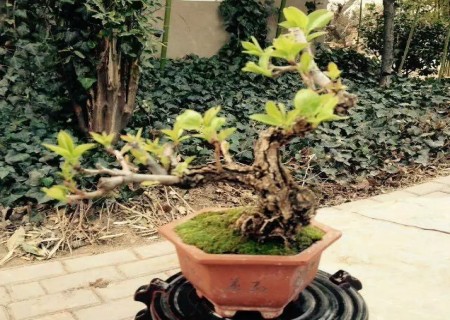
You can directly choose a pear tree stump that is curved in trunk, graceful in form, and suitable for bonsai to make the bonsai. Wild tangli and pear trees have well-developed root systems, and after root cutting and planting they readily send out new roots, so they easily survive when potted. The following is the making method for tangli bonsai:
1. Material selection
For stump selection and breeding, in central China at the end of autumn and beginning of winter, you can choose relatively thick wild tangli and other pear rootstock stumps that meet traditional bonsai conditions for grafting, which is simple and easy to do.
2. Soil
Pear trees like fertile, loose, well-drained soil. The growing medium can be prepared from materials such as leaf mold, garden soil, coal cinder or coarse sand, and mixed with decomposed organic fertilizer and bone meal as base fertilizer. For potting, a loose, fertile, humus-rich neutral loam with a pH of about 5-8 is especially good.
3. Potting
After potting, water thoroughly, place in a wind-sheltered, shaded spot, and spray water frequently to keep moist; after budding, move to a spot with ample light for normal care.
4. Watering
During growth, water fully and keep the potting soil moist. But during the leaf-unfolding period, water should be appropriately controlled to check vigorous growth of branches and leaves, avoiding large leaves and sparse nodes that would affect ornamental value. Also, excessive vegetative growth is not good for the plant's reproductive growth, so during the flower bud differentiation period (generally starting from mid-June) attention should be paid to reducing the amount of watering.
5. Fertilizing
Pear trees like fertilizer and cannot tolerate poor soil; during the growing season, apply fertilizer about once every 10 days. Around July, during the flower bud differentiation period and after flowering during the fruit growth period, fertilizer mainly of phosphorus and potassium should be applied to promote flower bud differentiation and fruit enlargement. Avoid heavy fertilizer and heavy watering as well as applying nitrogen fertilizer alone, so as to prevent excessive vegetative growth that would affect flowering and fruiting.
4. Pruning
To maintain the stump's form, medium fruit branches need to be cut back. Vegetative branches are also divided into growth branches, water sprouts and moderate branches. According to the styling needs, cut back the above branches, and remove water sprouts that disrupt the tree form, overly dense moderate branches, and bud shoots sprouting from the rootstock.
5. Styling
Tangli is suitable for making many forms of bonsai, such as formal upright, slanting, curved trunk, double trunk, and semi-cascade. It is just that the leaves are relatively large, so it is not suitable to be wired into pads; the natural form is more appropriate.
6. Repotting
To keep the tree healthy and to make it bloom and fruit more, it should be repotted once every 2 years. When repotting, cut away excessive and overly long old roots and dead roots, and change to new soil, to stimulate new roots and maintain vigorous tree growth.
7. Pollination
Because pear bonsai are often few in number, and the cultivars are relatively single or their flowering periods are not synchronized, most cultivars have a low self-fruit-setting rate. Therefore, artificial supplementary pollination is needed to increase the fruit-setting rate. Artificial pollination should be carried out about 6 days after flowering; alternatively, when the flowers open, place pear trees of different cultivars nearby to let them pollinate each other.
8. Fruit protection
The weather in May to June is capricious. During the young fruit period, if there is strong wind, move them indoors in time to shelter from the wind, so the fruit is not blown off. When displaying the fruit indoors for viewing, the time should not be too long; when placed indoors, the room temperature should not be high, and as much light as possible should be given, while also spraying water on the branches and leaves frequently; otherwise the fruit is prone to dropping early.
9. Pests and diseases
There are hazards from pests and diseases such as powdery mildew, pear black heart disease, pear rust, and aphids, fruit borers, red spider mites, slug moths, leaf-rolling moths, and pear lace bugs; attention should be paid to early prevention and control.