How to Make Wine Bottle Bonsai, Easily Create Exquisite Potted Plants
Bonsai of all shapes and forms are already commonplace, such as the dragon-swimming style plum trunk, the sea-exploring dragon style Buddhist pine, and the slanting trunk style elm, but if you were to connect these bonsai with completely unrelated wine bottles, you would surely be surprised or even astonished, right?
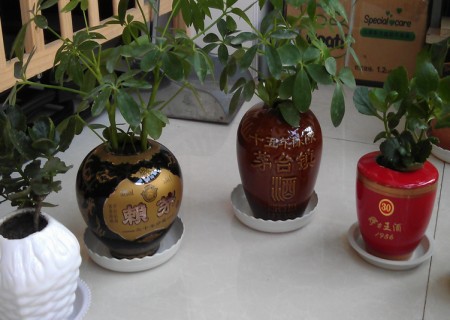
Making wine bottle bonsai requires the creator to be good at breaking convention, blending together two things in life that are otherwise completely unrelated. An empty wine bottle becomes the highlight, bypassing fixed thinking patterns and turning the impossible into the possible, and creativity thus creates value. Below let us take a look together at how to make wine bottle bonsai.
Actually, you can also use finished wine bottles to make simple little potted plants, high-end, elegant and classy. Let us learn together below!
Materials: discarded wine bottles, a hammer, pliers, a whetstone, an electric drill
Methods and steps:
1. First use the ridged edge of a whetstone to rub a complete ring around the mouth of the wine bottle, then gently tap it off with a hammer. Be sure to first use the whetstone to grind a deep mark around the bottle mouth. Below, a black bottle is used as an example.
2. Use a whetstone to rub a mark into the mouth of the wine bottle, then wrap it with a towel or the like, and give it a firm tap. The black bottle mouth will fall off.
3. After that, you need to drill a hole at the very bottom of the wine bottle, for drainage. For this step use an electric drill to drill a hole in the bottom of the wine bottle.
4. Finally, add base soil and potting soil into the wine container and plant the plants.
Wine bottle modification methods:
1. Cutting method: Find the best planting position on the wine bottle, then use a marker to make a mark at the position to be cut, hold the wine bottle firmly with your left hand, and cut with a portable electric saw. The cutting method is suitable for long, square and trapezoidal cutting openings, with the cut in a straight line direction.
2. Chiseling method: This method is suitable for round, irregular and smaller planting openings. First use a cutting machine or grinder to grind away the glaze layer on the surface where the wine bottle is to be opened; then fix the wine bottle on a sand pad or soil pad, and use a chisel and hammer to gently chisel the planting opening, or you can directly use a chisel to gently strike and chisel the planting opening.
3. Making ventilation and drainage facilities. Wine bottles are highly sealed and poor in ventilation, so when modifying a wine bottle attention should be paid to making ventilation and drainage. Both the bottle mouth and the planting opening can provide ventilation, and their size is directly related to how good the ventilation performance is. In addition, to prevent water accumulation in the bottle from causing root rot, drainage grooves should be sawed into the bottom of the bottle. For example, saw several "—"-shaped drainage grooves into the bottom of the bottle or cut off the bottom of the bottle.
When filling the substrate for making wine bottle bonsai, shake the wine bottle while filling it firmly. After planting, water thoroughly the first time, and place it in a ventilated and shady spot. In this way a distinctive golden larch wine bottle bonsai has begun to take shape, and in future care, the shape should be constantly corrected so that it grows toward perfection.
Compared with other bonsai, wine bottle bonsai are more difficult to care for. The bottom of the wine bottle must be modified to enhance its ventilation, and new soil must be replaced every year, with attention paid to fertilizing.