Detailed Explanation of the Methods and Steps for Making a Wisteria Bonsai
Beside an ancient wall, the wisteria brings gentleness and brightness to that sense of weathering and resilience; when wisteria covers a household's eaves, hanging down purple tassels, that home invisibly gains a touch of elegance; when wisteria forms a dense flower canopy or trellis, it creates a secluded, profound little world. After the cultivated wisteria blooms, it produces pod-shaped fruits that hang among the branches, adding a unique charm. Sometimes it blooms again in late summer and early autumn. The flower racemes and pods set each other off beautifully against the backdrop of feathery green leaves.
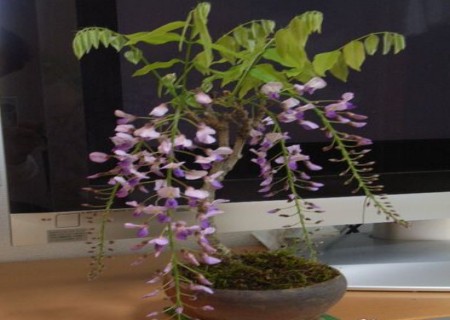
Wisteria, also known as tengluo or zhuteng, is an excellent flowering woody vine. It is generally used on garden trellises and in courtyard designs. In spring, its purple flowers bloom in profusion, full of unique charm. It is suitable for planting beside lakes, ponds, rockeries, stone archways and other such places, with a distinctive style, and is also commonly used for bonsai. It has strong resistance to harmful gases such as sulfur dioxide and hydrogen oxide, and can adsorb dust from the air. It has been widely used in greening, especially playing a pivotal role in vertical greening. It not only achieves greening and beautification effects, but also plays a role in increasing oxygen, lowering temperature, reducing dust and reducing noise.
How do you make a wisteria bonsai? The methods for making and cultivating a wisteria bonsai are as follows:
1. Obtaining the material
You can sow seeds or take cuttings, or dig up wild old root stumps from the mountains and fields. After growing them on for 1 year, they can be potted and worked on.
2. Potting
In spring, from February to March, it is best to plant before the wisteria leafs out. The potting soil is made by mixing fertile, well-drained leaf mold with garden soil; for the pot, choose a relatively deep purple clay pot, in shapes such as square, rectangular, perfectly round and oval.
3. Styling
In wisteria bonsai styling, pruning is the main method and wiring is supplementary. The branches should be staggered high and low to avoid monotony, and the number of layers should be fewer rather than more. The forms of wisteria bonsai include curved-trunk style or slanting-trunk style, weeping-branch style and cascade style, and they can also be made into root-over-rock style.
4. Watering
Watering should follow the principle of not watering until dry, and watering thoroughly when you do. In August, during the flower bud differentiation period, withhold water appropriately; in September, normal watering can be carried out; after leaf fall in late autumn, water less.
5. Fertilizing
During the growing season, along with watering, apply a thin cake fertilizer once every half month until fertilizing stops in July and August; in September, continue fertilizing, but both the frequency and concentration should be appropriately reduced; before flowering, appropriately increase the application of phosphorus and potassium fertilizer.
6. Pruning
When wisteria sprouts tender buds in spring, appropriately remove dense buds; when new branches grow to more than 20 cm long, the excess length can be cut off; at ordinary times, be sure to cut off water sprouts, diseased branches and weak branches at any time; pruning should also be carried out during the dormant period. In September, remove old leaves to encourage the growth of new leaves.
7. Repotting
It is better to choose early spring before budding. Repot once every 2-3 years.
8. Pest and disease control
Wisteria has relatively few pests and diseases. Its pests include aphids and leaf moths; the control method is to spray with solutions such as trichlorfon and emulsified dimethoate.
Summary of key operating points:
Wisteria is mostly transplanted before sprouting in spring. First plant it in a clay pot or in the ground to "grow on the material." Before planting, the plant must be pruned. Because it is a vine, it has a relatively long trunk, which can be cut off at a suitable position, keeping only the main branches and trunk needed for the bonsai styling; its main root is also very long, while fibrous roots and lateral roots are sparse, so the overly long main root can be shortened and more lateral roots retained.
After planting, keep it in a sheltered place for care, avoid exposure to scorching sun, and frequently spray water on the trunk to encourage adventitious buds on the old stump to sprout. After new branches grow out, remove the tender buds and new branches not needed for the styling, and pay attention to developing transition branches so that the branches and trunk of the bonsai are harmonious in proportion.