How to create a pine-style bonsai design with tamarisk
It is known that tamarisk is an excellent material for creating "weeping willow style" bonsai, and the soft, graceful charm it expresses is especially beloved. I had originally intended to learn from Master Wang Xuanmin and also create a weeping willow style bonsai with tamarisk, but the tamarisk material now in hand is of the tall-trunk, upright type, particularly stiff and strong. How could it express the gracefully lithe "soft beauty"! What to do? I had no choice but to change course, express "grand beauty," and create a "pine-style" design.
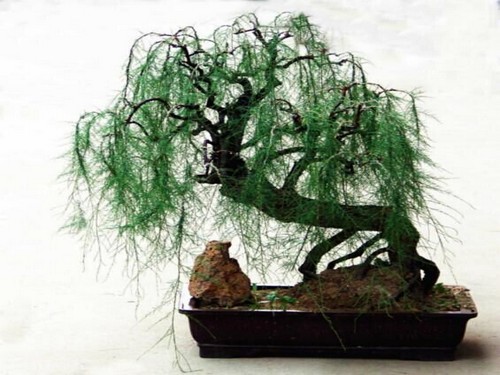
When trunk-chopping, the retained trunk has appropriate height and thickness, upright and powerful. In order to fully express the trunk's firmness and highlight this visual center, the branching position was raised and the main branches were reduced as much as possible, leaving only three: one on each side plus an apex branch. This achieved yielding space to the trunk spatially and highlighting the trunk structurally.
However, the main branches being merely concise is not enough; they also need lively and powerful spirit and charm. So the following styling measures were adopted:
1. Cultivate buds to grow branches, forming thick, sturdy main branches. The material's trunk was originally very tall; the middle and upper portions were cut off, leaving a "bald stump" at the lower part with no accompanying branch available, so new buds could only be stimulated and cultivated over the long term.
2. The main branches should have variation. Let the left and right main branches be one high and one low, one long and one short, one raised and one lowered, one bent and one extended, one protagonist and one supporting role.
3. The main branches and the trunk must be consistent in the direction of dynamic movement. The lower end of the trunk's raised base splits into two, forking left and right, with the right protrusion dominant and very beautiful. Besides being towering, the trunk also has a slight rightward shallow curve. Thus, from the root base and the basic skeleton, the tree's rightward dynamic movement was established. Therefore, in the subsequent styling, the upper trunk and apex branch were made to lean slightly right while towering upward, the crown was directed rightward, and the large cascading branch on the right was made to cascade rightward, all fully conforming to the trunk's rightward dynamic, thereby achieving overall unity.
When creating a pine-style tamarisk bonsai, the crown's "branch clusters" and "leaf pads" must be shaped into pine-like "cloud pads." This work's cloud pads are somewhat thicker and heavier, making them more firm and powerful. The shortcoming is that the crown top has not yet grown full and is relatively small in form; in the future it should be expanded somewhat. In addition, to avoid the monotony of having relatively few main branches, two small leaf clusters were added on the left side of the trunk. Though not fully formed, they are quite interesting.
Looking at the bonsai as a whole: the trunk is firm and upright, ancient and rugged, standing with a backbone of steel; the raised base forks apart, thick and powerful, standing firmly on its feet; the left and right main branches extend and bend freely, waving a vigorous posture; the crown is like a head and neck held high and looking forward, yearning toward the future (see the title image)-------
"In the vast twilight, behold the sturdy pine, XXXX remains calm," The pine-style tamarisk bonsai style draws on China's traditional pine-venerating culture, making it more conducive to expressing the brilliant image of people of lofty ideals and heroes. Mencius said: "Wealth cannot corrupt him, poverty cannot move him, power cannot subdue him - this is what is called a great man!" Through the ages, many classic teachings have nurtured generation after generation of passionate sons and daughters of the Yellow Emperor. At today's time of China's rejuvenation, such great men are likewise needed to strengthen the nation and enrich the people, and to make greater contributions to humanity.
The poem says:
Spirited and soaring, bones firm and strong, self-reliant and self-strengthening, a model of tree character. Admirable and praiseworthy is the great man, towering majestically between heaven and earth!