How to make a zelkova bonsai? A detailed guide to the complete production method
Wild zelkova trees often have tall and majestic forms, broad crowns, and very graceful shapes. Their leaf color can change richly with the seasons, and during the vigorous growth period they form dense green shade. They are widely used in landscaping and other fields and are an important ornamental tree species.
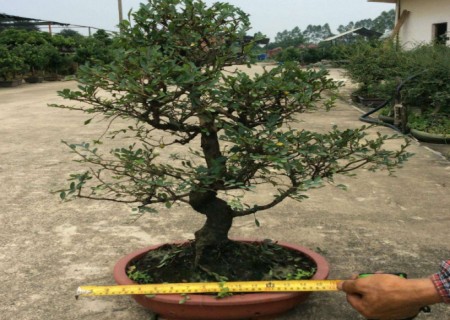
In addition to surrounding outdoor landscapes, the tree form can also be appreciated as a bonsai. Not only is its appearance graceful and varied, it also has strong sprouting ability and is very tolerant of wiring, so it is an excellent material for bonsai. Today, the editor will briefly explain the production method of tree-form bonsai for everyone.
1. Source of materials
Zelkova can be propagated by sowing seeds to produce young plants as the basic seedling source for making bonsai. Usually, its fruits are picked in late autumn, dried in the shade, and stored, and sowing can be carried out in early spring of the second year. However, as with sowing many seeds, the seeds need to be soaked in advance for 1-2 days.
2. Transplanting young plants
The root system of young zelkova plants is not only slender but also very tough, so when digging up young plants, the surrounding roots should first be cut off, and then the plant should be dug out together with the soil ball. This can avoid tearing the root bark and affecting the survival rate of transplanting. Its potting method is basically the same as that for most potted tree species, so it will not be described in detail here.
3. Pruning and shaping
Zelkova is suitable for being trained into a straight-trunk style, because zelkova has sympodial branching and extremely strong sprouting ability, but the terminal bud often does not sprout endlessly. Every year in early spring, 2-3 competing branches sprout from the lateral buds at the branch tips, so it is not easy for it to grow a perfectly straight trunk. However, in order to cultivate a straight trunk, appropriate pruning is generally carried out every year after transplanting. To make the trunk grow thicker and stronger, it is recommended to use a knife to make several longitudinal cuts on the trunk each year when the zelkova sprouts.
4. Maintenance and management
Zelkova likes sunlight and a warm growing environment. Although it does not have high requirements for the potting soil environment, planting it in fertile soil will make it grow better. Also, considering the strong expansiveness of its root system, deep planting is recommended. Usually, it is only necessary to keep the potting soil slightly moist, and watering must not be excessive enough to cause problems in the pot; in summer, watering can be appropriately increased, and in winter, watering should be strictly controlled. To keep the plant in good growing condition, we can supplement it with cake fertilizer water at the right time and in the right amount to increase nutrients.