Tangli pear - one of the main deciduous fruit trees for making bonsai
Tangli pear is one of the main deciduous fruit trees suitable for making bonsai, with many excellent varieties. When used for bonsai, you can enjoy the flowers in spring, the leaves in summer, and the fruit in autumn, while after the leaves fall in winter, the gray-black, cracked, rugged trunk shows even more its jagged, quaint, and natural character, and the whole tree's vigorous clusters of short fruit spurs also hang upside down like chicken claws and anchors, full of charm.
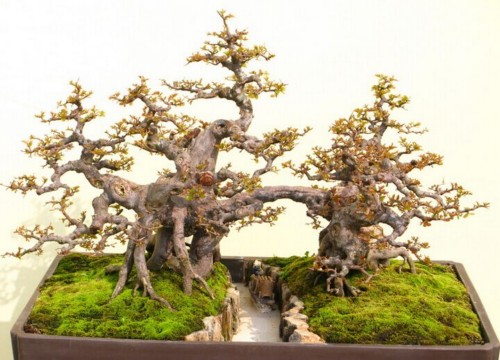
Tangli pear has a well-developed root system, grows robustly, bears fruit easily, and has a long lifespan. It has strong adaptability to climate and environment, likes light and favors fertilizer, but can also tolerate poor and dry conditions and cold, and is not strict about soil, environment, and other natural conditions.
For pot cultivation, loose, fertile neutral loam rich in humus with a pH of about 5-8 is especially good. Tangli pear is suitable for making many forms of bonsai, such as straight-trunk style, slanting-trunk style, curved-trunk style, double-trunk style, and waterside style. It is just that the leaves are relatively large, so it is not suitable to be wired into pads; a natural form is more appropriate.
When selecting materials for Tangli pear bonsai, for rootstock selection and breeding in the Central China region, you can choose relatively thick wild Tangli pear and other pear rootstock stumps that meet traditional bonsai conditions for grafting in late autumn and early winter, which is simple and easy to do.