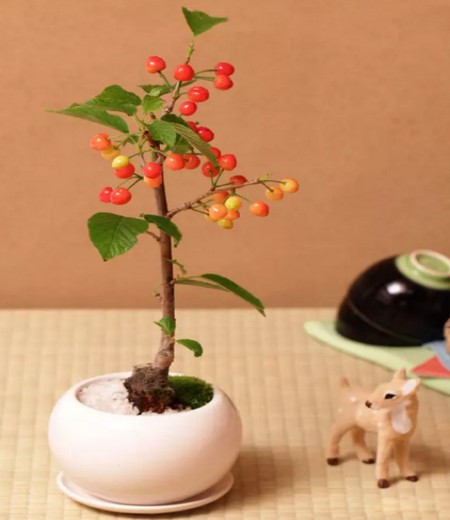
Detailed Explanation of Cherry Bonsai Planting Methods and Techniques
Cherry seedlings should be cultivated in loose, fertile, well-drained sandy loam soil. For pot cultivation, the growing medium is prepared by mixing 4 parts leaf mold, 3 parts garden soil, and 1 part each of fine coal cinder granules, sawdust, and fine sand particles. Place some decomposed organic fertilizer at the bottom of the pot as a base fertilizer. Spring is the best time for planting. Seedlings should have a well-developed root system, a trunk diameter of about 1 cm, and a plant height of 50 to 60 cm.
Air layering method:
Select a branch that is more than two years old, and make a ring bark cut on the lower part near a node (destroying the phloem at that location to encourage the cambium above that point to develop roots), then place moist moss into a transparent plastic bag and wrap it around the entire wound, tying both the upper and lower ends. Once roots have formed, cut below the layered area and pot it as a new plant. This is usually done during the vigorous growth period of the cherry (in late spring and early summer), when rooting is easy. Although rooting is relatively easy, results vary greatly between varieties.
Cuttage method:
During the spring and summer growing season, select semi-mature, healthy branches with a diameter of 0.7-30px, each segment 15-500px long, with 4-6 leaves attached, and insert them into river sand, vermiculite, peat moss, or a mixture of several of these, all suitable as a cutting bed medium. The cuttings especially need to be kept moist and shaded. After cutting, roots develop in about 1.5-2 months, and transplanting should be done after the root system grows vigorously. If managed properly, the cuttage method can achieve a 60-90% survival rate. The cuttage method is simple and has the highest success rate.
Seed propagation method:
After harvesting cherries, break open the skin and flesh to remove the pit, and wash off the flesh attached to the pit with clean water, then place it in a cool, shaded area to dry for 1-2 days before sowing. When sowing, place the pit directly into a shallow pot, and germination occurs in about 10-30 days after sowing. When the seedling grows to 5-250px, transplant it into a soft plastic pot. Cherry seeds germinate easily, but germination is not uniform, and seeds produced by some plants often lack viable embryos, with a germination rate often below 30%. The seed propagation method takes longer to reach fruiting age, and the quality varies greatly among seedlings.
Grafting method:
Cherry grafting uses cherry seedlings, mountain cherry, flowering cherry, etc. as rootstock, and good cherry varieties as scions, and is carried out in spring before buds break. It is best to choose a rootstock and scion with the same or similar thickness, and either cleft grafting or approach grafting can be used. When grafting by the cleft method, select the grafting position on the rootstock, cut off the excess branches above with sharp shears, and split the remaining "stump" with a knife, making the opening about 2-3 cm deep. The scion should be about
10 cm long, quickly cut the scion into a "wedge" shape on both sides and insert it into the cleft; after aligning the cambium layers, bind tightly with plastic film strips, with no gaps for air to enter. First place it in a cool, ventilated area, and spray water on the ground to maintain high humidity in the environment, or cover it with a plastic bag to retain moisture. Afterwards, ventilate promptly according to temperature changes, and do not let the temperature inside the bag get too high. When new buds grow, remove the plastic bag. And move the plant to a location with ample sunlight. Watering should be done with alternating dry and wet periods.