How to make a bonsai from Schefflera? A step-by-step guide to the making method
Schefflera is also called duck-foot wood or duck-palm wood. Because of its unusual leaf shape, evergreen branches and leaves, and high ornamental value, many households grow it as a potted plant. But some bonsai enthusiasts also train it into fine bonsai works for appreciation, so how is Schefflera made into a bonsai? Today the editor will illustrate for everyone the method of using Schefflera to make a rock-clinging bonsai.
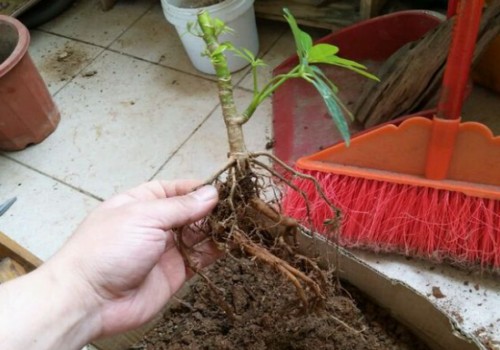
1. First we need to find a dwarf variety of Schefflera, or cut off the head or pinch the top of a Schefflera seedling that has grown to a height of 20-30 cm to encourage it to sprout side branches. After the wound has healed, dig it out of the soil and remove the soil clinging to the root system.
2. Next find a stone of suitable size. Do not choose the kind that is smooth all over, but choose a stone with an uneven, relatively rough surface, as this is more conducive to the distribution and climbing of the plant's roots after the Schefflera rock-clinging bonsai is made. Then carry out simple processing on the chosen stone, and if necessary, grooves also need to be cut into the stone.
3. Place the Schefflera plant roughly on the stone, try various placement effects to seek the best one, and at the same time conceive and design the styling effect. Make marks in the most ideal posture, then prepare to cut grooves in the stone.
4. Next we prepare the tools needed for cutting grooves in the stone, and cut grooves in the stone according to our own design ideas or framework. After the grooves have been made in the stone, place the stone in a flower pot of suitable size.
5. Place the Schefflera on the grooved stone, then tie it slightly with string. Wire or aluminum wire is not recommended, because it not only easily injures the plant's root system, but also needs to be removed later, which is somewhat troublesome. So it is suggested to use ordinary sewing thread, as over time the thread will rot by itself, thus saving the trouble of removing the thread.
6. Take a large plastic drink can, then cut off the top and bottom, leaving only the middle section, then cut it open and place and fix it around the outside of the stone. Note that a certain distance should be kept between the inner wall of the plastic can and the stone to form a space. This is because the space formed can be filled with growing soil to cultivate the Schefflera on the stone.
7. Finally, we fill the space formed between the plastic bottle and the stone with soil, then water it thoroughly once. After completion, place the finished bonsai work in a cool, ventilated place to recover, and just pay attention to keeping it moist during this period.