Detailed Explanation of the Production Methods and Steps of Vitex Bonsai
Vitex (Vitex negundo) has characteristics such as liking sunlight but tolerating shade, liking warmth but tolerating cold, liking moisture but not tolerating waterlogging, and liking fertile soil but tolerating poor soil. It is an evergreen tree species. It has peculiar forms, and can be appreciated both for its leaves and its shape, so it is a bonsai tree species with extremely high ornamental value. Moreover, this vitex has strong vitality and is easy to manage, so it is also very easy to grow well when made into a stump bonsai. So, how do you make a vitex bonsai?
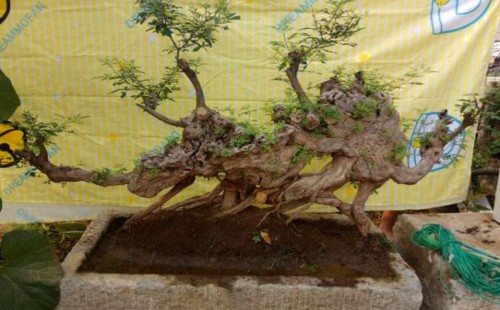
Vitex is a form of old vitex tree stumps, and has unique advantages in making stump bonsai, so it is very widely used. But the production process of vitex bonsai also requires mastering certain techniques, and the creator needs to have a certain foundation in bonsai making, especially the basic techniques for making stump bonsai must be proficient. Now follow the editor to take a look at the production methods of vitex bonsai!
I. Material Collection
To make a vitex bonsai, first we need to obtain suitable stump material. Wild-collected vitex stumps can be obtained by digging in the wild, and wild stumps generally grow in outdoor mountain forests. Relying on its tenacious vitality, vitex can often survive smoothly in relatively harsh wild environments, so it is also relatively easy to dig up. In addition to collecting from mountains and wilds, it can also be artificially cultivated, except that artificially cultivating old stumps takes a relatively long time, and to grow vitex, the technical requirements are often relatively high.
II. Digging the Stump
After determining the time, we need to dig up the wild-collected stump in time. But when digging, be careful to keep a certain distance from the vitex stump to avoid cutting off too many roots because of being too close, thereby affecting the survival of the vitex. At the same time, during the digging process, try to keep the soil ball, and during the transportation of the wild-collected stump, protective measures should be taken to avoid breaking up the soil ball, thereby affecting its rapid survival.
III. Processing
After digging up and transporting the vitex wild-collected stump back, we cannot blindly pot it. Generally, it still needs to be cultivated as a stump. And before cultivating the stump, we also need to properly trim the roots, and at the same time use drugs such as carbendazim or thiophanate-methyl to sterilize and disinfect the wounds, to avoid wound infection, thereby affecting the survival of the stump. Of course, if there are too many branches and trunks, they also need to be properly shortened to avoid excessive consumption of water and nutrients. After all, before the wild-collected stump survives, it mainly relies on the nutrients and water in the tree body to maintain life.
IV. Cultivating the Stump
After carrying out the necessary processing and preliminary shaping of the vitex wild-collected stump, the original creator then plants it in the ground to cultivate the embryo. At the same time, do a good job in the management of light, water, and fertilizer, thereby promoting the vitex wild-collected stump to quickly take root and sprout. After the vitex wild-collected stump smoothly develops a large number of roots during the ground cultivation stage and produces a certain amount of branches and leaves, we then choose an opportunity to dig it out and transplant it into a pot.
V. Potting
When the well-cultivated vitex stump is strong enough and has enough capacity to grow in a flower pot, we need to choose an appropriate time to pot it and plant it in an ornamental pot for cultivation. Although the root system of vitex is relatively shallow, its distribution is still relatively developed, and it relatively likes deep and fertile soil environments, so it is necessary to prepare a slightly larger flower pot, and then fill it with fertile, loose, breathable, and water-permeable slightly acidic potting soil. After completing the potting, pay attention to taking shading measures in time, to avoid the vitex having a process of recovering and surviving. During this period, its root system has not yet recovered its normal absorption capacity, so shading and moisture retention are very important.
VI. Shaping
Before ground cultivation, preliminary shaping treatment of the vitex is often required, and after potting and planting, we also need to carry out detailed shaping treatment of the vitex bonsai. Generally, after determining the bonsai style to be made, a combination of wiring and pruning should be adopted to complete the branch training and shaping treatment, so as to perfect its form and improve the ornamental effect of the bonsai. In particular, pay attention to keeping the proportions between the branches and the tree body and the flower pot coordinated.
VII. Maintenance
Since vitex likes a fertile and loose potting soil environment, and at the same time requires a growth environment with sufficient sunlight, warmth, and humidity, in our usual maintenance and management process, in addition to proper shading under the scorching sun in summer, at other times it should generally receive sufficient light. Watering is generally carried out after the potting soil becomes dry, to avoid excessive watering causing water accumulation in the pot and leading to root suffocation. And in the peak growth season, we also need to properly apply some thin liquid fertilizer, mainly nitrogen fertilizer. But at the same time, avoid giving too much fertilizer, otherwise it is easy to cause excessive growth of branches and leaves. At the same time, it is also necessary to do a good job in the prevention and control of pests and diseases in a timely manner.