Detailed explanation of the steps for making a formal upright (Chokkan) bonsai
The formal upright style is also a relatively common design in the bonsai-making process. It requires the trunk to be straight and upright, thicker at the bottom and thinner at the top, with the side branches on both sides of the trunk kept flat and extended, while the root system is often exposed around the base yet appears strong and powerful. Viewed as a whole, the lowest branches are the longest and slant downward, the middle branches stay flat and tilt slightly downward, and the upper branches rise slightly, giving the whole bonsai a clear sense of layering and a striking ornamental effect. So how do you make a formal upright bonsai?
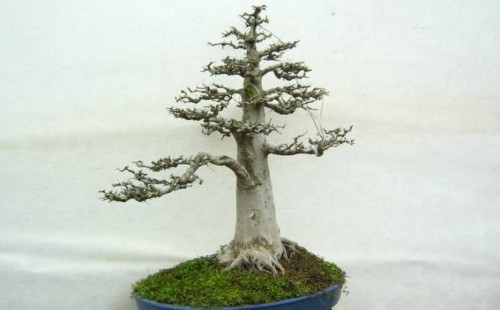
To make a formal upright bonsai, we first need to find a suitable tree; if we cannot find suitable material, we need to cultivate it. The goal is to keep the trunk straight or slightly curved, so that overall it looks towering and upright, giving a sense of reaching straight into the clouds. A formal upright bonsai is generally a single upright tree, but due to differences in tree species, tree age and styling techniques, each one often has its own merits and distinctive features. Today, the editor will share with you the steps for making a formal upright bonsai, which can be simply understood as having just two core parts.
1. Cultivating the tree
For making a formal upright bonsai, you can use a young tree or a stump, but the cultivation process differs for the two. Below, the editor will briefly introduce the cultivation process for these two tree forms!
1. Cultivating a formal upright bonsai from a young tree
Generally, when a young tree grows to a certain size, the lower part of the young tree needs a first trunk-chopping treatment, and the cut surface should keep a 45-degree angle with the trunk, maintaining the left and right angles. After several years of cultivation, a second and third trunk-chopping treatment is often also needed, and each time the angle of the cut surface must be noted. While carrying out the trunk-chopping treatment, it is often necessary to combine it with pruning and styling, so that the size of the trunk meets the basic requirements for making a bonsai. Finally, it is transplanted into an ornamental pot to continue being cultivated.
In the cultivation process of a young tree, it is often easier to process and shape it according to the creator's ideas and design concepts, and the cultivated material is very novel, with little deviation from the preset goal. But there is also an obvious drawback: the cultivation time often seems too long, and we need enough patience to complete this work.
2. Cultivating a formal upright bonsai from a stump
In the process of obtaining a stump, we should choose as much as possible those stump specimens with an upright trunk. After the stump is in hand, it first needs branch trimming and root pruning, retaining the trunk part with a relatively natural transition, then planting it in sandy soil to nurture the stump, or planting it directly in a large flower pot to build branches and grow the trunk. After several years of cultivation, when the branches and leaves have grown in relatively good harmony with the trunk, it is then transplanted into an ornamental pot to continue being cultivated and shaped.
2. Bonsai styling
The biggest feature of a formal upright bonsai is that the trunk is straight or basically in an upright, upward state, with the characteristics of being tall and vigorous, which of course is also a typical feature of arbor species. But when making the styling, we also need to choose a tree suitable for styling. This kind of tree should have a perfect root spread, a rugged and upright base, a trunk of moderate size with a clear distinction between the thickness of the upper and lower parts, and many side branches on the trunk. After determining the required tree, we can proceed with the styling treatment.
Normally, the process of cultivating and styling a formal upright bonsai is relatively difficult, and often needs to be carried out comprehensively from design, apex formation, growth promotion, whole-tree shaping and other stages. But it is required to shape a monotonous and rigid tree appearance into one with dynamism and spirit, so that the bonsai work has novelty and there is some breakthrough in its creation.
The first thing is the allocation of the main branches, which should be arranged according to certain rules. The first branch should extend toward the left front or the right front; the second branch should extend to the right or left in an alternating way to achieve balance; the third branch should become an inner branch extending backward to show depth; but starting from the fourth branch, the position allocation is as described above, while the lower branches are almost horizontal and slightly drooping, and the higher the branch, the greater the tilt, which is very important in the performance of young branches and can show beauty to the greatest extent. But the drooping extent of the main branches often differs depending on the tree species.
Next is the apex, which is winding and varied in direction, with two situations: deviating from the trunk and not deviating from the trunk, but both need to use floating branches to capture momentum and create different styling effects. The more common ones include the welcoming-guest style, the natural wild red cotton type, and the double formal upright towering style, etc. Of course, each styling pattern uses different techniques, and the styling effects each have their own characteristics, all of which are worth our study and deep understanding.