A Detailed Guide to Grafting Techniques and Methods for Potted Osmanthus
There are many methods for grafting osmanthus, among which the approach grafting method is a commonly used one, and in China potted osmanthus is mostly grafted by the approach grafting method. Its advantages are: a long suitable grafting period, easy survival, quick shaping, and early flowering. The key points of the osmanthus approach grafting technique are introduced as follows:
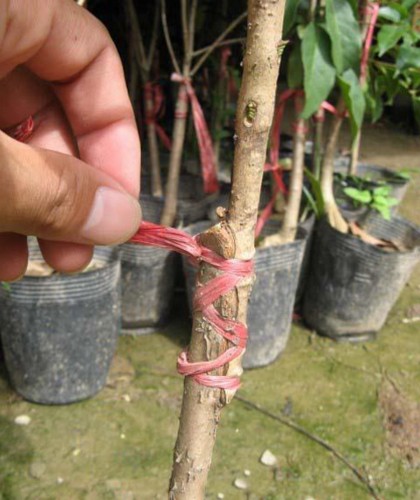
1. Cultivate the rootstock. The rootstock tree species used for grafting osmanthus include privet (Ligustrum) and fringe tree (Chionanthus retusus), among others. The rootstock used for grafting needs to be strong-growing, free of pests and diseases, and 2-3 year old saplings or 2-3 year old branches on multi-year-old trees with a thickness of 1 cm or more.
2. Select the scion. Osmanthus varieties include golden osmanthus (Jin Gui), silver osmanthus (Yin Gui), orange osmanthus (Dan Gui), and four-season osmanthus (Si Ji Gui). First, select an osmanthus variety according to your preferences and resource conditions, then from the selected osmanthus tree choose strong-growing, well-developed, pest-free, and moderately sized 2-3 year old branches as the scion.
3. Grafting method.
(1) Move the scion close to the rootstock. Methods such as propping, padding, racking, hanging, and tying can be used to bring the selected osmanthus branch serving as the scion close to the rootstock branch in the same direction. Then specifically determine the suitable grafting positions of the rootstock and scion, and secure them in place.
(2) Cut the joining surfaces. Cut joining surfaces at the determined grafting positions on the rootstock and the scion respectively. The surface is oval in shape, 3-5 cm long, and the depth of the cut generally does not exceed half the thickness of the branch.
(3) Cut the rootstock. After the grafting and tying are completed, cut off the rootstock branch 1 cm above the join.
(4) Remove sprouts. After grafting, if branches sprout from the part of the rootstock below the join, they should be wiped off promptly. 31-35 days after grafting, cut off the scion from below the join to separate it from the mother plant.
(5) Check survival. 3-5 days after cutting off the scion, if the scion's branches and leaves grow normally, it has survived; if the leaves become wilted and curled, it has not survived, and grafting should be done again. After the graft has survived, the branches grow quickly, and the tying string can easily become embedded in the bark and affect growth, so the tying string should be loosened promptly.
How is osmanthus grafted and grown? Osmanthus grafting and growing generally uses privet or water privet as the rootstock. Privet and water privet have strong adaptability, are cold-tolerant and waterlogging-tolerant, and are easy to grow, but after survival the join is easily broken. To overcome this shortcoming, a low grafting method can be adopted, that is, when planting, bury the grafted part in the soil so that the scion itself grows roots. The grafting time is in March-April. The grafting methods generally used are side grafting and approach grafting.
(1) Side grafting:
Side grafting means trimming the rootstock before grafting. Cut everything off 6-7 cm above the soil surface, and make a slanted cut near the root collar. Do not damage the pith. Use a 2-3 year old branch (without leaves) as the scion, about 10 cm long. One with 2-3 nodes is preferable. Then cut the scion's joining end into an unequal-sided wedge shape, insert it into the cut on the rootstock so that they fit closely together. After tying with plastic or hemp fiber, mound soil up to the top of the scion.
(2) Approach grafting:
For approach grafting, first grow the rootstock in a pot. During the plum rain period in June-July, choose a two-year-old osmanthus branch similar in thickness to the rootstock for approach grafting with the pot, and after survival, cut it off before "White Dew". That is, the new plant can bloom in the same year. After the graft has survived, when the new shoot of the grafted plant reaches 10-15 cm, cut off all remaining rootstock shoots and tillers. Because the rootstock easily sprouts adventitious buds, they should be peeled off at any time. Between June and August, carry out drought resistance measures, apply top dressing, and weed. For potted seedlings, when the new shoot reaches about 15 cm, pinch off the growing tip to promote side branch growth and form a shrub shape.