How to grow a Diospyros cathayensis bonsai so it flowers and fruits? A detailed guide to care methods
Several years ago I dug up a Diospyros cathayensis stump from the mountain that had already borne fruit, but in recent years it has not flowered or fruited. What is causing it to no longer flower and fruit? How can I encourage the Diospyros cathayensis to flower and fruit?
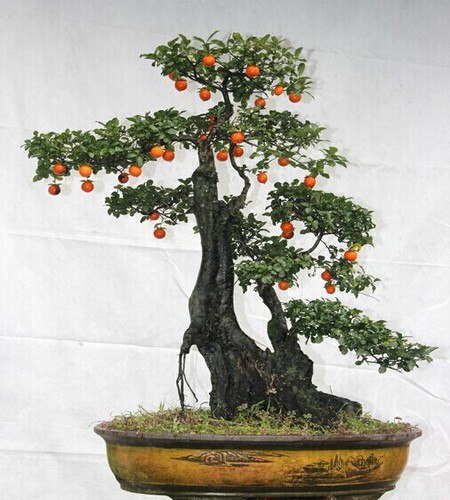
According to experts, the fact that the Diospyros cathayensis stump I dug up had already borne fruit shows that it is undoubtedly a female plant. The reasons it has failed to flower and fruit normally in recent years are as follows:
First, a large amount of the root system was damaged when the stump was dug up, and the trunk and branches were heavily pruned back, which took a severe toll on its vigor, so it needs 2—3 years or even longer for the tree to recover and build up nutrients before it can produce flower buds and bloom again. Second, the light, temperature, water and humidity of the placement site differ greatly from its native environment, and it has not been able to fully adapt in a short time. Third, fertilizer was unbalanced during care, for example too much nitrogen fertilizer and insufficient phosphorus and potassium fertilizer. Fourth, care was neglected during flower bud differentiation, with the soil being too dry or too wet, or the air humidity being insufficient, so the flower buds could not complete normal differentiation and development.
How can flowering and fruiting be encouraged?
1. Graft 1—2 vigorously growing male branches onto the female plant, in April—May or August—September. After the grafts take, take care to protect the flowering branches, or move it to a place where there is a flowering male plant, and the pollination problem of the female plant can be well solved. If it is grown on a balcony or rooftop, you can also consider artificial supplementary pollination at 9—10 in the morning during the April flowering period.
2. Pay attention to balanced nutrition. It keeps green branches and leaves all year round, and the fruit remains on the plant for as long as 10 months, so a sufficient nutrient supply is required throughout the entire vegetative growth and reproductive growth stages. After the beginning of spring, apply more liquid fertilizer based mainly on nitrogen, at a concentration of 1:6 or 1:8, applying light fertilizer frequently, so the plant can regain its vigor as quickly as possible. It blooms around mid-to-late April. When flower buds appear in mid-April, apply more quick-acting fertilizer based mainly on phosphorus and potassium, and if necessary spray a 0.2% potassium dihydrogen phosphate solution to promote flower bud swelling and flowering and fruiting. Half a month after fruit set, apply a liquid fertilizer with equal amounts of nitrogen, phosphorus and potassium to ensure an adequate supply of water and fertilizer so the plant grows vigorously. Its flower bud differentiation generally occurs about one month after the new shoots stop growing, that is, from late June to August. At this time, appropriately applying phosphorus and potassium fertilizer can promote flower bud differentiation: fertilizing at this time not only helps flower bud differentiation and ensures normal flowering and fruiting the following year, but also helps the current year's fruit swell rapidly.
3. Pay attention to fruit thinning to maintain a balanced nutrient supply. Fruit thinning starts 4—5 days after the flowers fade and is completed within 10 days. Keep 15—20 fruits on a medium-sized bonsai and 30__80 fruits on a large bonsai.
4. Maintain relatively high air humidity. It likes an environment with moist soil and air, and the relative air humidity is required to be greater than 800/Torr. Throughout its flowering and fruiting period, the pot soil should be kept moist and must not fluctuate between high and low. This is the key to care that ensures normal flowering and fruiting of Diospyros cathayensis.