How to Grow Apple Bonsai? Detailed Explanation of Key Planting Techniques
Apple trees can be shaped into various bonsai forms according to the shape of the trunk, such as straight-trunk style, curved-trunk style, double-trunk style, slanting-trunk style, lying-trunk style, and exposed-root style. For young trees, the trunk can be wired and shaped to make it winding and graceful, combining rigidity and softness. For trunks lacking an aged appearance, methods such as splitting, carving, or planing the trunk can be used to achieve a clear, extraordinary, and elegantly antique artistic effect.
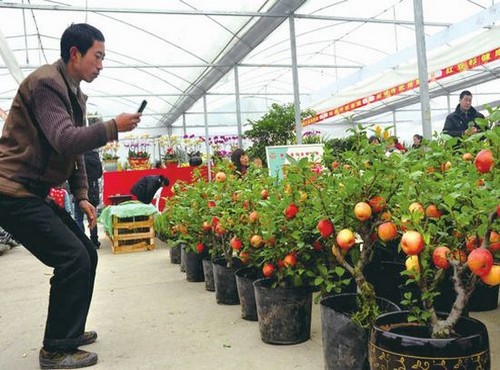
I. Pot Selection and Preparation of Nutrient Soil
Choose a clay pot, wooden bucket, or wooden box with a diameter of 40cm, a bottom diameter of 35cm, and a height of 30cm with drainage holes. Prepare nutrient soil: 6 parts fertile loam, 2 parts river sand, 1 part decomposed sheep manure, 1 part rotted leaves and fermented horse hoof fertilizer, mix evenly in proportion, and sift.
II. Potting
Select seedlings that are robust, with plump buds and free from pest and disease damage, and plant them in pots in early to mid-April. When planting, soak the roots in 5-degree lime sulfur mixture for disinfection, and cut off necrotic roots. First put a small amount of nutrient soil into the bottom of the pot, place the seedling in, spread the root system evenly, firm the soil, and water promptly to ensure survival.
III. Grafting
For apples used to make bonsai, choose varieties that are not too large in plant size, bear fruit early, have strong self-pollination and fruit-setting ability, have moderate fruit size, and bright colors. Use crabapple, Malus baccata, or apple seedlings as rootstock, and use healthy branches or plump buds slightly above the middle as scions, grafting by cleft grafting, cut grafting, or bud grafting. It is also possible to use old stumps that have grown for many years and have peculiar and antique forms as rootstock, and 1- to 3-year-old branch groups as scions for grafting. This method can not only speed up the shaping process but also bear fruit earlier.
Transplanting of the rootstock is carried out before sprouting in spring or after leaf fall in autumn. First plant it in a clay pot of appropriate size. Before planting, it should be properly pruned, cutting off branches not needed for shaping to reduce nutrient consumption and improve survival rate. The root system should also be pruned, cutting off thick main roots and retaining more lateral roots and fibrous roots. Roots of appropriate thickness and length can first be coiled into the pot to prepare for future exposed-root styling.
In the first year after survival, let it grow freely so that the branches develop fully and the root system becomes complete. In the second year, carry out grafting and cut off branches on the rootstock to ensure sufficient nutrients are supplied to the scion for growth.
IV. Wiring
Apple branches are soft and quite flexible, so in May each year, 1- to 3-year-old branches can be wired to give them certain bends and variations. Since wired branches grow downward or extend parallel, their apical dominance can be removed, gradually changing the plant from vegetative growth to reproductive growth, which is conducive to flower bud formation. Root exposure can also be carried out according to shaping needs and the rootstock variety. Among them, apple bonsai grafted onto arbor-form rootstock is especially suitable for making exposed-root style bonsai because of its well-developed and thick roots. Root exposure should be carried out year by year and in stages, not all at once. Fresh roots of suitable shape, thickness, and length can also be selected and grafted by the bark insertion method. This makes the roots naturally twisted and powerfully antique.