How to Create an Antique, Weathered Aesthetic in Plum Blossom Bonsai
Plum blossom bonsai uses the pot as "paper" and plum blossoms, rocks and stones as the "painting". Through artistic treatment and careful cultivation, it concentrates and typically reproduces the spirit and appearance of plum trees in nature, and is a work of art that expresses the author's thoughts and feelings. Therefore, plum blossom bonsai is a perfect combination of horticultural technique and formative art; it originates from nature yet rises above nature.
In ancient China, plum blossom bonsai was relatively popular. During the Jiaqing period of the Qing Dynasty, Su Ling of Wuxi wrote "Random Records of Bonsai" in two volumes, dividing bonsai plants into the Four Great Masters, the Seven Sages, and the Eighteen Scholars, with plum blossom ranked first among the Eighteen Scholars. Plum blossom bonsai is generally divided into three categories: plum trunk bonsai, small plum blossom bonsai, and freehand-style plum blossom bonsai.
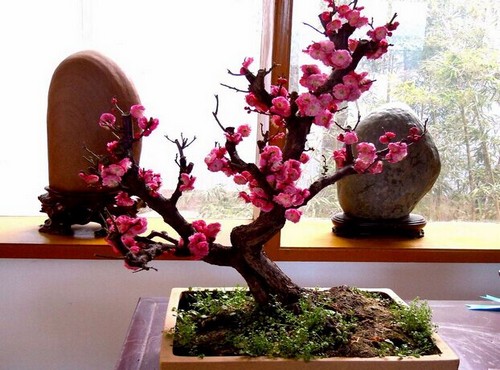
Plum blossom bonsai stands out uniquely in China's bonsai art, and its antique, vigorous form with sparse shadows slanting across is extremely poetic. Today, plum blossom bonsai has become one of the bonsai types cherished by families large and small. Some people are so fond of the antique, weathered look of plum blossoms that they simply "age" the young plum trees in their homes. What follows is an introduction to how to enhance the antique, weathered beauty of plum blossom bonsai.
1. Cutting
On the main viewing face of the plum blossom bonsai, use a carving knife to cut and peel away the bark, then use a small chisel to damage about 1/3 of the xylem. In this way, the scars on the trunk will appear aged.
2. Insertion
Choose a well-shaped, already dead plum trunk, trim away the long branches, chisel a vertical groove on its back side, then insert a young seedling, fill the outside with mud and moss, spray with water, and tie it tightly with rope. Over time, as the seedling's main trunk grows thicker, it fills the groove. Remove the rope. This method leaves no trace of human work and can achieve a effect so lifelike it passes for real, looking as if a withered tree has come back to life in spring.
3. Carving
On the side viewing faces of the plum blossom bonsai, use a carving knife to peel the bark from the trunk, then use a chisel to damage the xylem and insert stones. Carved scars should not be too many; they must be handled flexibly according to plum trunks of different sizes and shapes.
4. Tearing Branches
For surplus branches on both sides of the trunk's viewing face, do not cut them off with scissors; instead, tear the branches away from the base by hand, so that the xylem heals and forms natural, attractive tree scars. In short, all surplus branches can be handled by the tearing method, but this should be done in stages and batches, and only on the premise that it does not affect the tree's growth.
5. Hammering
To make plum blossom bonsai look aged, you must first make the smooth bark of the trunk show an aged, uneven, bumpy appearance. How can this be achieved? A hammering stimulation method can be used: during the tree's growing season, strike the lower part of the trunk with a hammer or other hard object to cause local damage, which accelerates cell division, forms local callus tissue that thickens, and creates local swellings that give an uneven, bumpy appearance.
6. Prying the Bark
In the season of vigorous tree growth, insert a small knife into the bark and gently pry, separating the bark from the xylem. After 2 months the wound heals, forming callus tissue that bulges like a tumor.
The above are the six methods for "aging" plum blossom bonsai. Note that you must not damage the plum tree because of your own preferences. Before any specific operation, be sure the plum blossom bonsai is healthy, and do not use excessive force during the operation, so as not to affect the plum tree's growth.