Detailed guide to grape bonsai growing techniques, easy for beginners to get started
When it comes to growing grapes, everyone immediately thinks of vast vineyards covering wide areas, but today we have good news for you: grapes can also be grown in flower pots, and they can even survive. Come and take a look.
Grape bonsai is the general term for grapes grown in containers, that is, grapes cultivated in pots, boxes, barrels, growing troughs and other containers. Grower Li Baoying: “After the grapes are eaten, the leaves will slowly fall, because grape growth requires a dormancy process, generally about 1400 hours. After the grape leaves have all fallen, just put it in a slightly cooler place, such as a shaded balcony. After about 1400 hours it begins to sprout, and then the following year, through pruning, it can bear fruit.”
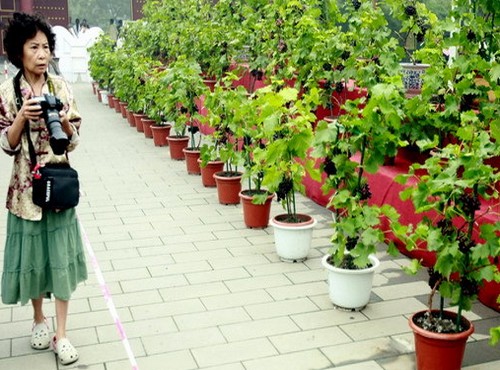
Using cuttings and layering, grapes are trained into bonsai shapes such as curved dragon form, flower basket form and fan form, which can be used both for ornamental enjoyment and for tasting delicious green fruit. In 2003, our center used new ultra-early-maturing potted grape varieties for layering in early spring and carried out industrialized field cultivation. In mid-to-late June, when the clusters turned red, they were sold on consignment by flower shops in cities such as Jinan and Shijiazhuang, selling for 30-40 yuan per pot, while the comprehensive cost was only about 3 yuan, giving especially good returns. The production technology for rapid grape bonsai is now introduced to readers, especially fruit growers engaged in grape growing with low returns, in the hope that it will be helpful.
1. Choosing soil and selecting varieties. Grapes can adapt to all types of soil except heavily saline-alkaline soil. The soil must be deeply plowed and generously supplied with organic fertilizer to improve soil fertility. For grape varieties, choose early-maturing large-fruited varieties suitable for pot culture. After 2 years of trial screening, we believe that the “Tezaohong” table grape variety bred by the Grape Research Institute of the Chinese Academy of Agricultural Sciences is suitable for pot culture. This variety has purple-red skin, belongs to the high-sugar large-fruit type, and has a rich rose fragrance. When potted in early spring, it can set and color fruit in early to mid-June of the same year.
2. Open-field cuttings. Cuttings can be taken in late March in the south and mid-April in the north. When taking cuttings, the cuttings should be inserted slightly slanted and fully inserted into the soil, with the upper bud eye 1 cm from the soil surface. In rainy southern regions, the bud eyes may also be left exposed above the soil surface. The grape rows should run north-south, with plant spacing of 17-20 cm and row spacing of 130-150 cm.
3. Field management. After the cuttings sprout, keep 1 main vine per plant for growth and remove all other lateral shoots. When the seedlings are 30 cm tall, to prevent lodging, trellises and wires must be set up, and the seedlings evenly tied to the wires. When the seedlings are 80 cm tall, pinch the main vine. After pinching, leave 4 lateral shoots at the top for growth, and pinch each lateral shoot after it grows 5 leaves. After entering June, spray 200-fold Bordeaux mixture once every 15 days to prevent disease. After the grapes sprout, except during the 10-day flowering period when pesticides cannot be used, spray low-dose, high-efficiency, low-toxicity, low-residue pesticides once every 10 days to prevent insects. After leaf fall in winter, open 1 deep trench 30 cm wide and 30 cm deep in the exact middle between rows, then apply pond sludge, cake fertilizer and farmyard manure, and cover with soil.
4. Pot pressing and shaping. For the pot, it is best to choose a ceramic pot with a diameter of 35-50 cm and good water and air permeability. The potting soil should be rich in humus and organic fertilizer. Before grape sprouting in spring, first bury the pots in the soil along the rows at intervals of about 35 cm, with the pot surface slightly lower than the soil surface. Gently pull down vines with plump bud eyes and fruit-bearing capacity (vine length not shorter than 80 cm) and press them into the pot, then fill with soil and firm it. Leave 4-5 plump bud eyes above the potting soil, then insert 1 thin pole 120 cm long and tie the vine to it. Twenty days after sprouting, carry out girdling on the vine inside the pot to encourage early rooting and more rooting. The girdling site is inside the pot close to the root end of the plant, with a girdling length of 2 cm, and the bark layer should be completely removed. After the inserted branch sets fruit, leave 5 leaves above the fruit cluster and pinch, keeping the plant in the pot below 120 cm. Leave 4-6 fruit clusters per pot. Before flowering, remove half the berries from each cluster to ensure the clusters are neat and the berries uniform.
5. Fertilizer and water management. After the grapes sprout, water immediately. In order to make the root system in the pot well developed, the potting soil must always be kept moist. If the weather is dry, water thoroughly once every 4-6 days, and after watering cover the pot surface with wheat bran or rice straw to retain moisture. After the grapes drop their flowers, combine with watering and apply 1 topdressing of nitrogen, phosphorus and compound fertilizer at a concentration of 3-5% into the pot once every 15 days.
6. Cutting the pot and selling. From sprouting and flowering to berry enlargement, grapes generally need 60-70 days. At this time the root system in the pot is very well developed, and the pot can then be cut. Five days before cutting the pot, spray the leaves twice with 2-3% plant ash extract. One day before cutting the pot, remove some young tender branches and leaves to reduce water transpiration. Cutting the pot should be done after watering thoroughly in the evening. The method is to use scissors outside the pot near the root of the plant to cut the vine, leave it in place for a few days to harden, and when the grape branches and leaves do not wilt at noon on a sunny day, they can be marketed and sold.