Key Cultivation Techniques and Precautions for Azalea Bonsai
Azaleas prefer cool conditions and dislike intense sunlight. Their growing temperature is 15°C to 25°C, and most varieties can withstand low temperatures of minus 8°C to 12°C. In landscape cultivation, they are best placed under trees or beside ravines. Too much light can cause leaves to yellow, curl inward, and grow poorly, while insufficient light affects flower bud differentiation and the number of blooms. Slightly acidic humus soil is best. Azaleas enjoy rainy, misty environments and dislike waterlogging; the planting site should have a certain slope, as standing water easily causes root rot. Azaleas have relatively shallow roots that mostly cluster densely together. When transplanting, never plant them too deep, otherwise the recovery period will be long and growth slow, and after several years the old roots will gradually rot, with new roots growing again from the surface soil layer to form "multi-layered roots."
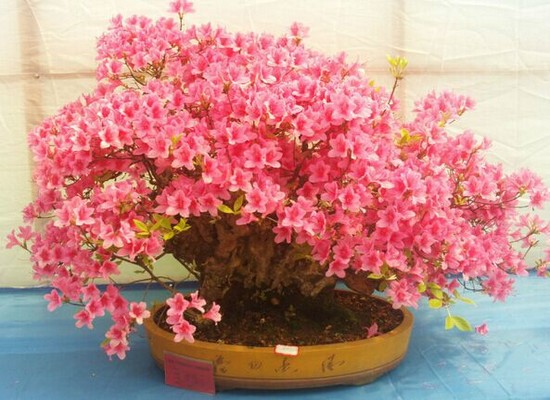
Key cultivation techniques for azalea bonsai:
1. Collecting the stump: Although the rhododendron is a common variety, good stumps mostly grow in places that are difficult to access, so digging must be done carefully, protecting the root system well. The root ball should be slightly large and carry native soil (symbiotic fungi). Dig around the flowering period.
2. Trimming the stump: Cut the slightly large root ball down to the size needed for cultivation, and trim the branches and trunk in one go to the final shape. The root ends and branch ends should be sealed to prevent dieback.
3. Planting: Disinfect the soil beforehand. Plant in loose, plain soil, preferably in the ground. After the root system is well established (about one year), plant again in a soil mix suited to its habits; place it according to its habits. The first year is for keeping it alive, the second year for building roots, the third year for building the tree, and the fourth year for potting.
4. Fertilizer and water: No fertilizer the first year, light fertilizer the second year depending on conditions, normal fertilizer the third year, with light, frequent applications. Maintain moisture management throughout.
In landscape design, azaleas can be planted on a large scale according to the growing habits of different species, following hills, accommodating rocks, and accompanying water, creating a garden atmosphere of "natural simplicity, quiet elegance, and winding paths leading to secluded spots," forming a landscape garden scene in harmony with the local natural environment. According to differences in azalea form and color, a variety of tree and shrub azaleas can be planted together to form garden groupings with a varied vertical profile and clearly layered horizontal planes. One can imitate natural growth by planting azaleas densely on hillsides and foothills to create landscapes such as azalea hills, azalea ridges, and azalea valleys.
Precautions for azalea bonsai cultivation:
1. They prefer shade and fear the sun; direct strong light easily scorches them, but excessive shading will also cause poor growth and make flower buds hard to form.
2. They prefer acidic soil, with a pH of around 6 being more suitable; in overly alkaline soil, the leaves will gradually yellow and wither from the bottom upward, and the plant may even die.
3. Physiologically, iron deficiency affects chlorophyll synthesis, and the leaves will become smaller and appear yellow-white.
4. They can generally withstand low temperatures below 10°C, but because azalea roots are shallow and fine, close to the surface soil, they cannot tolerate intense heat.
5. Because the root system is fine and delicate, its ability to absorb and supply water is poor, and it fears both drought and waterlogging. It can only grow well when air humidity is 70% to 90%.
6. Watering must be just right. If the surface is wet but the bottom is dry, the root system will be damaged and old leaves will drop early; if water accumulates and roots rot, new leaves will turn white and yellow; if water is lacking during the flowering period, the petals will soften and droop; if water is lacking during leaf expansion, the heart leaves will curl and the leaf color will turn yellow.
7. With insufficient nitrogen fertilizer, leaves are thin and lusterless, branches are short and spindly, and flowers are few and small; with phosphorus deficiency, some leaves turn red-purple and drop easily; with potassium deficiency, old leaves turn gray-green, leaf margins become yellow-green, spots appear on the leaves, and they eventually turn brown, even scorching and dropping.
8. If fertilizer is too concentrated or too abundant, it causes reverse osmosis, and the fibrous roots shrink from water loss. The leaf tips and leaf margins all lose their luster and gradually scorch and fall off.
9. Poor ventilation and stagnant air cause leaf drop.
10. They fear snow attacks and frost. For overwintering, around 8°C is suitable; if the room temperature is too high, they cannot enter dormancy, physiological activity does not decline, and nutrients continue to be consumed in large amounts, which is unfavorable for growth and development the following year.